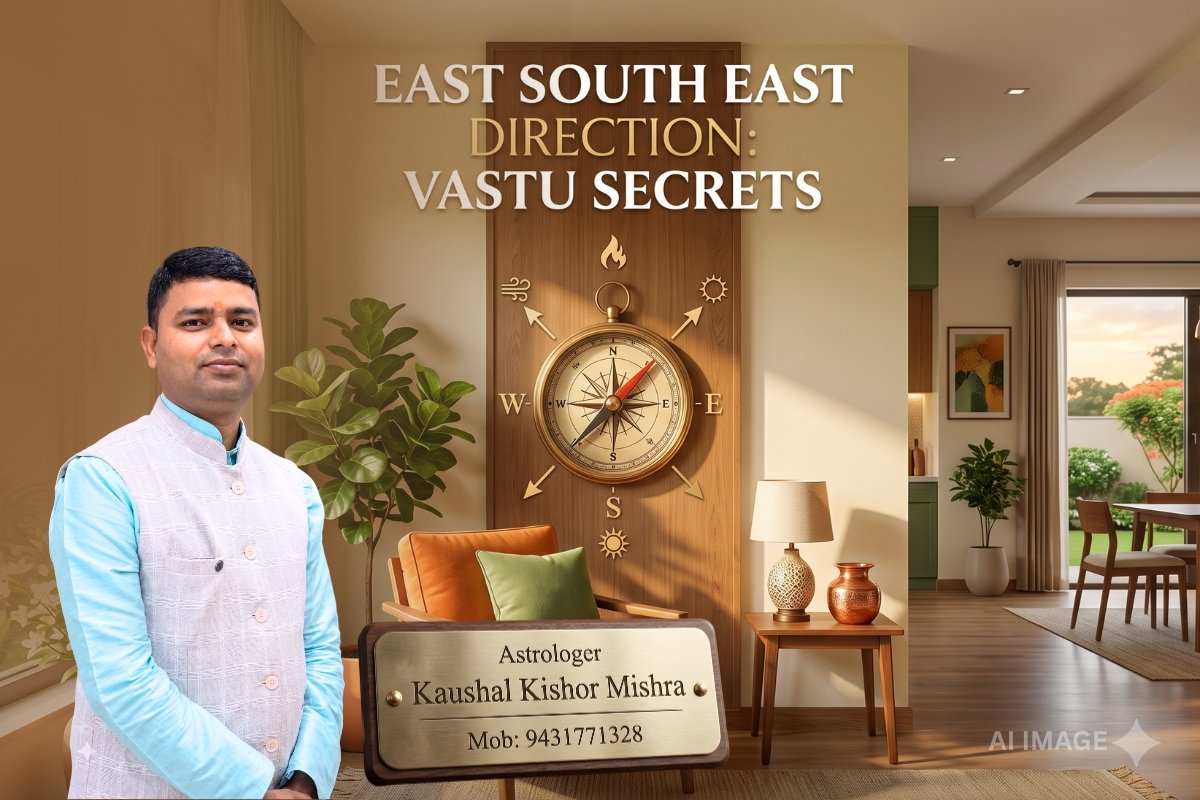
Among the eight primary directions in Vastu Shastra, each direction has its own unique energy and influence on different aspects of life. The East-South-East (ESE) direction, in particular, is closely associated with the energy of churning, analysis, and decision-making, making it an important zone to understand for maintaining balance and harmony in a space.
East-South-East (ESE) Direction
When we talk about Vastu Shastra or the science of directions, our attention often remains focused on the four main directions—East, West, North, and South. However, the sub-directions between these primary directions also play an important role in determining the flow of energy. One of these highly sensitive and significant directions is the East-South-East (ESE) direction.
This direction lies between the East and the South-East (Agneya or Fire) zone. If we look at the directional cycle, it comes as we move from the East towards the South. Since it is very close to the Agneya (Fire) zone, it carries a partial influence of solar heat and the Fire element.
According to modern Vastu research and beliefs, the East-South-East direction is considered the direction of “Churning” and Analysis.
Churning is essential in every aspect of life, as it helps us think in the right direction and within certain limits. However, excessive thinking about anything can lead to anxiety, making it difficult to reach a conclusion. As a result, it may affect decision-making and lead to biased or inappropriate decisions.
Suitable Uses
Facilities such as mixers and grinders can be placed in this zone.
A bed placed in this area may make it difficult for a person to take quick and effective decisions. Painful or disturbing thoughts may also continue to occupy the mind.
A toilet can be constructed in this zone, as it is believed to help dispose of the unnecessary “churning” from people’s lives.
If the Zone Is Deficient
If there is an imbalance in this direction of your home, such as an inappropriate colour, cut, or extension, it may increase tendencies toward anxiety, disagreements among family members, and poor financial decision-making.
You may find yourself overthinking even small issues unnecessarily. Decision-making may take longer because excessive analysis keeps the mind occupied. The mind may never feel completely free, as one concern or another may continue to remain in your thoughts, potentially leading to serious anxiety.
In Advertising
Excessive analysis can delay the overall process, particularly in areas related to sales and networking, where reaching a decision may become more difficult.
If the Zone Is Excessive
If this zone is increased or expanded excessively, a person may start making decisions without adequate thought or analysis. They may purchase things without properly evaluating them. Due to a non-analytical approach, several decisions may turn out to be incorrect.
Repeatedly making inappropriate decisions can eventually contribute to anxiety.
In Business
Incorrect decisions may particularly affect areas related to sales and networking.
Balancing the Zone
If the zone needs to be reduced, use pink shades rather than red. If the zone needs to be increased, green colour can be used.
Sanskrit Reference:
आग्नेय पूर्वयोर्मध्ये दधि मन्द मन्दिरम्।
अग्नि हदयोर्मार्ध्ये अज्यगेहं परविति।।
Author

Related Stories


Most Read
- 1Argentina’s ‘Vanishing Sea’: Rare Low Tide
- 2Effect of the 12 August 2026 Solar Eclipse on the 12 Zodiac Signs, Know Who Will Benefit and Who Will Have to Be Careful
- 3HC finds peon’s dismissal over tea and biscuits amounted to ‘injustice’
- 4Brace for 29 June: a Capricorn Full Moon, Mercury retrograde and Jupiter’s leap into Leo
- 5Japan Coach’s Whiteboard Tactics Go Viral at FIFA World Cup