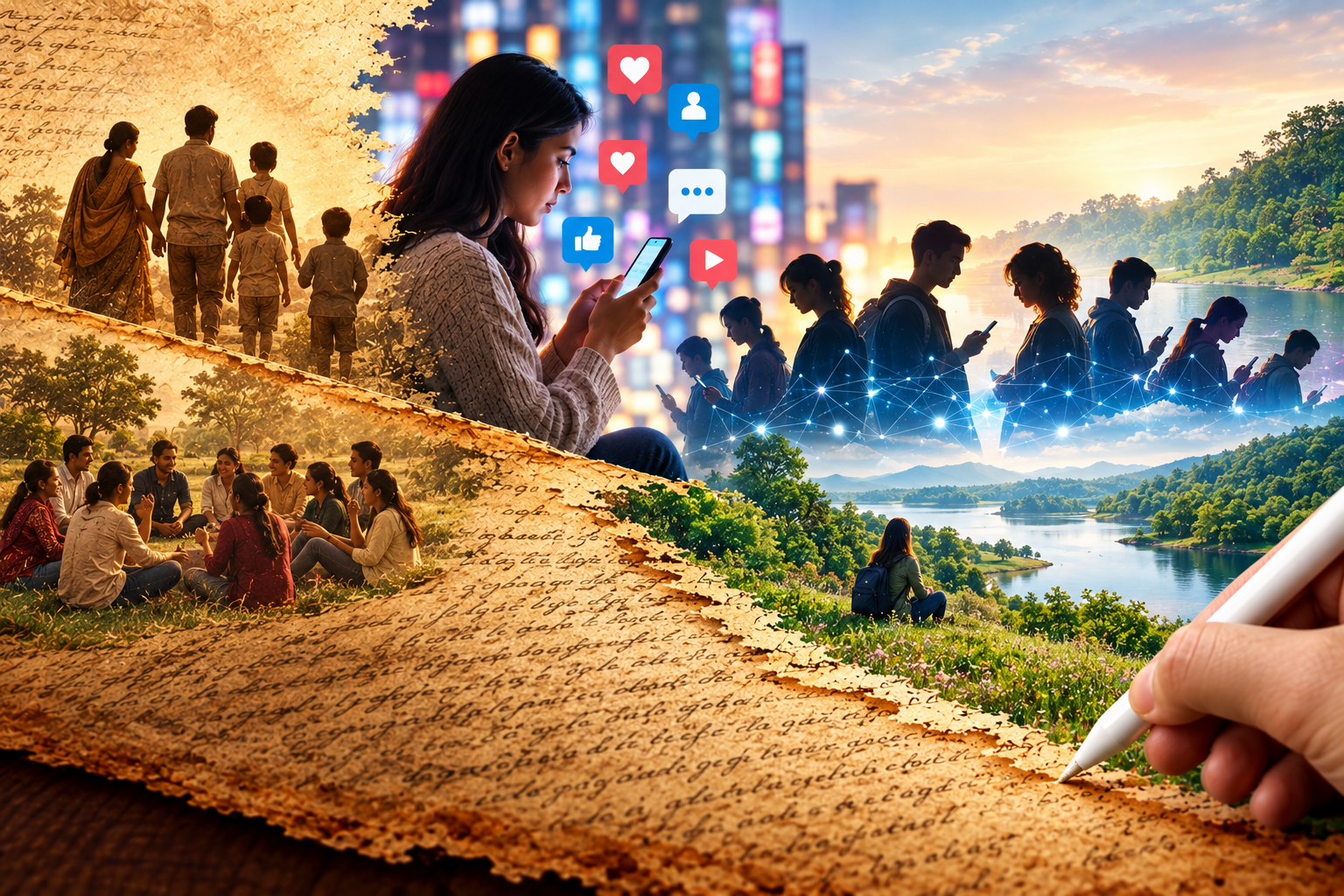
The metaphor of the palimpsest—a parchment or canvas that has been written upon, scraped clean, and overwritten, yet still retains distinct traces of its original script—is perhaps the most accurate framework for understanding the moral landscape of the twenty-first century. Human values are rarely discarded wholesale; instead, they are layered. Today, the accelerating forces of technological disruption, hyper-globalisation, and existential climate anxiety are aggressively scraping away at the dominant ethical scripts of the past few centuries. In their place, a new, complex text is being written, creating a profound reset of human values where ancient survival instincts, modern hyper-individualism, and emerging digital ethics awkwardly coexist.
For generations, human value systems were anchored by localized institutions: the family, religious structures, geographic communities, and national identities. These institutions dictated traditional scripts of duty, hierarchy, communal responsibility, and linear progress. However, the dawn of the digital age acted as a powerful solvent on these old inks. The rise of a hyper-connected, algorithmically driven global village has shifted the premium from collective duty to radical individualism and self-actualisation. Authenticity, personal autonomy, and immediate self-expression are the primary scripts of today’s moral canvas.
Yet, the old text has not vanished. Beneath this layer of modern individualism lies a deep-seated human yearning for belonging, often manifesting in the resurgence of neo-tribalism, online echo chambers, and identity politics—proving that the foundational human need for collective identity cannot be fully erased.
Furthermore, the definition of empathy and human connection is undergoing a radical structural rewrite. Historically, empathy was a proximity-based virtue, cultivated through face-to-face interactions, shared physical spaces, and tangible communal bonds. Today, our moral proximity has expanded exponentially, yet thinned out. Through the glass screens of smartphones, we witness global crises in real-time, leading to the rise of “performative empathy” or “slacktivism.” We value global awareness, yet we suffer from compassion fatigue.
Underneath this digital veneer, the ancient, evolutionary script of “us versus them” is frequently triggered by algorithms designed to monetize outrage. Thus, the modern palimpsest shows a jarring contrast: a highly vocal commitment to global human rights layered directly over an increasingly polarized, fragmented, and lonely daily reality.
Nowhere is this reset more striking than in our changing relationship with nature and material success. The industrial-era script, which valued unbridled consumption, dominance over nature, and material accumulation as the ultimate markers of a successful life, is being forcefully overwritten. Driven by the stark realities of climate change, the emerging generation is scribbling a new ethic onto the parchment: sustainability, environmental stewardship, and minimalism.
Success is increasingly measured not by what one owns, but by the ethical footprint one leaves behind. And yet, this eco-conscious script must constantly battle the residual, deep-set conditioning of capitalist consumerism that still pulses beneath the surface, resulting in the complex hypocrisy of “greenwashing” and eco-anxiety.
The Digital Stylus: Social Media as the Prime Catalyst of the Value Reset
If the human value system is a palimpsest, social media acts as the digital stylus, aggressively scraping away traditional moral frameworks and overwriting them at unprecedented speed. Platforms like Instagram, X, TikTok, and YouTube do not merely reflect changing human values—they actively manufacture them.
By commodifying human attention, social media has restructured how we define truth, empathy, success, and community, serving as the primary engine behind the modern ethical reset.
The Monetisation of Truth and the Death of Nuance
Historically, values surrounding truth were anchored in institutional credibility, consensus, and deliberate reflection. Social media has completely overwritten this script with the currency of engagement.
• Algorithmic Outrage: Algorithms are engineered to amplify content that triggers high emotional arousal—most notably, outrage and division.
• The Erosion of Nuance: As a result, the traditional value of intellectual humility and patient nuance is erased. In its place, the new text demands absolute certainty, rapid performative takes, and ideological tribalism. Truth is no longer a collective pursuit; it is hyper-personalized, curated by echo chambers that reinforce individual biases.
From Lived Empathy to Performative Virtue
The definition of empathy has undergone a profound structural shift on the digital screen. Proximity-based, quiet acts of community service are frequently overshadowed by visible, digitised solidarity.
• Slacktivism: Moral worth is increasingly measured by public declaration—sharing a hashtag, changing a profile picture, or posting an infographic.
• The Spectacle of Compassion: This creates a jarring layer in the palimpsest: a hyper-awareness of global suffering coexisting with a thinning of real-world, localized empathy. We become deeply moved by global crises on our feeds, yet increasingly disconnected from, and intolerant of, the immediate neighbors who disagree with us.
The Quantification of Human Worth
Social media has fundamentally rewritten the metrics of self-worth and validation.
• The Metricized Self: Timeless values of character, quiet resilience, and intrinsic self-esteem are being overwritten by quantifiable metrics—likes, followers, views, and viral reach.
• Curated Authenticity: The ancient script of genuine vulnerability is replaced by “curated authenticity,” where personal struggles and mental health are packaged into aesthetic content for digital consumption. This constant comparison engine fuels unprecedented rates of anxiety, resetting the human condition to one of perpetual inadequacy and hyper-individualistic competition.
The Illusion of Connection and the Rise of Neo-Tribalism
While social media promised a boundaryless global village, it has instead fragmented society into digital tribes.
• Performative Belonging: Traditional structures of belonging—like geography and physical community—are fading.
• Polarised Echo Chambers: In their place, social media allows individuals to form hyper-specific communities based on shared grievances or niche identities. Beneath the sophisticated, globalised surface of the internet, the primal, evolutionary script of “us versus them” is forcefully reactivated, making polarization the dominant social reality of our time.
In the final analysis, social media accelerates the palimpsest’s cycle, rewriting values so rapidly that society is left in a state of perpetual cultural whiplash. It amplifies our most progressive ideals while simultaneously triggering our most primitive tribal instincts, leaving us to navigate a chaotic moral landscape where the line between genuine virtue and digital performance is permanently blurred.
(The author is a renowned historian. The views expressed are personal.)
Author

Related Stories




Most Read
- 1Argentina’s ‘Vanishing Sea’: Rare Low Tide
- 2Effect of the 12 August 2026 Solar Eclipse on the 12 Zodiac Signs, Know Who Will Benefit and Who Will Have to Be Careful
- 3HC finds peon’s dismissal over tea and biscuits amounted to ‘injustice’
- 4Brace for 29 June: a Capricorn Full Moon, Mercury retrograde and Jupiter’s leap into Leo
- 5Japan Coach’s Whiteboard Tactics Go Viral at FIFA World Cup