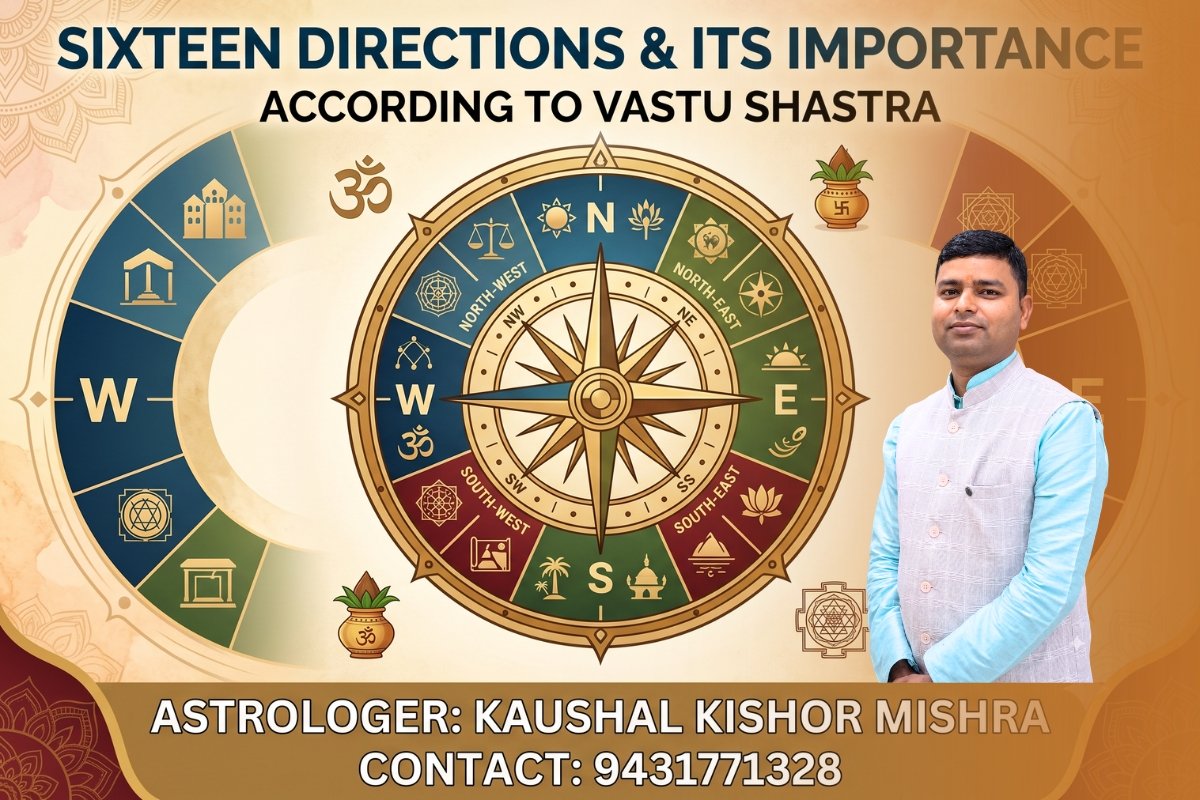
In Vastu Shastra, directions play an important role in the traditional planning of homes, offices and temples. Along with the four main directions, East, West, North and South, 16 directions in Vastu Shastra are traditionally considered significant. Each direction is associated with energies, elements and deities.
According to traditional Hindu Vastu Shastra, maintaining harmony among these directions is considered important while designing or arranging a space. These Vastu directions are also linked with different aspects of life, making them an important part of traditional architectural and spiritual practices.
What Are the 16 Directions in Vastu Shastra?
The traditional Vastu direction guide divides the space into 16 directions. These can broadly be understood as main, intermediate and sub-directions.
Main Directions
East
West
North
South
Intermediate Directions
Ishaan (North-East)
Agneya (South-East)
Nairutya (South-West)
Vayavya (North-West)
Sub-Directions
East-Ishaan
North-Ishaan
North-Vayavya
West-Vayavya
West-Nairutya
South-Nairutya
South-Agneya
East-Agneya
Understanding these directions is an important part of Vastu principles and is often considered while planning different areas of a property.
Importance of Directions in Vastu Shastra
The importance of directions in Vastu comes from the traditional belief that every direction has its own influence and association. Vastu practitioners consider factors such as the shape of a property, placement of rooms, entrances and activities while assessing the directional balance of a space.
The spiritual significance of directions is also connected with various deities and traditional beliefs found in Indian culture.
East Direction in Vastu Shastra
The East direction is considered particularly important in Vastu Shastra. It is traditionally associated with the Sun, or Surya Dev, and is linked with light, vitality and energy.
Lord Indra is traditionally regarded as the Dikpal, or guardian deity, of the East. In Hindu traditions, Indra is associated with rain, abundance and prosperity.
Because the Sun rises in the East, this direction has a special place in traditional Indian architectural practices. According to Vastu beliefs, a well-balanced East direction is associated with qualities such as social connections, recognition, vitality and opportunities.
For this reason, the East is often considered while planning spaces intended for interaction and communication, such as living areas, drawing rooms or meeting spaces.
When the East Direction Is Excessive
According to traditional Vastu interpretations, an overly prominent East direction may be associated with an increased focus on social interaction and building connections.
In a business setting, this interpretation may relate to increased efforts toward networking, marketing and reaching a wider audience. However, Vastu beliefs vary among practitioners, and such interpretations should be understood as traditional guidance rather than scientifically established outcomes.
When the East Direction Is Deficient
A weak or restricted East direction is traditionally believed to be associated with reduced social interaction and fewer opportunities to build connections.
For businesses, some Vastu practitioners associate an imbalanced East direction with difficulties in gaining visibility or connecting effectively with customers.
Similarly, in a workplace, traditional Vastu interpretations may associate the East with professional relationships and interaction with colleagues.
When the East Direction Is Balanced
A balanced East direction is traditionally considered favourable for communication, networking and visibility.
According to Vastu for home, maintaining an open and well-organised East side is often recommended. In a business environment, the direction is traditionally associated with opportunities to connect with customers, employees and other people.
Vastu Remedies for the East Direction
Traditional Vastu tips for home often recommend using suitable colours and decorative elements to create a harmonious environment.
If the East Direction Is Excessive
Some Vastu practitioners recommend using pink shades or pink decorative elements, such as curtains, flowers or accessories, to create balance.
If the East Direction Is Deficient
Green shades or green decorative elements are traditionally suggested by some Vastu practitioners for this area.
These remedies are part of traditional Vastu practices and should not be considered scientifically proven methods of changing outcomes.
Vastu and Astrology
Vastu and astrology are two traditional systems that are often discussed together in Indian spiritual practices. While Vastu primarily focuses on directions, spaces and architectural arrangements, astrology traditionally examines planetary positions and their relationship with an individual’s life.
Both are part of India’s broader spiritual and cultural traditions, but they have different methods and purposes.
Vastu Directions and Hindu Traditions
The concept of directions has a long association with Hindu traditions, where different directions are connected with deities, elements and symbolic meanings. The Dikpalas, or guardians of directions, are traditionally believed to protect and govern different areas of space.
Therefore, the 16 directions are not simply geographical points in traditional Vastu. They also carry cultural and religious beliefs about directions, making them an important subject in Indian architectural and spiritual traditions.
Final Thoughts
The 16 directions in Vastu Shastra provide a traditional framework for understanding how different parts of a space are associated with particular energies, elements and deities. From the four main directions to the intermediate and sub-directions, each has its own traditional significance.
For those interested in Vastu direction meaning, Hindu traditions or traditional Vastu principles, understanding these directions can provide useful cultural and spiritual context when exploring the ancient Indian system of architecture.
Author

Related Stories


Most Read
- 1Argentina’s ‘Vanishing Sea’: Rare Low Tide
- 2Effect of the 12 August 2026 Solar Eclipse on the 12 Zodiac Signs, Know Who Will Benefit and Who Will Have to Be Careful
- 3HC finds peon’s dismissal over tea and biscuits amounted to ‘injustice’
- 4Brace for 29 June: a Capricorn Full Moon, Mercury retrograde and Jupiter’s leap into Leo
- 5Japan Coach’s Whiteboard Tactics Go Viral at FIFA World Cup