From France and Italy to Albania and India, a generation confronting economic insecurity, failing public services and political disillusionment is finding new ways to challenge authority. Governments should recognise the warning before anger hardens into lasting instability.
A new generation of political dissent is unsettling governments across continents. From the streets of Paris and Milan to the student-led demonstrations in Tirana and the examination-related protests in India, young people are increasingly challenging institutions they believe have failed to deliver fairness, opportunity and accountability. The causes differ, but an unsettling question connects these movements: what happens when a generation loses faith in the promise that hard work will lead to a better future?
The term Gen Z movement has become a convenient shorthand for this emerging phenomenon. Yet it would be misleading to treat every protest as part of a single, centrally organised global uprising. These are largely distinct movements, shaped by national circumstances but connected by shared anxieties about economic security, political representation and the future.
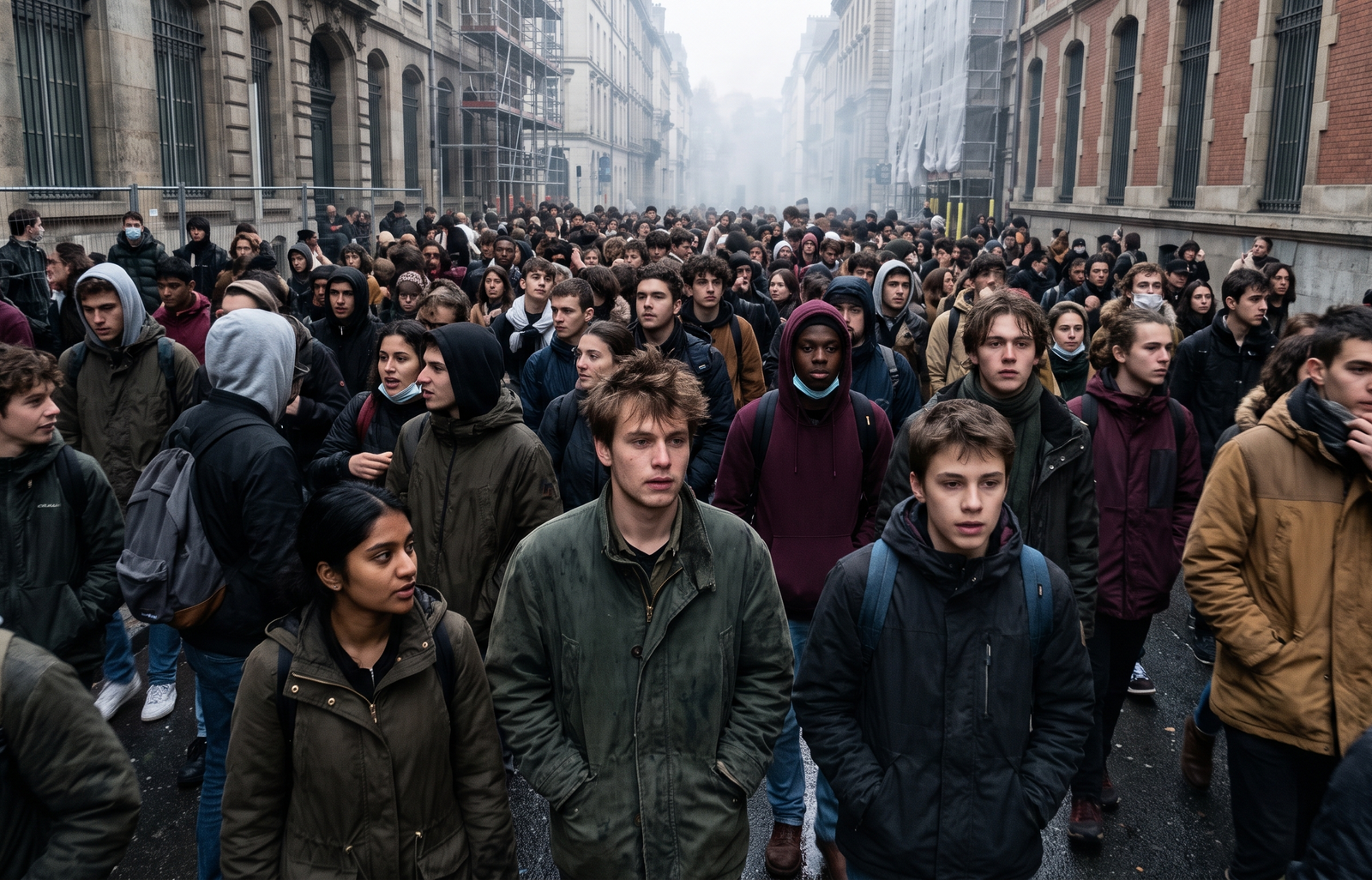
In France, student protests over deteriorating school conditions have merged with wider anger over living costs, public services and economic inequality. Demonstrations on 17 October drew hundreds of thousands of people, according to French authorities, while some confrontations escalated into looting, arson and clashes with police. The unrest has intensified pressure on President Emmanuel Macron’s government amid a wider crisis of political confidence.
Italy has witnessed its own turmoil, with demonstrations over living costs and public services escalating into violence in some cities. In Albania, student grievances over university conditions, tuition fees and limited employment prospects have converged with demands for accountability over corruption allegations and controversial development projects. The protests have become a significant challenge to Prime Minister Edi Rama’s government.
India offers a different but equally revealing example. Protests following the 2026 NEET examination paper leak developed into a wider youth-led campaign for accountability and examination reform. The agitation helped intensify pressure that culminated in the resignation of Union education minister Dharmendra Pradhan in July. It demonstrated how a grievance affecting students’ immediate prospects can evolve into a broader demand for institutional responsibility.
The common thread is not simply youthful anger. It is the growing distance between political promises and lived experience.
For many young people, housing is increasingly unaffordable, secure employment is elusive and education no longer guarantees social mobility. They watch governments debate fiscal restraint and national competitiveness while struggling to see how those priorities will improve their own lives. When institutions appear more responsive to influential interests than ordinary citizens, disillusionment becomes fertile ground for protest.
Digital platforms have transformed how that disillusionment is expressed. Memes, short videos, encrypted messaging and decentralised networks can turn a local grievance into a national controversy within hours. Traditional political organisations no longer have a monopoly on mobilisation. Online satire can become a rallying point, while loosely organised movements can attract supporters who distrust established parties. Yet this apparent strength carries a weakness.
Leaderless movements can mobilise rapidly but struggle to negotiate, formulate coherent programmes or sustain pressure after the initial demonstrations. Their energy may expose a crisis without providing a viable route out of it.
The geopolitical implications are significant. Persistent instability in major European economies can undermine investor confidence, complicate economic policymaking and deepen political polarisation. In Albania, a candidate for European Union membership, questions about corruption, governance and public trust also have implications for its European integration. Across the continent, parties on the far right and far left may seek to exploit popular discontent, turning legitimate grievances into instruments of political polarisation.
Governments must therefore resist the temptation to interpret every demonstration as a security threat or an attempt at regime change. Violence, arson and attacks on individuals or public property cannot be excused as expressions of democratic participation. Equally, peaceful protest must not be conflated with criminality, and the use of force by authorities must remain proportionate and accountable. The answer lies neither in repression nor in superficial concessions. It requires credible action on housing, education, employment, corruption and the quality of public services, alongside institutions that listen before frustration becomes explosive.
Gen Z is not politically uniform, nor does every young protester share the same ideology. But the breadth of the unrest should concern every democratic government. A generation that feels excluded from decisions shaping its future will eventually seek other ways to make itself heard. The real test for governments is not whether they can clear the streets. It is whether they can restore the trust that brought people there in the first place.
Author

Related Stories


Most Read
- 1Argentina’s ‘Vanishing Sea’: Rare Low Tide
- 2Effect of the 12 August 2026 Solar Eclipse on the 12 Zodiac Signs, Know Who Will Benefit and Who Will Have to Be Careful
- 3HC finds peon’s dismissal over tea and biscuits amounted to ‘injustice’
- 4Brace for 29 June: a Capricorn Full Moon, Mercury retrograde and Jupiter’s leap into Leo
- 5Japan Coach’s Whiteboard Tactics Go Viral at FIFA World Cup