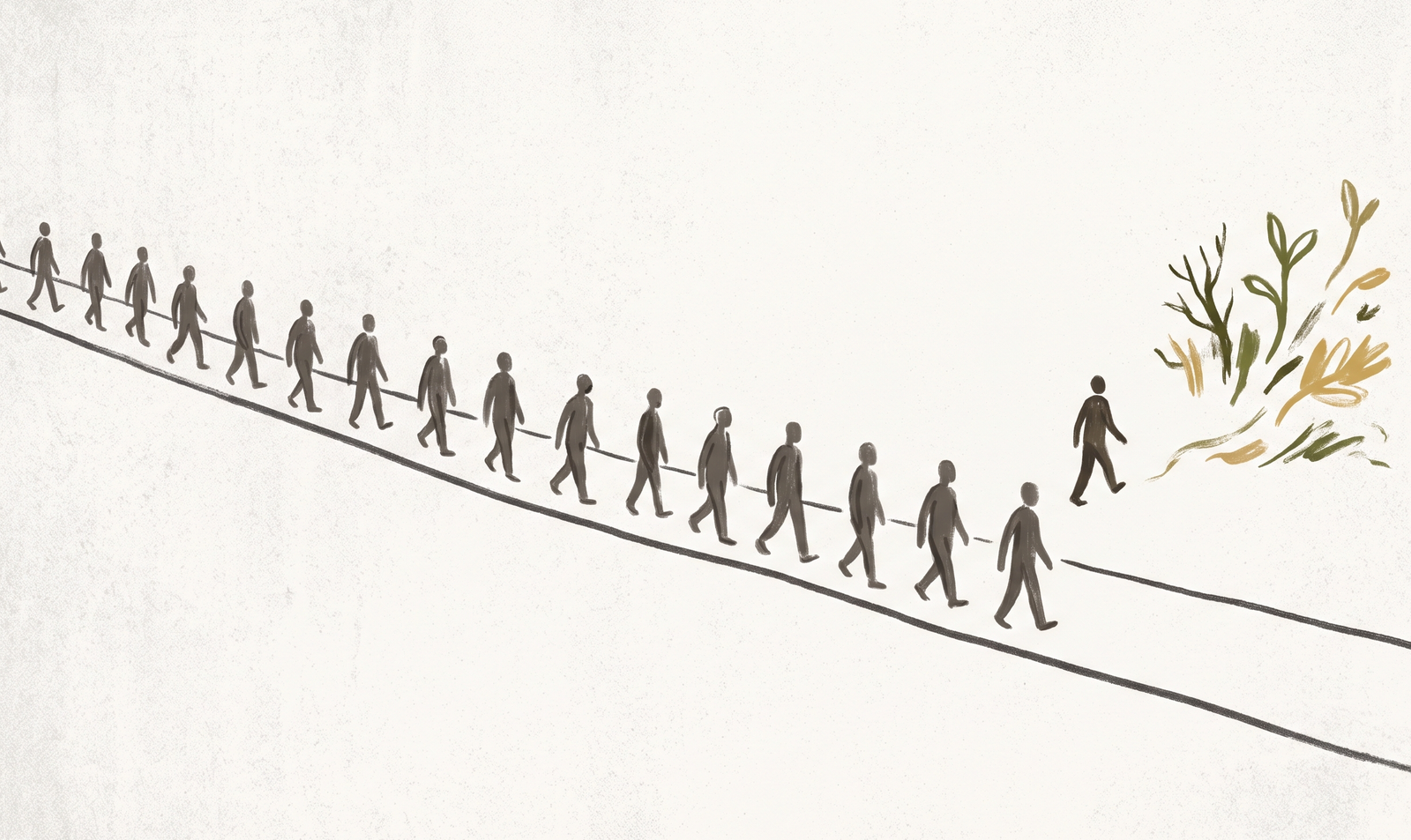
As people become more protective of their prosperity and reputations, the appetite for experimentation appears to be shrinking. The challenge is to make life safer without making society intellectually timid.
A safer life is an understandable aspiration. Yet what happens when the desire to avoid danger extends beyond physical safety to careers, scientific discovery, artistic expression and even unconventional ideas? Society may become more predictable, but it risks losing the courage to challenge established conventions.
In The Decline of Deviance, American psychologist Adam Mastroianni argues that people have become increasingly reluctant to engage in risky behaviour and that this cultural shift may also be constraining creativity. Some changes are clearly welcome: reduced substance use among American school students, for instance, represents progress. But safer behaviour does not automatically translate into better mental health or greater social well-being. Nor does conformity necessarily produce a more fulfilled generation.
The same pattern appears in popular entertainment. Original ideas increasingly compete with familiar franchises, sequels, prequels and spin-offs. Mastroianni observes that such productions accounted for approximately a quarter of top-grossing films before 2000, compared with roughly three-quarters in the more recent period he examines. The commercial logic is straightforward: established characters offer recognisable brands, predictable audiences and a comparatively manageable financial risk. Yet when familiarity becomes the dominant formula, cinema can lose some of its capacity to surprise.
The implications extend beyond Hollywood. A landmark 2023 study published in Nature by Michael Park, Erin Leahey and Russell J. Funk analysed 45 million scientific papers and 3.9 million patents. It found that research and inventions had become less likely, over the periods studied, to break decisively with existing ideas and redirect their fields. The findings do not prove that fear of risk caused this decline, but they raise important questions about the conditions in which genuine innovation flourishes.
Economic insecurity helps explain the attraction of caution. High living costs, uncertain employment, intense competition and the pressure to maintain social status can make failure prohibitively expensive. Young people navigating an unforgiving job market may rationally prefer secure employment to entrepreneurial experimentation. Researchers facing pressure to publish and institutions demanding measurable returns may likewise favour incremental advances over ambitious, uncertain investigations.
Yet the consequences could be profound. At a time when artificial intelligence, geopolitical competition and climate change demand fresh thinking, societies cannot afford to confuse stability with stagnation.
The answer is not to romanticise recklessness or dismiss legitimate concerns about safety. It is to build institutions that allow people to experiment without being ruined by failure: education that rewards independent thought, workplaces that tolerate intelligent mistakes and research systems that support unconventional ideas. Progress requires more than protecting what society has achieved. It also requires the courage to question it. A civilisation that fears every risk may preserve its comforts, only to discover that it has surrendered the imagination needed to shape its future.
Author

Related Stories




Most Read
- 1Argentina’s ‘Vanishing Sea’: Rare Low Tide
- 2Effect of the 12 August 2026 Solar Eclipse on the 12 Zodiac Signs, Know Who Will Benefit and Who Will Have to Be Careful
- 3HC finds peon’s dismissal over tea and biscuits amounted to ‘injustice’
- 4Brace for 29 June: a Capricorn Full Moon, Mercury retrograde and Jupiter’s leap into Leo
- 5Japan Coach’s Whiteboard Tactics Go Viral at FIFA World Cup