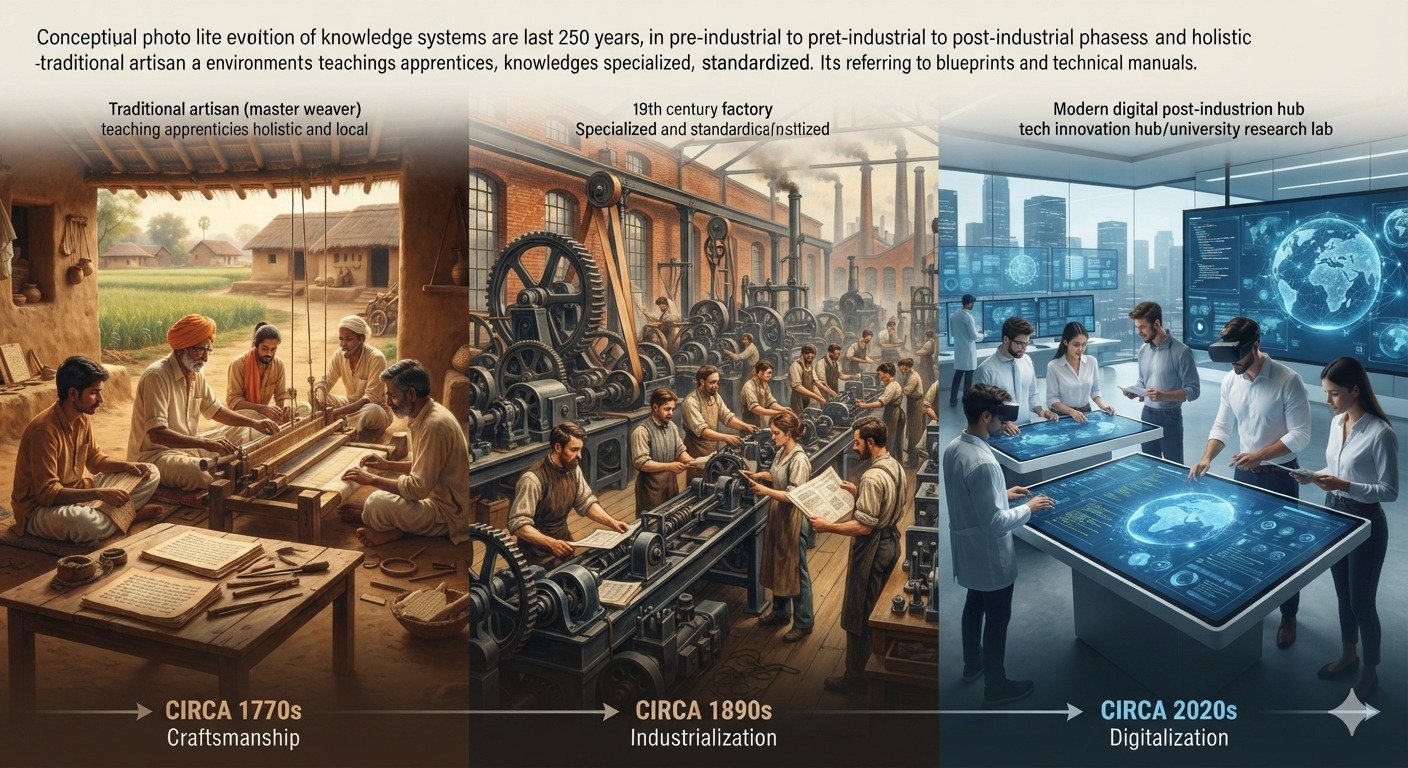
The transformation of knowledge systems since the Industrial Revolution is a narrative of acceleration, institutionalisation, and structural fragmentation. A knowledge system—defined as the interconnected network of institutions, technologies, practices, and human agents that generate, validate, preserve, and distribute knowledge—does not exist in a vacuum. It is fundamentally shaped by the socio-economic paradigms of its era.
As society transitioned from an agrarian economy to an industrial one, and eventually into the post-industrial digital age, the form of knowledge evolved from a holistic, artisanal, and localized asset into a highly specialized, hyper-scaled, and digitized commodity. Examining this trajectory reveals how the architectural framework of human understanding has changed over the past two and a half centuries.
The First and Second Industrial Revolutions (Late 18th to Early 20th Century): Institutionalisation and Specialisation
Prior to the Industrial Revolution, knowledge production was largely decentralized, often relying on individual polymaths, monastic traditions, or localized guilds where trade secrets were passed down through apprenticeships. The explosion of steam power, mechanization, and factory production in the late 18th century fundamentally upended this structure, creating an urgent societal need for standardized, predictable, and scalable information.
The Rise of the Disciplines
The primary formal change during this era was the compartmentalization and professionalization of knowledge. As technologies grew more complex, the figure of the generalist “natural philosopher” gave way to the specialized scientist, engineer, and bureaucrat. Universities reorganized themselves into distinct academic departments and disciplines.
Knowledge was systematically cataloged, a trend exemplified by the expansion of comprehensive encyclopedias and standardized decimal classification systems in libraries (such as the Dewey Decimal system).
The Architecture of Validation
Validation mechanisms shifted from royal patronage and informal scientific correspondences to rigorous, peer-reviewed academic journals and state-sponsored research institutions. Knowledge became a structured, top-down hierarchy.
To be recognized as valid, information had to pass through highly institutionalized gatekeepers: universities, professional societies, and state academies. This formalization turned knowledge production into an efficient machine, mirroring the assembly lines of the factories outside the university walls.
The Third Industrial Revolution (Late 20th Century): The Digital Transition and Globalization
The mid-to-late 20th century introduced computing, automation, and early digital networks, initiating a shift from an industrial economy to information-centric societies. This “Information Age” drastically altered both the storage capacity and the speed of knowledge systems.
From Material to Digital Mediums
For over a century, the physical book, the paper folder, and the brick-and-mortar archive were the undisputed vessels of knowledge. The digital revolution decoupled knowledge from physical matter. Magnetic tapes, optical discs, and eventually the internet transformed knowledge storage into bits and bytes.
Information became hyper-textual, non-linear, and instantaneous.
Democratization and the Challenge to Gatekeepers
The emergence of the World Wide Web decentralized the distribution of knowledge. The monopoly of traditional gatekeepers began to fracture. Open-source knowledge systems, epitomized by platforms like Wikipedia, proved that decentralized, peer-produced knowledge networks could rival the accuracy and scope of centralized, corporate entities like the Encyclopædia Britannica.
Knowledge was no longer just something consumed from an authoritative source; it became collaborative and fluid. However, this democratization also laid the groundwork for hyper-fragmentation, as the boundaries between vetted expertise and unverified information began to blur.
The Present Era: Algorithmic Knowledge and Generative AI
Today, knowledge systems are undergoing their most radical mutation yet, driven by ubiquitous connectivity, big data, and generative artificial intelligence. Knowledge is no longer merely processed by machines; it is actively synthesized and generated by them.
The Shift from Indexing to Synthesis
In the early digital era, search engines acted as indexes, directing human users to external sources of knowledge (websites, papers, books) where the actual synthesis took place in the human mind. In the current landscape, advanced artificial intelligence and Large Language Models (LLMs) have shifted the paradigm from search and retrieval to automated synthesis.
Knowledge systems have transformed into dense, multi-dimensional vector spaces. When a user queries a contemporary knowledge system, they do not receive a list of reading materials; they receive a bespoke, real-time articulation of synthesized information. The “form” of knowledge has transitioned from a stable static document to a fluid, prompt-driven output.
Epistemic Challenges: Echo Chambers and Algorithmic Bias
This algorithmic turn introduces profound structural vulnerabilities. Because modern knowledge systems rely on vast datasets scraped from the internet, they risk reflecting, amplifying, and institutionalizing historical biases.
Furthermore, the commercial algorithms that curate contemporary information streams are optimized for user engagement rather than objective truth. This has led to the fragmentation of the public square into hyper-personalized epistemic echo chambers, where what is accepted as “knowledge” depends entirely on the profile of the user interacting with the interface.
Conclusion
Since the Industrial Revolution, the form of human knowledge systems has evolved through a cycle of centralization and decentralization. The rigid, siloed academic departments born out of the industrial need for specialization have given way to fluid, interconnected, and automated networks.
We have transitioned from an era where knowledge was scarce, heavily guarded, and permanently bound to paper, to an era where it is abundant, ephemeral, and mediated by algorithms.
As we navigate this cognitive landscape, the primary challenge of our knowledge systems is no longer the acquisition or storage of information, but its validation, ethical management, and the preservation of nuanced human critical thought amidst a sea of automated synthesis.
(The author is a renowned historian. The views expressed are personal.)
Author

Related Stories




Most Read
- 1Argentina’s ‘Vanishing Sea’: Rare Low Tide
- 2Effect of the 12 August 2026 Solar Eclipse on the 12 Zodiac Signs, Know Who Will Benefit and Who Will Have to Be Careful
- 3HC finds peon’s dismissal over tea and biscuits amounted to ‘injustice’
- 4Brace for 29 June: a Capricorn Full Moon, Mercury retrograde and Jupiter’s leap into Leo
- 5Japan Coach’s Whiteboard Tactics Go Viral at FIFA World Cup