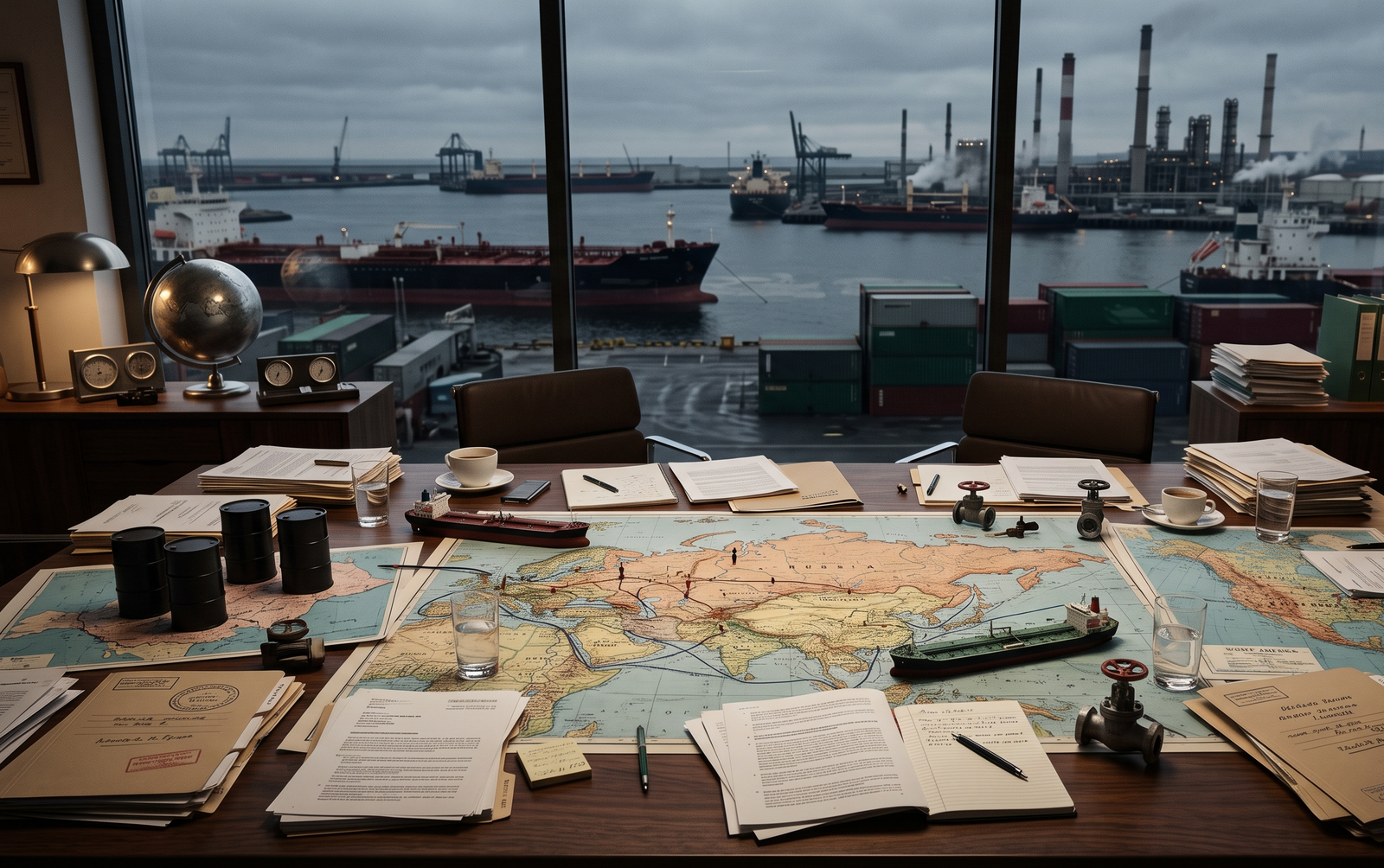
Donald Trump’s decision to ease sanctions on Russian diesel exposes the widening gulf between America’s professed principles and its pursuit of national interest. As Ukraine faces mounting pressure and India confronts the threat of punitive tariffs, Washington’s credibility as a champion of a rules-based international order is at stake.
There is a particular irony in a superpower that demands compliance from others while reserving the right to make exceptions for itself. Donald Trump’s latest decision to facilitate Russian diesel exports, despite his administration’s policy of economic pressure on Moscow, has brought that contradiction into sharp focus.
On 9 October, Trump announced an understanding with Vladimir Putin under which Russia would immediately supply more than 300,000 tonnes of diesel to the American and global markets, followed by further shipments. Washington subsequently eased sanctions to permit Russian diesel sales under a temporary licence. The immediate objective is to contain soaring fuel costs ahead of America’s 3 November midterm elections. Yet the quantities involved are unlikely, by themselves, to transform the global market. The political implications are considerably larger.
No country can reasonably be expected to disregard the economic interests of its own citizens. American farmers, hauliers and businesses need affordable fuel, just as Indian households and industries need reliable energy supplies. The question, therefore, is not whether Washington should protect its interests, but whether it can legitimately deny other countries comparable freedom of choice.
In September, Trump signed legislation authorising tariffs of up to 100% on imports from countries purchasing Russian oil and gas, potentially exposing India and China to severe economic penalties. The law gives Washington considerable discretion over enforcement. Its juxtaposition with the latest Russian diesel arrangement raises an uncomfortable question: if energy security justifies an American exemption, why should it not also inform the decisions of other sovereign states?
India’s predicament is especially significant. The country imports more than 88% of its crude oil requirements, leaving its economy vulnerable to international price shocks. Russian supplies have helped diversify its energy sources. Punitive American tariffs could affect Indian exporters, complicate bilateral trade and undermine a partnership that both countries have long described as strategically important. Strategic autonomy cannot mean choosing one great power’s preferences over another’s; it must mean retaining the capacity to make decisions in India’s own national interest.
Ukraine faces an even graver dilemma. While Russian forces continue to threaten Ukrainian energy infrastructure, Washington has pressed Kyiv to halt attacks on Russian oil refineries. Zelenskyy has criticised the diesel arrangement, arguing that easing restrictions risks providing Moscow with additional resources. Trump’s public criticism of Ukraine’s leadership has further unsettled relations between the allies.
There is a legitimate debate about whether attacks on energy infrastructure advance Ukraine’s military objectives or prolong the economic costs of war. But a credible peace strategy cannot rest on placing disproportionate pressure on the country resisting invasion while offering economic relief to the aggressor. Nor can sanctions retain their deterrent value if they appear negotiable whenever domestic political calculations demand it.
The wider geopolitical context makes this contradiction more consequential. Conflict involving Iran has intensified pressure on energy markets, demonstrating how regional wars can transmit economic shocks across continents. In such circumstances, energy policy cannot be separated from diplomacy, inflation or electoral politics. Yet short-term relief must be weighed against the longer-term costs of weakening alliances and eroding international trust.
America remains a formidable economic, technological and military power. Indian talent and the technology sector have also contributed substantially to its economic dynamism. But durable partnerships require reciprocity, not merely demands for compliance.
The fundamental question is whether Washington believes in a rules-based international order or only in rules that serve its immediate interests. Power can compel obedience; it cannot manufacture legitimacy. If America expects its allies to bear the costs of its geopolitical priorities, it must be prepared to apply its own principles consistently.
A superpower’s credibility is measured not by the rules it imposes on others, but by the standards it is willing to uphold when its own interests are at stake.
Author

Related Stories




Most Read
- 1Argentina’s ‘Vanishing Sea’: Rare Low Tide
- 2Effect of the 12 August 2026 Solar Eclipse on the 12 Zodiac Signs, Know Who Will Benefit and Who Will Have to Be Careful
- 3HC finds peon’s dismissal over tea and biscuits amounted to ‘injustice’
- 4Brace for 29 June: a Capricorn Full Moon, Mercury retrograde and Jupiter’s leap into Leo
- 5Japan Coach’s Whiteboard Tactics Go Viral at FIFA World Cup