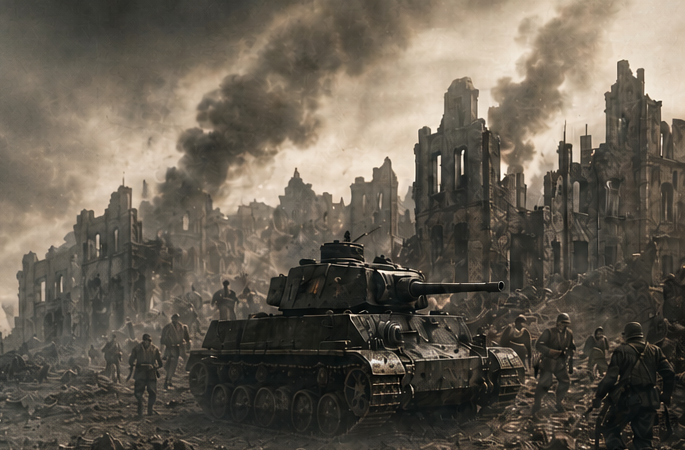
The cinematic representation of World War II constitutes one of the most prolific and enduring subgenres in global film history. Unlike any other conflict, the Second World War provides an almost inexhaustible repository of narrative material. However, Hollywood and international cinema do not merely record the events of 1939–1945; instead, filmmakers filter the war through a shifting matrix of cultural, psychological, and political lenses.
When analyzing the vast catalog of these films—ranging from mid-century propaganda to contemporary hyper-realistic epics—a distinct thematic preponderance emerges. Directors and screenwriters consistently return to a core set of profound human and ideological dilemmas: the corruption of absolute moral clarity, the psychological trauma of industrialized slaughter, the institutional erasure of individuality, and the shifting nature of collective memory.
The Myth of the “Good War” vs. The Erosion of Moral Clarity
For decades following 1945, Western cinema leaned heavily into the thematic binary of absolute good versus absolute evil. This perspective—frequently termed the myth of the “Good War”—framed the Allied forces as unblemished champions of liberty crusading against the absolute tyranny of the Axis powers.
Early films like Casablanca (1942) or The Sands of Iwo Jima (1949) served clear ideological purposes: they validated the immense sacrifices of the conflict by emphasizing ideological purity, clear objectives, and heroic martyrdom.
However, the thematic preponderance in modern World War II cinema has shifted radically toward moral ambiguity and subversion. As global perspectives evolved through the Vietnam War era and beyond, filmmakers began dismantling this black-and-white framework.
• The Shared Sins of War: Modern masterpieces choose to examine the dark, compromised spaces inhabited by the victors. In Steven Spielberg’s Saving Private Ryan (1998), Captain Miller’s squad openly debates the logic of risking multiple lives for one man and executes defenseless German prisoners of war.
• Humanizing the Enemy: Clint Eastwood’s dual-narrative project, specifically Letters from Iwo Jima (2006), forced Western audiences to confront the shared humanity, terror, and domestic longings of Japanese soldiers. By shifting the perspective, the thematic focus migrates from geopolitical victory to the tragic reality that young men on both sides were trapped within the same meat-grinder of state-sponsored violence.
Visceral Realism and the Trauma of Industrialized Slaughter
A dominant thematic thread in contemporary World War II cinema is the de-romanticization of combat through overwhelming, visceral realism. Early war cinema, constrained by censorship codes and technical limitations, often featured bloodless deaths and neatly choreographed battle sequences.
The turning point in modern cinematic memory occurred when technical advancements allowed directors to replicate the sensory overload of industrialized warfare. The opening 27 minutes of Saving Private Ryan (the D-Day landing at Omaha Beach) or the relentless, chaotic mortar barrages in Christopher Nolan’s Dunkirk (2017) do not celebrate military strategy. Instead, they isolate the soldier—and the audience—in an environment governed purely by chance, terror, and physical mutilation.
The thematic takeaway here is profound: war is presented as a chaotic lottery rather than an arena for traditional bravery. In Dunkirk, heroism is stripped of grand rhetorical gestures and reduced to its barest, most desperate component: absolute survival. Surviving the slaughter becomes an act of defiance in itself.
The Absurdity of Bureaucracy and the Dehumanization of the Individual
Beyond the frontline trenches, a significant body of World War II cinema explores the systemic, institutional machinery of the conflict. This thematic avenue highlights the absurdity of military bureaucracy and the existential erasure of the individual within mass mobilization.
Films like The Thin Red Line (1998), directed by Terrence Malick, contrast the pristine, indifferent beauty of nature with the ugly, artificial structures of human military ambition. Malick pits the poetic, internal monologues of individual soldiers against the cold, careerist calculations of commanding officers (such as Nick Nolte’s character), who view human lives simply as numerical variables required to capture a meaningless hill.
Similarly, satirical or darker anti-war entries like Catch-22 or JoJo Rabbit (2019) weaponize absurdity to expose how institutional indoctrination and bureaucratic logic warp human morality, rendering ordinary citizens complicit in systemic madness.
The Cinema of Remembrance: The Holocaust and the Burden of Witnessing
It is impossible to discuss the thematic landscape of World War II movies without addressing the catastrophic trauma of the Holocaust. The cinematic treatment of the Shoah represents a distinct, deeply sensitive thematic category focused on the burden of memory, the limits of human empathy, and the struggle to maintain dignity amidst industrialized genocide.
For decades, films like Schindler’s List (1993) and The Pianist (2002) relied on historical realism to shock the collective conscience, emphasizing the thin thread of survival and individual acts of salvation.
However, recent cinematic shifts have explored the horror through the terrifying lens of human indifference and complicity. Jonathan Glazer’s The Zone of Interest (2023) represents a radical thematic evolution. By focusing entirely on the mundane, bourgeois domestic life of Auschwitz commandant Rudolf Höss and his family—living right next to the camp walls—the film shifts its thematic gaze away from the victims and onto the terrifying human capacity for compartmentalization and apathy.
The horror is completely auditory and subtextual, reminding modern audiences that the architects of the Holocaust were not monsters from a fairytale, but organized bureaucrats going about their daily routines.
Conclusion
The thematic preponderance in World War II cinema reveals that these films are rarely about the past alone; they are mirrors reflecting the anxieties, moral evolutions, and political climates of the eras in which they are made. As time distances us from the actual survivors of the conflict, cinema has transitioned from an instrument of immediate post-war myth-making into a vital, complex archive of human psychology.
By continuously oscillating between grand geopolitical epics and intimate stories of psychological survival, World War II movies remind us of a universal truth: while weapons and political boundaries change, the shattering impact of total war on the human soul remains permanently unaltered.
(The author is a renowned historian. The views expressed are personal.)
Author

Related Stories




Most Read
- 1Argentina’s ‘Vanishing Sea’: Rare Low Tide
- 2Effect of the 12 August 2026 Solar Eclipse on the 12 Zodiac Signs, Know Who Will Benefit and Who Will Have to Be Careful
- 3HC finds peon’s dismissal over tea and biscuits amounted to ‘injustice’
- 4Brace for 29 June: a Capricorn Full Moon, Mercury retrograde and Jupiter’s leap into Leo
- 5Japan Coach’s Whiteboard Tactics Go Viral at FIFA World Cup