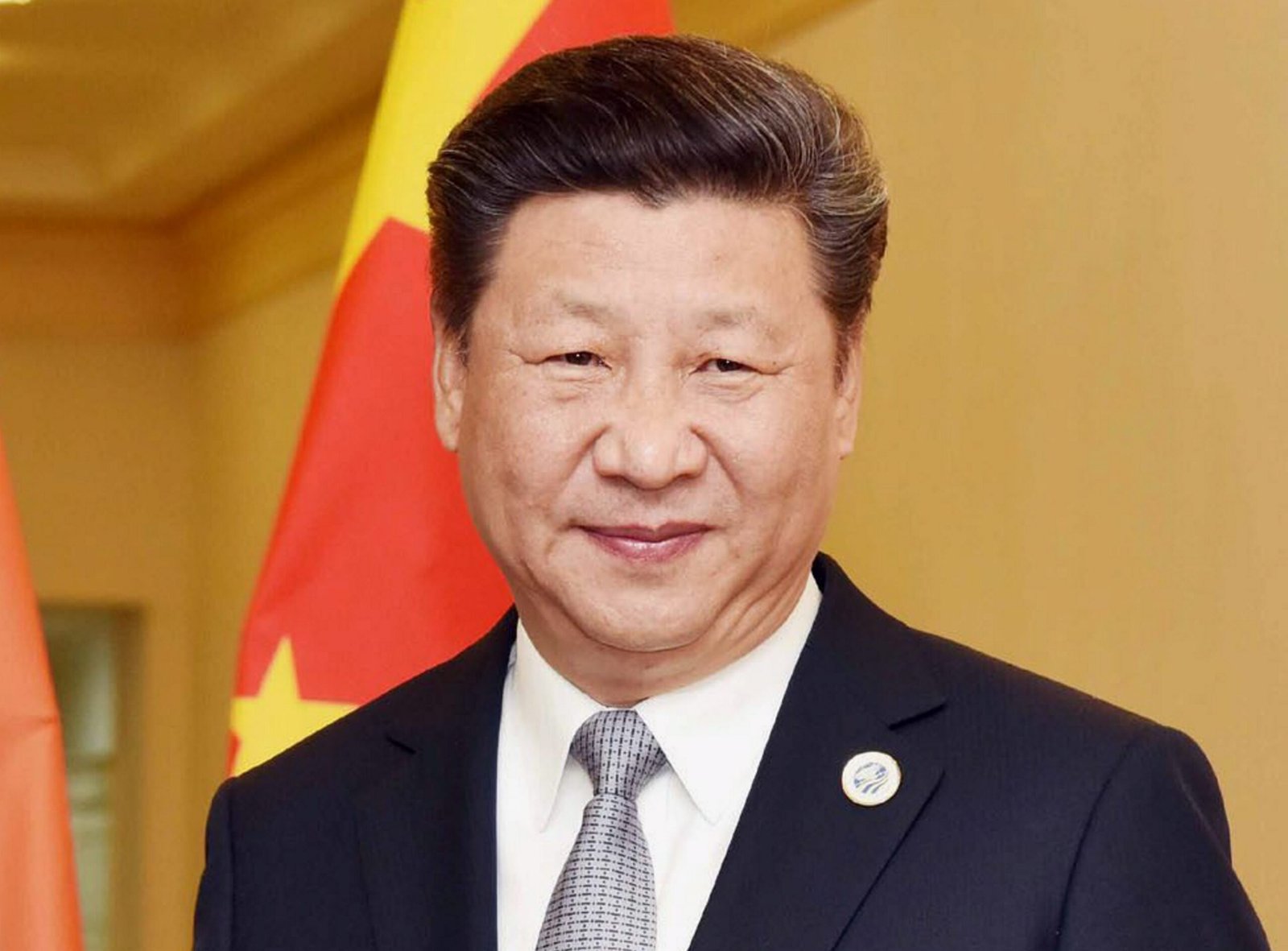
Beijing: Chinese President Xi Jinping on Wednesday left for Washington to hold a rare second summit with his US counterpart Donald Trump in less than six months to discuss a broad range of bilateral and international issues.
Xi is accompanied by his wife Peng Liyuan, Cai Qi, a member of the Standing Committee of the Political Bureau of the Communist Party of China Central Committee and director of the General Office of the Central Committee, and Foreign Minister Wang Yi, a member of the Political Bureau of the Central Committee, the foreign ministry said.
Trump had invited Xi and Peng to visit the White House during his visit to China in May this year.
They are expected to arrive at Joint Base Andrews just outside Washington on Wednesday, where Trump planned to accord a rare airport reception by personally receiving them on the tarmac, according to media reports.
The Chinese Foreign Ministry has described their second meeting within six months as a “milestone of historic significance”.
Trade tariffs, technology, AI, military ties, conflicts in the Middle East, the Russia-Ukraine war, the arms race in space and US arms sales to Taiwan were expected to figure in talks between Xi and Trump.
Ahead of Xi’s visit, Chinese Vice Premier He Lifeng, US Treasury Secretary Scott Bessent and American Trade Representative Jamieson Greer held wide-ranging talks on economic and trade issues, including on AI.
In his talks with He in New York on Sunday, Bessent said the US has proposed a new notification mechanism for artificial intelligence (AI) incidents that could affect national security.
Xi-Trump talks assume significance in the immediate backdrop of Trump signing the ‘Lindsey O. Graham Sanctioning Russia and Iran Act of 2026’, which authorises him to impose steep tariffs of up to 100 per cent on the top five importers of crude oil and gas from Moscow, including China and India.
Trump also unveiled a new “AI Force” in a potential escalation of the high-stakes technology race between the rival powers.
Last week, the US confirmed the deployment of a space weapon in Earth’s orbit, the first time it has acknowledged such offensive capabilities.
China has rejected US attempts to impose tariffs over its purchases of Russian oil and gas, saying normal trade cooperation between countries should not be subject to interference by third parties.
China opposes long-arm jurisdiction and unilateral sanctions that have no basis in international law and lack a UN Security Council mandate, Foreign Ministry spokesperson Guo Jiakun said.
Despite the tariff threat, Washington and Beijing are also negotiating a reciprocal tariff reduction framework covering products worth USD 30 billion from each side, China’s Commerce Ministry said.
The consultations aim to reach a reciprocal tariff reduction arrangement at the earliest possible date, the ministry’s spokesperson Huang Ling said.
Ahead of the summit, Chinese Foreign Minister Wang and US Secretary of State Marco Rubio also held a telephone conversation focusing on high-level exchanges between the two countries.
The Iran-US war was expected to figure in the Xi-Trump talks as the Iranian Foreign Minister Abbas Araghchi visited Beijing last week and held talks with Wang, during which he said Tehran is not interested in continuing the conflict with the US and looks forward to returning to a diplomatic solution including the implementation of the US-Iran Memorandum of Understanding reached earlier.
Trump is also urging Xi to prevail on Russian President Vladimir Putin to stop the war in Ukraine as Beijing-Moscow share close ties.
For his part, Xi was expected to press Trump to not to go ahead with the USD 11 billion arms sales to Taiwan, the biggest US military package to Taipei.
The deal includes HIMARS rocket systems, anti-tank missiles, anti-armour missiles, loitering suicide drones, howitzers, military software and parts for other equipment.
China, which claims Taiwan as part of it, said it firmly opposes and strongly condemns the US arms sales package.
Author

Related Stories




Most Read
- 1Argentina’s ‘Vanishing Sea’: Rare Low Tide
- 2Effect of the 12 August 2026 Solar Eclipse on the 12 Zodiac Signs, Know Who Will Benefit and Who Will Have to Be Careful
- 3HC finds peon’s dismissal over tea and biscuits amounted to ‘injustice’
- 4Brace for 29 June: a Capricorn Full Moon, Mercury retrograde and Jupiter’s leap into Leo
- 5Japan Coach’s Whiteboard Tactics Go Viral at FIFA World Cup