As 40,000 students boycott classes and thousands march to parliament, Denmark confronts a difficult question: can a nation strengthen its military security without undermining the educational equality that has long defined its welfare state?
Denmark, long regarded as one of the world’s most progressive welfare democracies, is witnessing an increasingly consequential confrontation between its younger generation and the political establishment. Thousands of students have taken to the streets in an unprecedented show of opposition to proposed reductions in state-funded educational grants, challenging a government that is seeking to redirect public resources towards national defence.
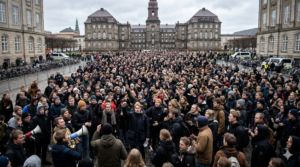
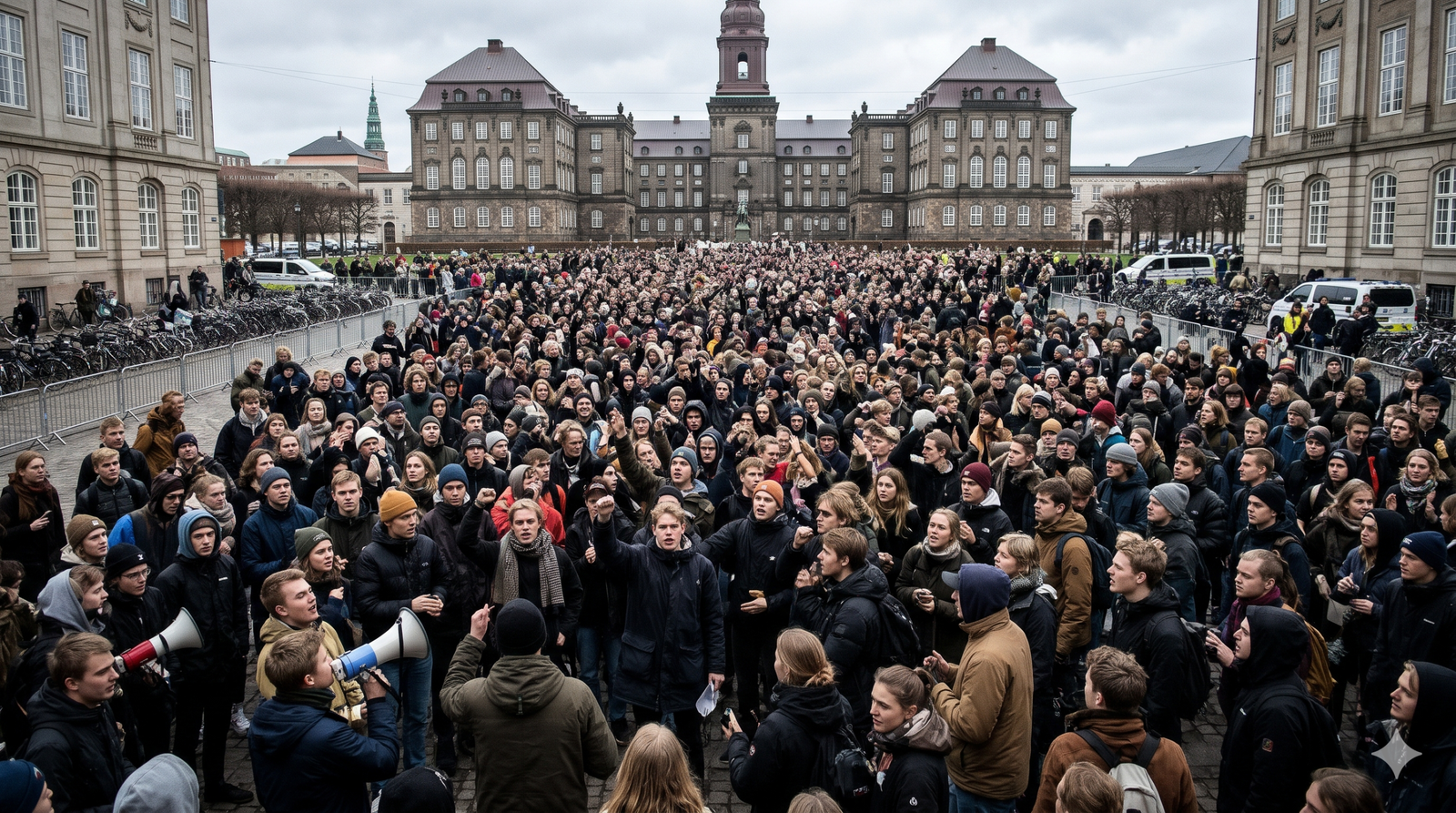
On 4 November, Copenhagen became the focal point of the protest movement as students marched from City Hall Square towards the Danish parliament, Christiansborg, under the slogan ‘Enough is Enough’. The demonstrations were not confined to the capital. According to student organisations, approximately 40,000 students across 57 schools boycotted classes, while between 12,000 and 13,000 participated in the Copenhagen demonstration. Eleven student associations representing secondary schools and universities helped organise the march.
At the heart of the controversy is the government’s proposed restructuring of Denmark’s State Educational Grant and Loan Scheme, commonly known as SU. Established in 1970, the scheme has traditionally enabled students aged 18 and above to receive financial assistance towards their education, irrespective of their parents’ income.
Under the proposed 2027 budget, students living with their parents would lose their grants entirely if their parents’ combined annual income exceeded 710,077 Danish kroner. For families earning between approximately 419,589 and 710,077 kroner, grants would be progressively reduced. According to the Ministry of Higher Education, around 14,000 students could lose their financial support altogether, while another 8,000 could face reduced payments.
Currently, students living with their parents receive approximately 1,154 kroner a month, while those living independently receive around 7,426 kroner. Although the government argues that assistance should be better targeted towards those most in need, students fear that the proposed changes will weaken the principle of equal educational opportunity.
The controversy, however, extends well beyond the question of student allowances. It reflects a fundamental dilemma confronting European governments: how to reconcile expanding security commitments with the preservation of social welfare.
Russia’s invasion of Ukraine has fundamentally altered Europe’s strategic calculations. NATO’s eastern flank, the security of the Baltic region, concerns over Russian military activity and the growing strategic significance of the Arctic have pushed defence preparedness to the forefront of European policymaking. Denmark, a NATO member with significant strategic interests in the Baltic and Arctic regions, cannot afford to disregard these developments.
The security of Greenland, the wider North Atlantic and vital maritime routes has further increased the country’s geopolitical importance.
Yet a legitimate security imperative does not automatically make every domestic spending decision equitable. Defence investment may be essential, but education is equally fundamental to long-term national resilience. A technologically sophisticated military, a competitive economy and a functioning democracy all depend on a well-educated population.
There is also an uncomfortable political contradiction in the proposed approach. The government’s wider budget plans include substantial tax reductions, while financial assistance for sections of the student population faces restrictions. This raises a pertinent question: are young people being asked to shoulder a disproportionate share of the economic adjustment?
The protests also represent something larger than resistance to a financial policy. Across Europe, Gen Z is increasingly questioning political priorities shaped without sufficient consideration of its economic future. Rising housing costs, uncertain employment prospects, inflationary pressures and anxieties about social mobility have intensified generational dissatisfaction. The Danish demonstrations, following similar student mobilisation in France and elsewhere, suggest that this discontent is acquiring a distinctly European dimension.
The government’s challenge is therefore not simply to balance its budget but to retain the confidence of a generation that will inherit the consequences of today’s decisions. Equally, students must recognise that national security is not an abstract political choice but a genuine responsibility in an increasingly unstable international environment.
Denmark now faces a defining test of its democratic and social contract. A country cannot sustainably defend its borders while neglecting the opportunities that make its society worth defending. Military strength may protect a nation’s sovereignty, but education safeguards its intellectual independence, economic vitality and democratic future.
The real measure of Denmark’s leadership will not be how much it spends on defence, but whether it can secure its future without making its younger generation pay an unfair price for doing so.
Author

Related Stories



Most Read
- 1Argentina’s ‘Vanishing Sea’: Rare Low Tide
- 2Effect of the 12 August 2026 Solar Eclipse on the 12 Zodiac Signs, Know Who Will Benefit and Who Will Have to Be Careful
- 3Powai: Minor Girl Sexually Assaulted by Six Men, All Accused Arrested Within 24 Hours
- 4HC finds peon’s dismissal over tea and biscuits amounted to ‘injustice’
- 5Brace for 29 June: a Capricorn Full Moon, Mercury retrograde and Jupiter’s leap into Leo