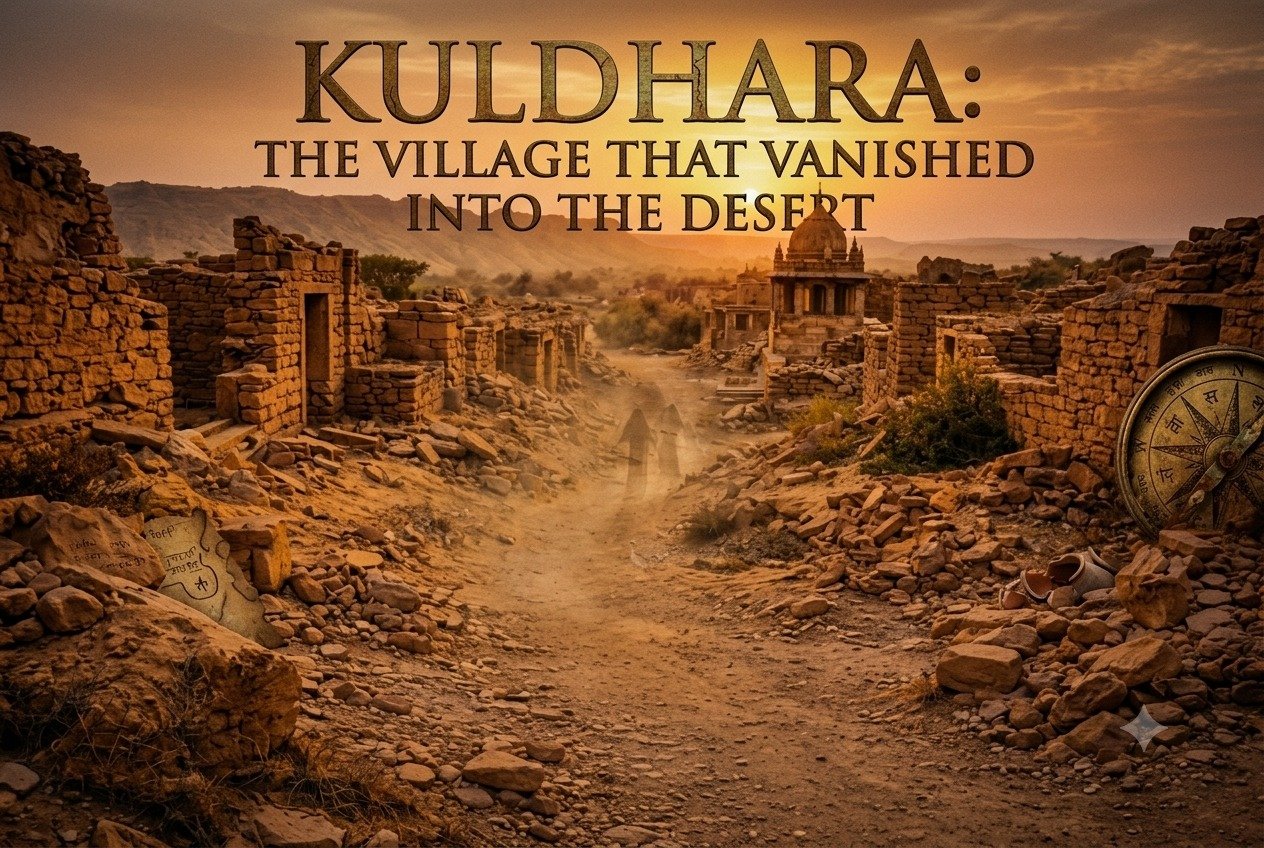
About 18 km from Jaisalmer, the ruins of Kuldhara have become one of India’s most famous “haunted” destinations. But behind the ghost stories lies a much older mystery: why did an entire community abandon its home ?
There is something unsettling about arriving at Kuldhara. The road from Jaisalmer cuts through the dry landscape of the Thar before suddenly giving way to a settlement of sandstone ruins. There are narrow lanes, roofless houses, crumbling walls and remnants of temples. Once, these were not ruins. They were homes. Today, nobody lives here. That emptiness is what made Kuldhara one of Rajasthan’s most enduring host stories. But the real mystery of the village begins long before anyone started calling it haunted.
A prosperous desert settlement
Kuldhara is believed to have been established in 1291 by Paliwal Brahmins, a community that developed a prosperous settlement despite the harsh desert environment. Rajasthan Tourism says the Paliwals were particularly successful at agriculture, managing to grow crops in an arid landscape. The village was part of a much larger network of Paliwal settlements. According to Rajasthan Tourism, Kuldhara and 83 neighbouring villages were eventually abandoned. The Paliwals were not simply desert villagers struggling to survive. They had developed sophisticated ways of living in a landscape where water was precious and farming was difficult. Their settlements were carefully planned, with houses, streets, temples and water-management systems adapted to the environment. And then, sometime in the early 19th century, something changed.
The night everyone supposedly left
The most famous version of the story revolves around Salim Singh, the powerful prime minister, or Diwan, of the Jaisalmer state. According to local legend, Salim Singh became interested in the daughter of Kuldhara’s village head and demanded that she marry him. When the villagers refused, he allegedly threatened them with severe consequences. The community faced an impossible choice: surrender the girl or confront the powerful official. Instead, the legend says, the Paliwal leaders chose a third option. They left. Not just Kuldhara, but the surrounding Paliwal villages are said to have been abandoned in the same period. Rajasthan Tourism’s account describes the departure as happening overnight in 1825, with the villagers leaving their ancestral homes and placing a curse on Kuldhara so that nobody could settle there again.
Why did everyone leave ?
The desert has never answered. And perhaps that is why Kuldhara continues to draw visitors not because anyone can prove it is haunted, but because its history is mysterious enough without the ghosts.
From abandoned settlement to “haunted village”
The empty village gradually acquired a supernatural reputation. Stories began circulating about strange sounds, shadows, unexplained sensations and other paranormal experiences. Rajasthan Tourism itself describes Kuldhara as a “ghost village shrouded in mystery”, while acknowledging the legend behind its abandonment. Over time, the abandoned settlement became a destination for travellers curious about the supernatural. But there is another way of looking at Kuldhara. Instead of asking whether ghosts inhabit its ruins, look at what the ruins tell us about the people who once lived there. The houses reveal a carefully organised settlement. The remains of temples point to a community with an established religious life. The streets and architecture provide clues about how people adapted to the desert centuries ago. The eeriness comes partly from the contrast. These were once ordinary places: kitchens, courtyards, shops, homes and places of worship. Now they stand empty.
Can you actually visit Kuldhara ?
Yes but treat it as a heritage site, not an abandoned property where you can wander around whenever you like. The entire ancient village is listed among Rajasthan’s protected monuments, and Rajasthan Tourism identifies Kuldhara as a protected monument under the State Archaeology Department. The easiest way to visit is from Jaisalmer, roughly 17–18 km away. Rajasthan Tourism recommends hiring a taxi from the city. And there is one rule that matters particularly for anyone attracted by the haunted reputation: don’t attempt an after-dark ghost hunt or trespass into restricted areas. Rajasthan Tourism’s own travel account notes the longstanding warning against remaining at the site after sunset and describes visitors leaving before dusk. In other words, the safest and most responsible way to experience Kuldhara is also the most interesting: arrive during permitted visiting hours, explore the ruins in daylight and leave with the mystery intact.
How to plan the trip
Perhaps the most compelling thing about Kuldhara is that you don’t actually need to believe in ghosts to find it haunting. Walk through its empty lanes and imagine the opposite: children playing, people preparing food, farmers returning from the fields, traders moving through the settlement and families closing their doors at night. Then consider that at some point, those sounds disappeared. The buildings remained. The people did not. Whether the Paliwals fled because of persecution, economic pressures, environmental difficulties or the circumstances described in local legend, their disappearance left behind a settlement that has been asking the same question for nearly two centuries.
Plan your visit
- Location – About 17–18 km from Jaisalmer, Rajasthan
- Getting there – Taxi/cab from Jaisalmer
- Where to stay – Jaisalmer
- Status – Protected ancient village/heritage site
- Overnight stay – Stay in Jaisalmer; don’t attempt to remain at Kuldhara after closing
- Best for – History, architecture, folklore, photography and desert landscapes
- Ghosts – Part of local folklore, not established fact
Author

Related Stories


Most Read
- 1Argentina’s ‘Vanishing Sea’: Rare Low Tide
- 2Effect of the 12 August 2026 Solar Eclipse on the 12 Zodiac Signs, Know Who Will Benefit and Who Will Have to Be Careful
- 3HC finds peon’s dismissal over tea and biscuits amounted to ‘injustice’
- 4Brace for 29 June: a Capricorn Full Moon, Mercury retrograde and Jupiter’s leap into Leo
- 5Japan Coach’s Whiteboard Tactics Go Viral at FIFA World Cup