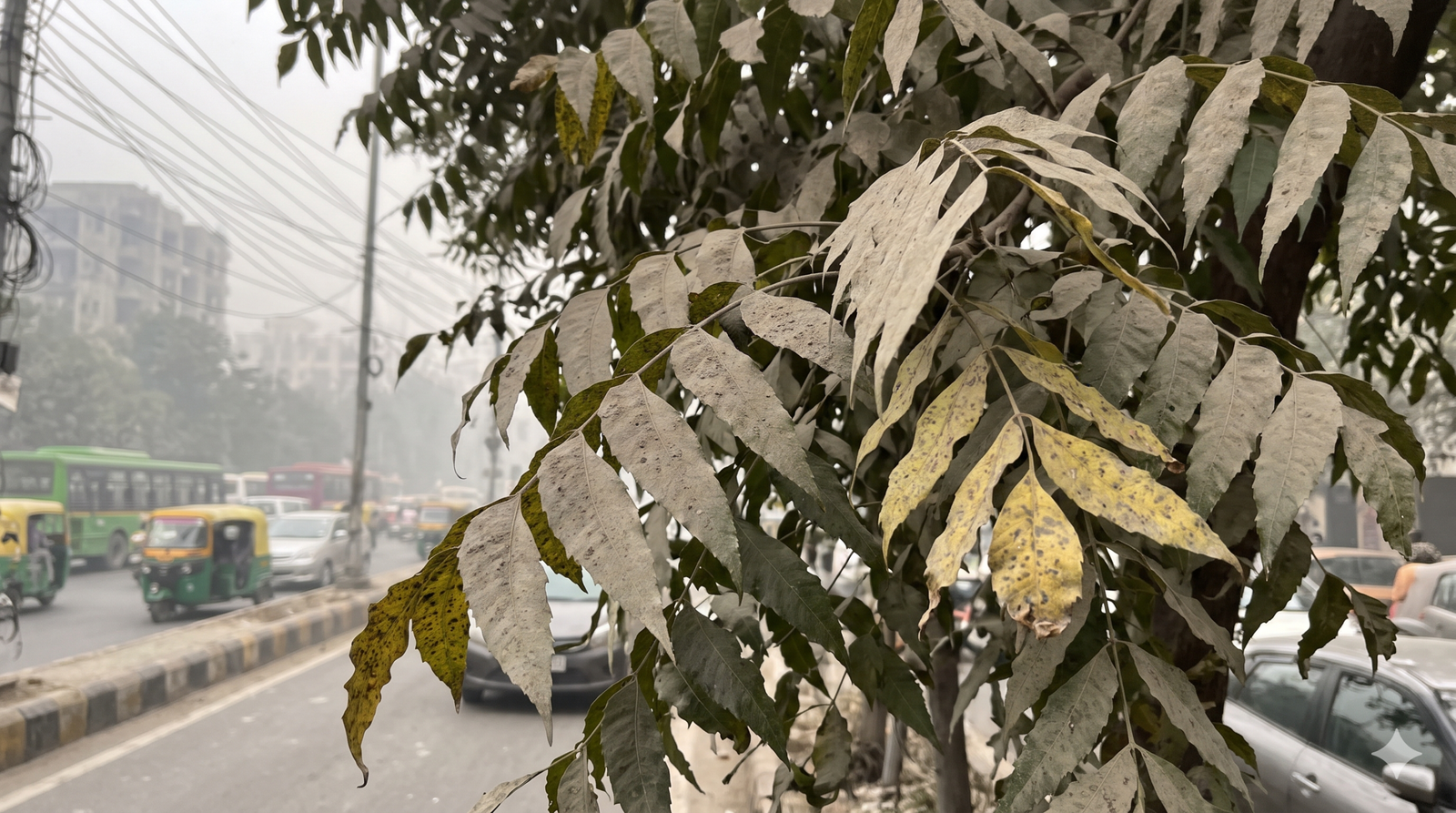
New Delhi: Air pollution may be altering the very chemistry of Delhi’s roadside leaves, affecting their ability to produce food and retain water, with trees in highly polluted areas showing greater physiological stress than those in less polluted locations, a study has found.
The study examined seven tree species across four locations in Delhi — the highly polluted areas of Anand Vihar and NTPC Badarpur, and the relatively less polluted areas of Lutyens’ Delhi and the Indian Agricultural Research Institute (IARI) in Pusa — to assess how pollution levels and seasonal variations affected their physiological properties.
One of the most striking differences was in chlorophyll content, the green pigment that allows plants to absorb sunlight and produce food through photosynthesis.
The total chlorophyll content in leaves was lowest at Anand Vihar, at 1.06 mg per gram of fresh leaf weight, compared with 3.31 mg per gram at Pusa, where the highest concentration was recorded.
At NTPC Badarpur, the chlorophyll content stood at 1.14 mg per gram, while trees in Lutyens’ Delhi recorded 3.11 mg per gram.
The study—Urban Air Quality and Pollution Tolerance of Roadside Trees in Delhi: An APTI Approach—also found differences in the amount of water retained by leaves, an important factor in maintaining their biological and biochemical functions.
Relative water content was highest at Pusa, at 88.78 per cent, followed by Lutyens’ Delhi at 88.16 per cent. In comparison, trees at Anand Vihar recorded 85.96 per cent and those at NTPC Badarpur 86.70 per cent.
The biochemical composition of leaves also varied across locations. Ascorbic acid, an antioxidant that helps plants counter oxidative stress caused by harmful molecules, was recorded at 5.07 mg in leaves from Lutyens’ Delhi and 4.93 mg at Pusa, compared with 4.33 mg at Anand Vihar and 4.49 mg at NTPC Badarpur.
Oxidative stress occurs when harmful molecules accumulate in cells and overwhelm their natural defence mechanisms, potentially damaging cellular components.
Published in BIO Web of Conferences, the study discusses this process as one of the ways pollution can affect plants, although it assessed the trees through biochemical indicators rather than directly measuring cellular damage.
Differences were also observed in leaf pH, with values of 5.78 at Anand Vihar and 5.91 at NTPC Badarpur, compared with 6.45 in Lutyens’ Delhi and 6.05 at Pusa. The researchers noted that leaf pH can be associated with a plant’s response to air pollution, with lower values linked to greater sensitivity in previous studies.
The researchers used chlorophyll content, ascorbic acid levels, leaf pH and relative water content to calculate the Air Pollution Tolerance Index (APTI), a measure used to assess a plant’s ability to withstand air pollution.
Among the seven species examined, neem recorded the highest APTI score of 14.52, followed by amaltas at 13.50 and false ashoka at 13.37. Arjun recorded a score of 13.13, while Peepal and Ficus infectoria recorded 12.27 and 12.39, respectively.
Alstonia scholaris, commonly known as the devil tree or saptaparni, recorded the lowest APTI score of 9.82, indicating greater sensitivity to pollution among the species studied.
The researchers also documented differences in the biochemical properties of individual species. Amaltas recorded the highest chlorophyll content at 3.59 mg per gram of fresh leaf weight, while arjun recorded the lowest at 1.23 mg per gram.
Neem had the highest ascorbic acid content at 6.22 mg, followed by Arjun at 6.08 mg, while Saptaparni recorded the lowest at 1.91 mg.
The average APTI score was higher at the two relatively less polluted locations. Lutyens’ Delhi recorded a score of 13.50 and Pusa 13.47, compared with 11.87 at Anand Vihar and 12.01 at NTPC Badarpur.
In their conclusion, the researchers said that locations, air pollution and seasons had direct impacts on the Air Pollution Tolerance Index and the biochemical properties of plants.
They identified neem, amaltas and false ashoka as species with higher pollution tolerance, while Alstonia scholaris had a lower score. The researchers said tree species with higher air pollution tolerance could be considered for greenbelt development in industrial and high-traffic areas.
The study examined seven species — neem, devil tree, peepal, arjun, Ficus infectoria, amaltas and false ashoka — across the four locations and assessed their physiological properties over four seasonal sampling periods.
It was conducted by researchers from the Amity Food and Agriculture Foundation at Amity University, Noida, and Sardar Vallabhbhai Patel University of Agriculture and Technology, Meerut.
Author

Related Stories




Most Read
- 1Argentina’s ‘Vanishing Sea’: Rare Low Tide
- 2Effect of the 12 August 2026 Solar Eclipse on the 12 Zodiac Signs, Know Who Will Benefit and Who Will Have to Be Careful
- 3HC finds peon’s dismissal over tea and biscuits amounted to ‘injustice’
- 4Brace for 29 June: a Capricorn Full Moon, Mercury retrograde and Jupiter’s leap into Leo
- 5Japan Coach’s Whiteboard Tactics Go Viral at FIFA World Cup