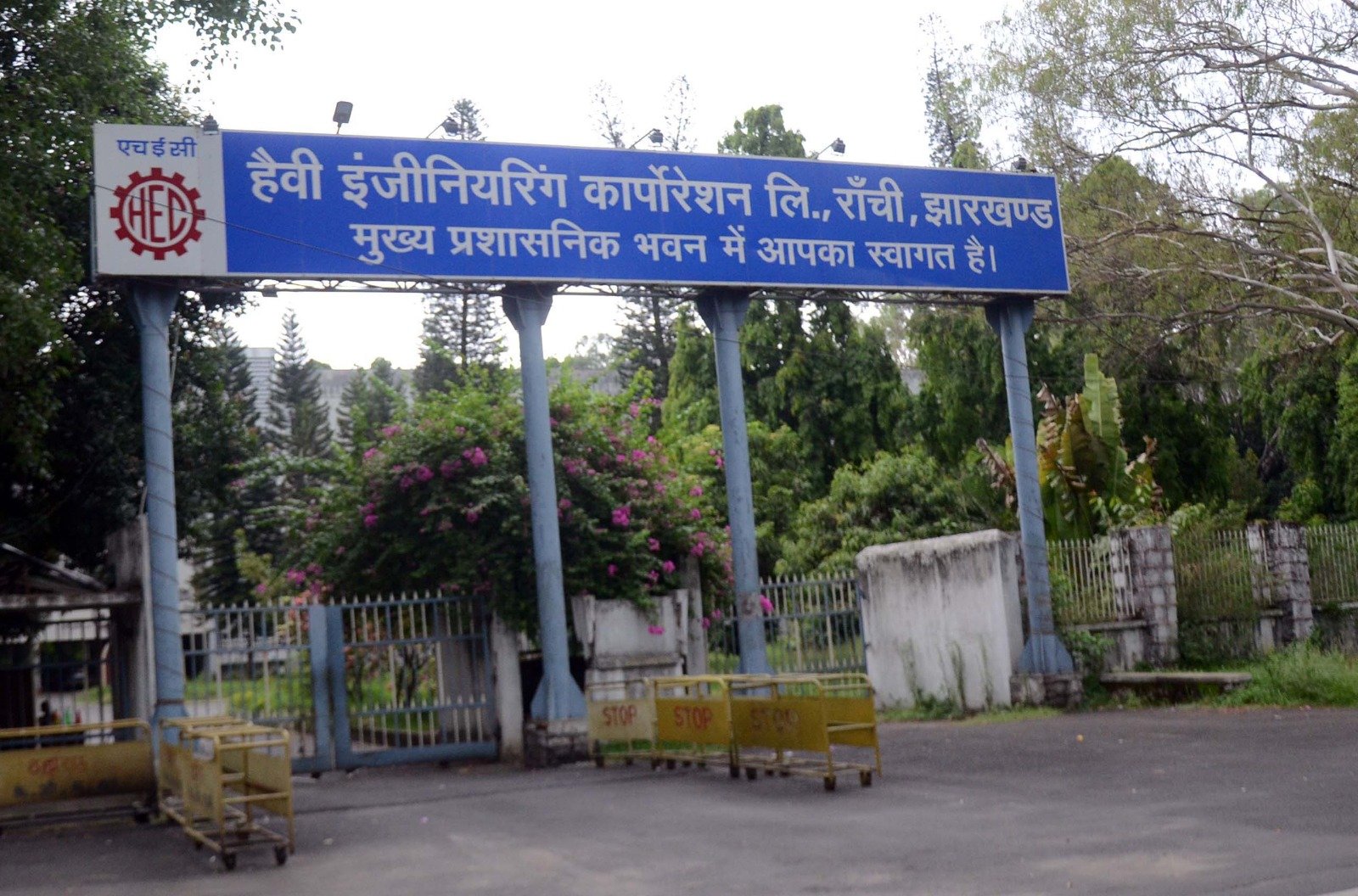
There was a time when the future of Indian industry was being built in Ranchi.
When the Heavy Engineering Corporation (HEC) was established in 1958, India was still a young republic attempting to build an industrial base capable of supporting its own economic ambitions.
HEC was conceived as part of that larger project: to manufacture the heavy machinery required by steel, mining, coal, and other strategic industries rather than depend indefinitely on imports.
The choice of partners reflected the geopolitics of the era. The Soviet Union provided technical and financial cooperation, particularly for the Heavy Machine Building Plant, while Czechoslovakia also contributed to the industrialisation effort. Production began in 1964.
HEC was therefore more than another public-sector enterprise. It represented a philosophy of nation-building in which industrial capacity was itself regarded as a form of national power.
Its machinery helped support the expansion of India’s steel industry, including major projects at Bokaro and Visakhapatnam. The significance was not simply commercial. Every large machine produced domestically reduced dependence on foreign suppliers and helped develop an ecosystem of engineers, technicians, and skilled workers.
That was the strategic logic of HEC.
But the world that created the corporation disappeared with the end of the Cold War. The Soviet Union collapsed, global manufacturing changed, and India’s economic model shifted towards liberalisation and greater private-sector participation. HEC, like several other public-sector industrial giants, found itself confronting a radically different competitive environment.
Yet the relationship with Russia did not end with the Soviet era.
From 2015 onwards, HEC entered into new technology-oriented agreements with Russian institutions, including CNIITMASH and the Krylov State Research Centre, covering areas such as advanced castings, forgings, and marine propulsion technologies. In 2018, a joint engineering facility in Ranchi involving a subsidiary of Russia’s Rosatom sought to strengthen specialist training in heavy-engineering welding technologies.
That continuity is significant. It suggests that the old industrial partnership was not merely a chapter in Cold War history; it could still provide a technological bridge between India’s industrial inheritance and its contemporary ambitions.
But history alone cannot revive an industrial institution. The real question for HEC is whether its legacy can be converted into competitiveness. India now speaks confidently about Atmanirbhar Bharat, advanced manufacturing, defence production, and strategic supply chains. Those ambitions require precisely the capabilities that institutions such as HEC were originally created to develop: engineering depth, specialist skills, manufacturing scale, and technological independence.
The irony is difficult to miss. A corporation established to make India less dependent on foreign machinery now needs investment, modern technology, reliable orders, and institutional reform if it is to remain relevant to the next phase of Indian industrialisation.
HEC’s story is therefore neither simply one of decline nor one of nostalgia. It is a test of whether India can preserve strategic industrial knowledge while modernising the institutions that hold it.
The machines may have changed. The question of self-reliance has not.
Author

Related Stories



Most Read
- 1Argentina’s ‘Vanishing Sea’: Rare Low Tide
- 2Effect of the 12 August 2026 Solar Eclipse on the 12 Zodiac Signs, Know Who Will Benefit and Who Will Have to Be Careful
- 3HC finds peon’s dismissal over tea and biscuits amounted to ‘injustice’
- 4Brace for 29 June: a Capricorn Full Moon, Mercury retrograde and Jupiter’s leap into Leo
- 5Japan Coach’s Whiteboard Tactics Go Viral at FIFA World Cup