Shorthand—the art of using abbreviated symbols, characters, or strokes to record the spoken word at the velocity of speech—stands as one of humanity’s oldest and most enduring information technology systems. Long before digital voice recorders, stenograph machines, or artificial intelligence transcription tools, shorthand served as the vital bridge between fleeting acoustic speech and permanent written records. The evolution of shorthand is not merely a history of clerical utility; it is a fascinating chronicle of human ingenuity, mirroring the shifting demands of law, governance, religion, and commerce across millennia.
Ancient Beginnings: The Birth of Tironian Notes
The genesis of structured shorthand is deeply rooted in the political and judicial theaters of classical antiquity. In ancient Greece, early attempts at rapid writing were utilized to record philosophical discourses, but the first highly systemized shorthand method emerged in the Roman Republic in 63 BCE.
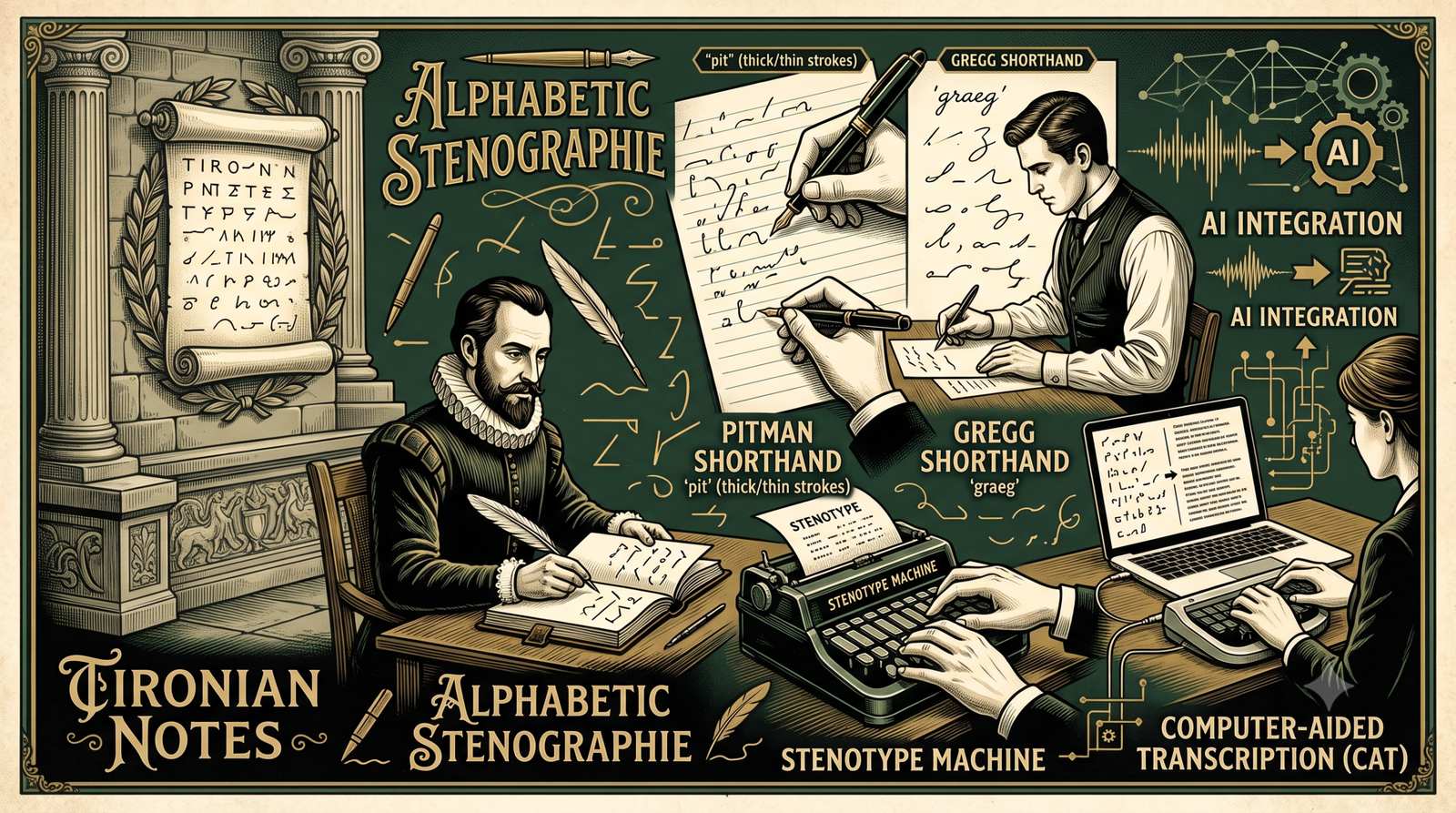
Developed by Marcus Tullius Tiro, a brilliant freedman and personal secretary to the legendary orator Cicero, the system became known as Tironian Notes (Notae Tironianae). Tiro constructed an alphabet of highly simplified cursive strokes derived from Latin characters, supplemented by an extensive system of symbols representing common prefixes and suffixes.
Tironian Notes allowed Tiro to capture Cicero’s fiery, rapid-fire speeches in the Roman Senate in real-time. The system became an administrative staple of the Roman Empire, taught in schools and utilized by emperors. It survived long after the fall of Rome, preserved by medieval Christian monks to copy manuscripts and record ecclesiastical councils, before gradually fading in the Middle Ages as it became falsely associated with witchcraft and the occult.
The English Renaissance and the Orthographic Revival
The modern resurgence of shorthand began in Renaissance England, catalyzed by the Protestant Reformation and the rise of parliamentary democracy. The demand to capture sermons verbatim and record parliamentary debates triggered a wave of typographic experimentation.
In 1588, Timothy Bright published Characterie: An Arte of Shorte, Swifte, and Secrete Writing, which used vertical and horizontal strokes attached to small circles to represent entire words. Bright’s system was clunky, requiring users to memorize thousands of arbitrary characters. The true evolutionary breakthrough came in 1602 when John Willis published The Art of Stenographie. Willis abandoned word-based symbols in favor of an alphabetic approach, assigning unique, simplified geometric strokes to individual letters.
Throughout the 17th and 18th centuries, alphabetic shorthand flourished. Celebrated figures like Samuel Pepys kept their intimate, historically invaluable diaries completely in shorthand to shield their private lives from prying eyes.
The 19th-Century Revolution: Phonetics and Mass Literacy
The Industrial Revolution, combined with the rapid expansion of global trade, journalism, and modern legal systems, required a shorthand that was not just faster, but universally learnable. The 19th century responded by shifting away from the visual alphabet to the science of acoustics, birthing the two titans of modern stenography: Pitman and Gregg.
In 1837, Sir Isaac Pitman introduced Stenographic Sound-Hand in England. Pitman’s revolutionary insight was to base shorthand entirely on phonetics—writing words exactly as they sound, discarding silent letters. Pitman utilized a strict geometric framework where straight lines and quarter-circles represented consonants.
Crucially, Pitman introduced shading: a thin stroke represented a light consonant (like /p/), while a thick, heavy stroke made by pressing harder on the pen represented its voiced equivalent (like /b/). Vowels were indicated by a delicate system of dots and dashes placed around the strokes.
While highly scientific and incredibly fast, Pitman’s system proved difficult for some due to its rigid reliance on pen pressure and ruled paper lines. In 1888, an Irish-born clerk named John Robert Gregg answered this friction by publishing Light-Line Phonography in America. Gregg threw out geometric rigidity and line-shading.
Instead, he based his strokes on the natural, fluid curves of longhand elliptical writing. Gregg shorthand was completely uniform in thickness, did not require ruled lines, and blended vowels smoothly into consonants without lifting the pen. Gregg rapidly captured the American market, becoming the undisputed linguistic engine of 20th-century corporate offices and secretarial schools.
The Technological Transition: From Pens to Keys
As the 20th century progressed, the physiological limits of the human hand writing with a pen came into direct conflict with the accelerating pace of modern industry. The evolution of shorthand shifted from paper to mechanical architecture.
In 1877, Miles Bartholomew invented the first successful Stenograph machine, a device that would revolutionize courtroom reporting. Unlike standard typewriters that type one letter at a time, a stenotype machine utilizes a specialized, abbreviated 22-button keyboard that allows operators to press multiple keys simultaneously—a process known as chording.
By pressing combinations of keys, a court reporter can type entire syllables, words, or complex legal phrases in a single stroke, achieving speeds upwards of 225 to 300 words per minute.
The Contemporary Era: Digital Shorthand and AI Integration
Today, the traditional sight of a secretary scribbling Gregg or Pitman symbols in a notepad has largely vanished from the corporate world, replaced by computer keyboards and digital interfaces. However, shorthand has not died; it has simply evolved into software code.
In modern legal, legislative, and captioning environments, shorthand thrives through Computer-Aided Transcription (CAT). Modern stenotype machines are connected to advanced software databases. When a reporter strikes a chord, the digital shorthand code is instantly translated by an internal dictionary into plain text on a screen, providing real-time closed captioning for the deaf and instant legal transcripts.
Furthermore, the logic of shorthand—compressing information for rapid transmission—lives on informally in the digital communication of everyday life, where “text-speak,” acronyms, and emojis serve as a vernacular, digital shorthand for the smartphone generation.
Conclusion
From the wax tablets of Marcus Tullius Tiro to the digital, chorded keyboards of modern supreme courts, the evolution of shorthand reflects humanity’s ceaseless quest to keep pace with time. Shorthand transformed the act of writing from a slow, reflective craft into an instantaneous mirror of human thought and speech.
Though its physical forms have migrated from bamboo pens, to fountain ink, to mechanical keys, and finally to digital algorithms, the core spirit of shorthand remains unchanged: a brilliant testament to our desire to capture the fleeting spoken word before it vanishes into the ether.
(The author is a researcher in cultural history. The views expressed are personal.)
Author

Related Stories




Most Read
- 1Argentina’s ‘Vanishing Sea’: Rare Low Tide
- 2Effect of the 12 August 2026 Solar Eclipse on the 12 Zodiac Signs, Know Who Will Benefit and Who Will Have to Be Careful
- 3HC finds peon’s dismissal over tea and biscuits amounted to ‘injustice’
- 4Brace for 29 June: a Capricorn Full Moon, Mercury retrograde and Jupiter’s leap into Leo
- 5Japan Coach’s Whiteboard Tactics Go Viral at FIFA World Cup