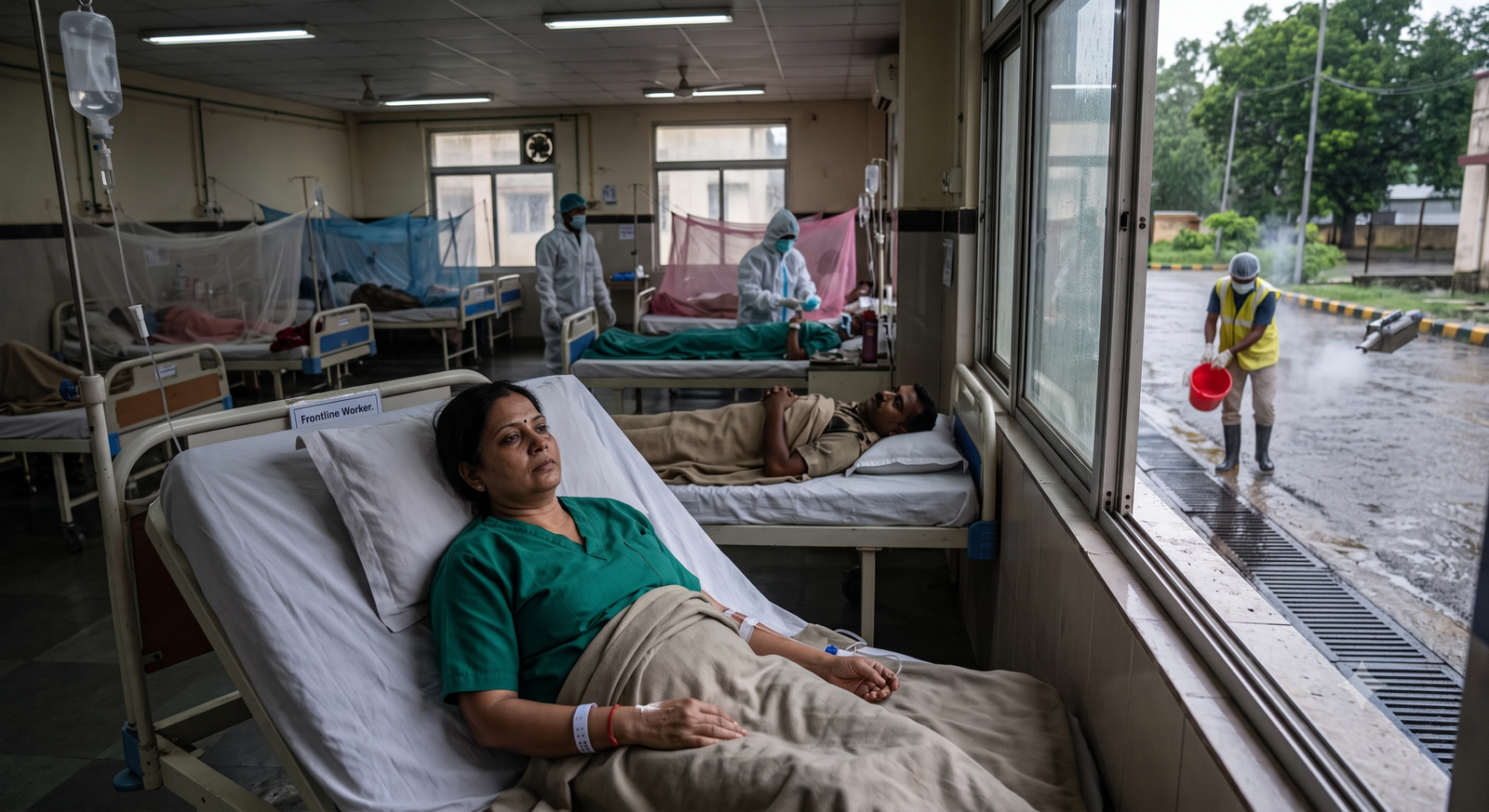
Jharkhand’s premier government medical college and hospital, the Rajendra Institute of Medical Sciences (RIMS), is likely to face a major challenge in tackling the rising number of dengue and malaria cases this monsoon as large parts of its campus have turned into potential mosquito breeding grounds due to persistent rainwater accumulation caused by an inadequate drainage system.
Even as vector-borne diseases continue to surge across the state, stagnant water has remained accumulated for days in several parts of the hospital premises, including the basement, raising concerns among patients, attendants, and healthcare workers over the heightened risk of mosquito-borne infections within the state’s largest referral hospital.
Visitors alleged that recurring waterlogging has worsened the mosquito menace, with rainwater often mixed with overflowing drain water entering the physiotherapy department, ground-floor sections, and basement during heavy showers.
They said the situation has not only disrupted hospital operations but also made movement difficult, particularly for elderly patients and those using wheelchairs.
“My father is admitted in the isolation ward, but various parts of the hospital are filled with stagnant water. We are worried not only about his existing illness but also about mosquito-borne diseases,” said Kabir Sahil, an attendant.
Another patient’s relative said mosquito infestation becomes severe during the evening and night, alleging that regular fogging and mosquito-control measures have not been carried out consistently despite the prolonged waterlogging.
Outpatient Neta Kumari said navigating through waterlogged stretches is particularly difficult for elderly patients and those with mobility issues.
Health experts warned that stagnant water provides ideal breeding conditions for Aedes mosquitoes, the primary vector responsible for spreading dengue. Ironically, RIMS itself is engaged in research on vector-borne diseases, including malaria.
Responding to the concerns, RIMS Public Relations Officer Dr Shishir said the agency responsible for sanitation and campus upkeep has been directed to investigate the issue.
He added that the hospital is planning infrastructure modifications, including the development of a proper drainage network, to address the recurring problem.
Hospital authorities maintained that the waterlogging is part of the larger drainage crisis affecting Bariatu, where surrounding roads and residential areas also experience severe flooding after heavy rainfall.
However, patients and attendants urged the administration to immediately remove stagnant water and intensify fogging to prevent the hospital from becoming a hotspot for mosquito-borne diseases.
Author

Related Stories



Most Read
- 1Argentina’s ‘Vanishing Sea’: Rare Low Tide
- 2Effect of the 12 August 2026 Solar Eclipse on the 12 Zodiac Signs, Know Who Will Benefit and Who Will Have to Be Careful
- 3HC finds peon’s dismissal over tea and biscuits amounted to ‘injustice’
- 4Brace for 29 June: a Capricorn Full Moon, Mercury retrograde and Jupiter’s leap into Leo
- 5Japan Coach’s Whiteboard Tactics Go Viral at FIFA World Cup