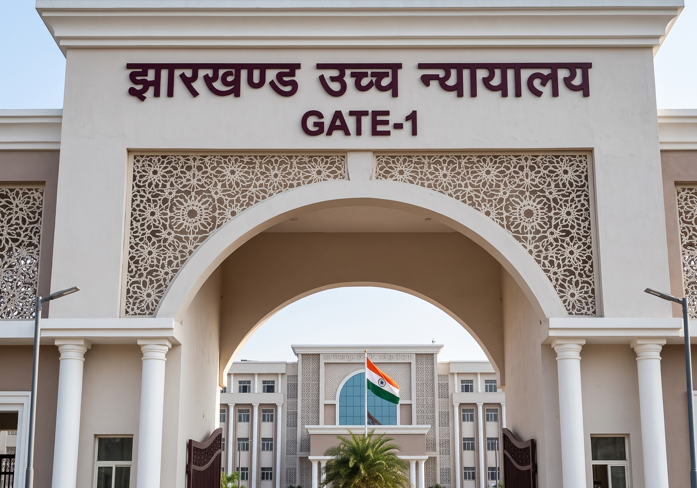
The Jharkhand High Court on Thursday brought an end to a decades-old legal battle over the ownership and management of church properties in Dumka by dismissing two appeals that had been pending since 1992.
The case originated from two civil suits filed in 1971 over the administration of the Santhal Mission of Northern Churches (SMNC) and the Northern Evangelical Lutheran Church (NELC).
A division bench of Chief Justice M.S. Sonak and Justice Rajesh Shankar upheld the 1992 judgment of the then Patna High Court, saying there was no reason to interfere with its findings.
The dispute traces its roots to 1880, when Norwegian missionaries Rev. Hans Peter Doerresen and Rev. Laurentius Olaves Skrefsrud established the Santhal Mission of Northern Churches (SMNC) and created a trust to manage its churches, schools, and other properties in the Santhal Parganas.
The legal battle began in 1968 after the trustees inducted the Trust Association of the Northern Evangelical Lutheran Church (NELC) as a trustee through an Instrument of Transfer.
A section of beneficiaries challenged the move, leading to two title suits in 1971. The suits were decided by a Dumka court in the mid-1980s, after which the matter went in first appeal before the Patna High Court (PHC).
In 1992, the PHC delivered a common judgment in the appeals.
The present Letters Patent Appeals (LPA) against that PHC judgment were later transferred to the Jharkhand High Court following the state’s creation in 2000 and have now been finally decided, bringing the decades-old litigation to an end.
The Jharkhand High Court held that the beneficiaries failed to prove any breach of trust or mismanagement by the trustees. It also observed that once the courts had refused their main prayers for the removal of trustees and the framing of a new management scheme, they could not seek to have the 1968 document declared illegal.
The bench further agreed with the earlier finding that the 1968 document did not transfer ownership of the church properties. Instead, it only changed the body of trustees managing the trust.
With this ruling, the High Court dismissed both appeals, bringing an end to a dispute that had remained in the courts for more than five decades.
Author

Related Stories




Most Read
- 1Effect of the 12 August 2026 Solar Eclipse on the 12 Zodiac Signs, Know Who Will Benefit and Who Will Have to Be Careful
- 2Argentina’s ‘Vanishing Sea’: Rare Low Tide
- 3HC finds peon’s dismissal over tea and biscuits amounted to ‘injustice’
- 4Brace for 29 June: a Capricorn Full Moon, Mercury retrograde and Jupiter’s leap into Leo
- 5Japan Coach’s Whiteboard Tactics Go Viral at FIFA World Cup