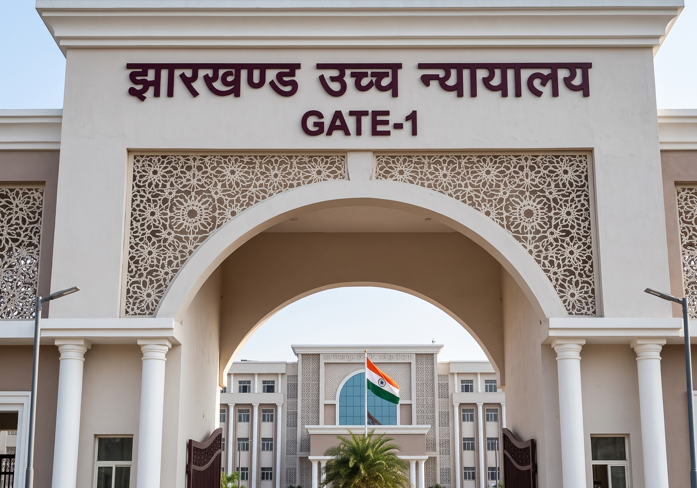
In a significant ruling reinforcing a father’s legal status as the natural guardian of his minor child, the Jharkhand High Court has held that a father cannot be charged with kidnapping merely for taking his own son with him.
The court also ruled that vague allegations of assault without specific averments of bodily injury or medical evidence, and allegations of wrongful restraint without any assertion that a person’s movement was obstructed, do not constitute criminal offences.
The bench of Justice Anil Kumar Choudhary passed the order while allowing a petition filed by Hazaribagh resident Khalid Eqbal, who had challenged a June 12, 2024, order of a Dhanbad Judicial Magistrate taking cognisance of offences under Sections 323 (voluntarily causing hurt), 341 (wrongful restraint) and 363 (kidnapping) of the Indian Penal Code and issuing summons against him.
The case arose from a complaint filed by the petitioner’s estranged wife, who alleged that he had called her to Dhanbad railway station with their four-year-old son and taken the child away. She further alleged that when she later went to his house, the petitioner and his family members assaulted her.
Acting on her complaint and the statements of witnesses recorded during the inquiry, the magistrate had found a prima facie case and summoned the petitioner.
Before the High Court, the petitioner argued that, being the father, he was the natural guardian of the child and therefore could not be prosecuted for kidnapping his own son. He also contended that the complaint lacked the essential ingredients of the offences of hurt and wrongful restraint.
Accepting the contention, the High Court observed that the offence of kidnapping under Section 363 IPC requires that a minor be taken away from the keeping of a lawful guardian without that guardian’s consent. Since the petitioner himself was the child’s natural guardian, merely taking his own son did not satisfy the ingredients of the offence.
The court further held that the complaint failed to disclose the essential ingredients of the other offences as well.
While it alleged that “maarpeet” had taken place, it neither described any bodily pain, disease or injury suffered by the complainant nor referred to any medical treatment or injury report. Likewise, there was no allegation that the petitioner had prevented the complainant from proceeding in a direction where she had a legal right to move.
Referring to a Supreme Court judgment on the offence of hurt, the court held that even if the allegations were accepted in their entirety, offences under Sections 323 and 341 IPC were not made out.
Holding that the continuation of the prosecution would amount to an abuse of the process of law, the High Court quashed the entire criminal proceeding, including the magistrate’s order issuing summons against the petitioner.
Author

Related Stories




Most Read
- 1Argentina’s ‘Vanishing Sea’: Rare Low Tide
- 2Effect of the 12 August 2026 Solar Eclipse on the 12 Zodiac Signs, Know Who Will Benefit and Who Will Have to Be Careful
- 3HC finds peon’s dismissal over tea and biscuits amounted to ‘injustice’
- 4Brace for 29 June: a Capricorn Full Moon, Mercury retrograde and Jupiter’s leap into Leo
- 5Japan Coach’s Whiteboard Tactics Go Viral at FIFA World Cup