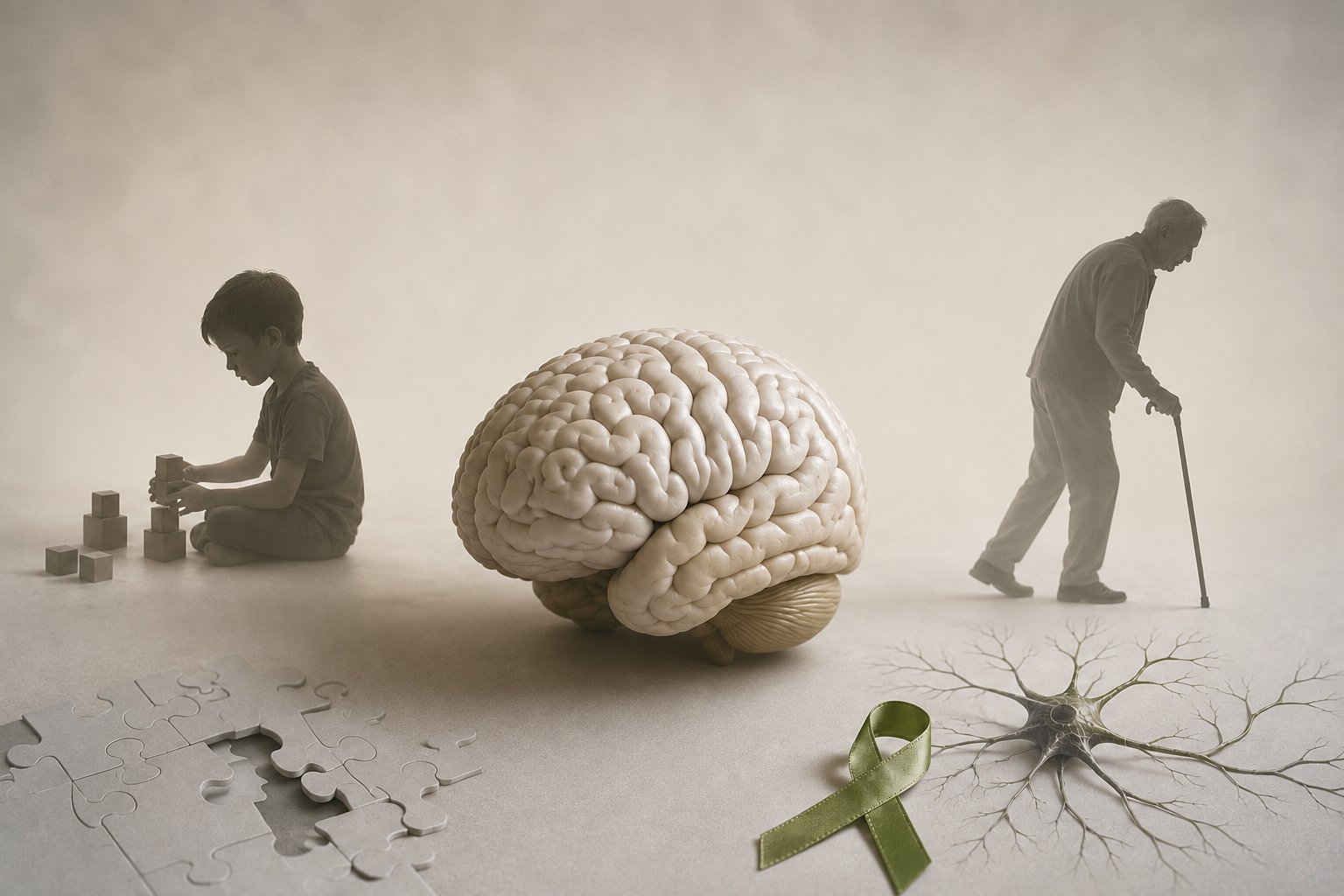
As the world prepares to observe World Brain Day on July 22, the occasion serves as a timely reminder of the growing prevalence of neurological conditions and the urgent need for greater awareness, research, and early intervention. According to the World Health Organization, neurological disorders are among the leading causes of disability and illness globally, affecting more than one in three people.
Among these, Autism Spectrum Disorder (ASD) and Parkinson’s disease represent two distinct neurological conditions that occur at different stages of life, yet are increasingly being explored for potential biological links. Autism Spectrum Disorder (ASD) is estimated to affect 1 in 127 children globally, while Parkinson’s disease affects more than 10 million people worldwide, with cases expected to rise significantly as populations age.
Although autism is a neurodevelopmental condition identified early in life and Parkinson’s is a neurodegenerative disorder that typically develops in later adulthood, new research suggests the two may share overlapping biological and behavioural pathways.
One of the strongest links being explored is dopamine, a neurotransmitter that plays an essential role in regulating movement, motivation, learning, reward processing, and behaviour. Parkinson’s is caused by the progressive loss of dopamine-producing cells in the brain, which results in tremors, rigidity, slow movement, and problems with balance.
In autism, differences in dopamine signalling are linked to repetitive behaviours and social difficulties. The conditions are different, but the discovery of these shared pathways is opening new research and treatment directions. Genetic research is also revealing interesting overlaps.
Importantly, this doesn’t mean autism causes Parkinson’s, or that people on the spectrum are doomed to develop it down the line. Rather, it highlights the complexity of neurological disorders and the possibility of shared biological mechanisms.
Another key area where Parkinson’s disease and autism seem to overlap is movement. While autism is primarily associated with differences in communication, social interaction, restricted or repetitive behaviours, and sensory processing, many neurodiverse individuals also experience challenges with balance, posture, coordination, and fine motor skills.
Some of these challenges closely mirror the movement-related difficulties seen in Parkinson’s disease. However, these symptoms are often overlooked and remain under-recognised in individuals with autism. In fact, a survey of neurologists found that only 36% recognised motor difficulties as a common feature associated with autism, highlighting the need for greater awareness and more routine assessment of these symptoms.
This growing understanding is encouraging researchers to view brain health as a lifelong journey rather than as a series of isolated conditions. They are increasingly examining how genetics, brain development, environmental factors, and ageing interact across different neurological disorders to identify opportunities for earlier intervention, improved diagnosis, and more personalised care throughout life.
Beyond science, both autism and Parkinson’s disease present similar caregiving challenges. Families often navigate concerns around independence, long-term support, financial planning, mental well-being, and access to specialised services. As populations age and awareness of neurodevelopmental conditions grows, healthcare systems must adopt more integrated, person-centred models of care.
Research into the links between autism and Parkinson’s goes beyond these two conditions alone. Uncovering shared neurological pathways could pave the way for better diagnosis, treatment, and care for many brain disorders to come. Continued investment in neuroscience and cross-disciplinary collaboration will be essential to translate these discoveries into improved diagnosis, better treatments, and a deeper understanding of lifelong brain health.
Author

Related Stories



Most Read
- 1Argentina’s ‘Vanishing Sea’: Rare Low Tide
- 2Effect of the 12 August 2026 Solar Eclipse on the 12 Zodiac Signs, Know Who Will Benefit and Who Will Have to Be Careful
- 3HC finds peon’s dismissal over tea and biscuits amounted to ‘injustice’
- 4Brace for 29 June: a Capricorn Full Moon, Mercury retrograde and Jupiter’s leap into Leo
- 5Japan Coach’s Whiteboard Tactics Go Viral at FIFA World Cup