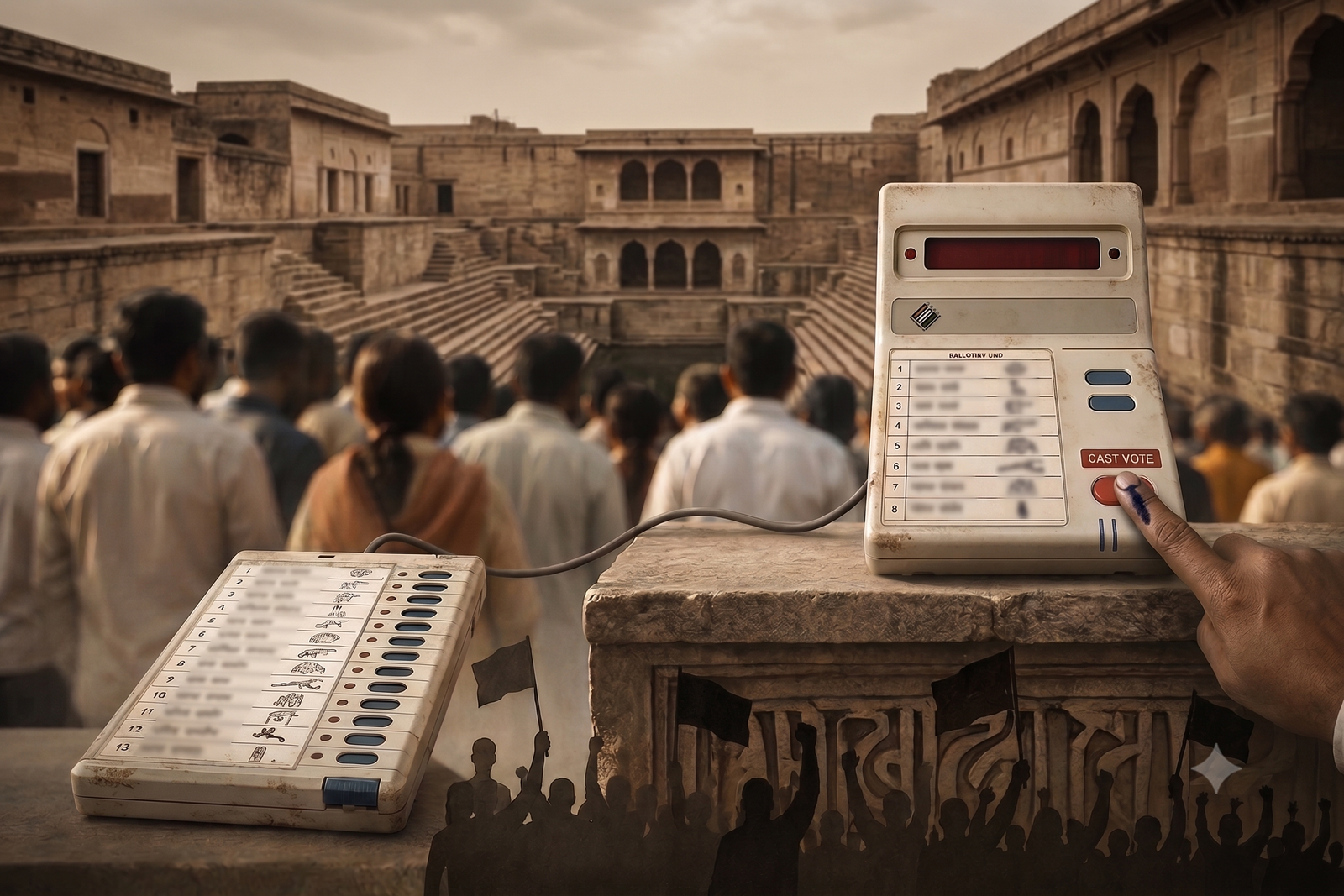
By-elections seldom redefine the trajectory of national politics. They are influenced by local leadership, constituency-specific grievances, organisational strength, and voter turnout that often differs significantly from that of a general election. Yet they occasionally illuminate broader political currents that deserve closer scrutiny. The Bankipur Assembly by-election in Bihar appears to be one such case.
If the official result confirms that Bankipur—long regarded as a strong electoral base of the Bharatiya Janata Party (BJP)—has elected a candidate from a different political formation, the significance extends beyond the numerical loss of a single legislative seat. The result would invite a broader discussion about the changing nature of electoral competition in India and the increasingly fluid relationship between political parties and voters.
Political strongholds are rarely permanent. Electoral history, in India and elsewhere, demonstrates that constituencies remain loyal only as long as voters believe that their expectations are being met. Governments, regardless of ideology, are periodically reminded that electoral success must be renewed through governance, communication, and responsiveness rather than assumed as a permanent entitlement.
The Bankipur verdict, if viewed in that context, should be interpreted cautiously. A by-election cannot establish a nationwide political trend, nor can it be treated as a definitive referendum on either the ruling party or the opposition.
Nevertheless, such contests often provide valuable insight into emerging voter behaviour that larger political parties ignore at their own risk.
One of the most notable developments in recent Indian politics has been the changing profile of the electorate, particularly younger voters. Access to digital media has fundamentally altered political engagement. Citizens increasingly consume speeches, interviews, policy debates, and campaign messaging directly through social media and digital platforms rather than relying exclusively on traditional news outlets. This has made political opinion more dynamic, less predictable, and increasingly influenced by governance outcomes rather than historical party loyalties alone.
Employment opportunities, educational quality, inflation, public services, transparency, and institutional accountability have become central issues in political discourse. Many analysts argue that younger voters are becoming more willing to evaluate governments on administrative performance rather than political identity.
Whether that tendency influenced voting behaviour in Bankipur will require more detailed electoral and demographic analysis rather than assumption.
For the BJP, any unexpected electoral setback offers an opportunity for organisational review. Successful political organisations typically respond to adverse results by examining local campaign strategy, candidate selection, grassroots engagement, and communication with voters. Democratic politics rewards those parties that recognise changing public expectations early rather than dismissing isolated setbacks as statistical anomalies.
At the same time, opposition parties and emerging political movements should exercise equal caution in interpreting such results. India’s electoral history offers numerous examples where impressive performances in by-elections did not translate into sustained success in subsequent state or parliamentary elections. Lasting political credibility requires more than electoral momentum; it depends upon organisational depth, policy coherence, effective leadership, and the ability to maintain public confidence over time.
The emergence of newer political formations has nevertheless added another dimension to India’s democratic landscape. Their presence has intensified political competition and broadened public debate by introducing alternative narratives and governance proposals. Whether these organisations evolve into durable political forces will depend not merely on electoral victories but on their capacity to build institutions capable of delivering effective governance if entrusted with power.
The broader significance of Bankipur therefore lies less in determining winners and losers than in highlighting the increasingly competitive nature of Indian democracy. Electoral volatility should not be viewed as political instability. Rather, it reflects an electorate that appears increasingly prepared to reward performance and reassess long-standing loyalties when circumstances change.
Ultimately, the Bankipur by-election is best understood as a reminder that democratic legitimacy is never permanent. Every election, however local, provides political parties with an opportunity to understand the aspirations, frustrations, and expectations of citizens. Those that treat electoral verdicts as opportunities for reflection rather than occasions for triumphalism or denial are often better positioned for long-term success.
Whether Bankipur proves to be an isolated local episode or an early indicator of broader political change will become apparent only through future elections. For now, its principal lesson is a timeless one: in a vibrant democracy, no constituency is permanently secured, no political mandate is unconditional, and no party—whether governing or aspiring to govern—can afford to stop listening to the electorate.
Author

Related Stories



Most Read
- 1Argentina’s ‘Vanishing Sea’: Rare Low Tide
- 2Effect of the 12 August 2026 Solar Eclipse on the 12 Zodiac Signs, Know Who Will Benefit and Who Will Have to Be Careful
- 3HC finds peon’s dismissal over tea and biscuits amounted to ‘injustice’
- 4Brace for 29 June: a Capricorn Full Moon, Mercury retrograde and Jupiter’s leap into Leo
- 5Japan Coach’s Whiteboard Tactics Go Viral at FIFA World Cup