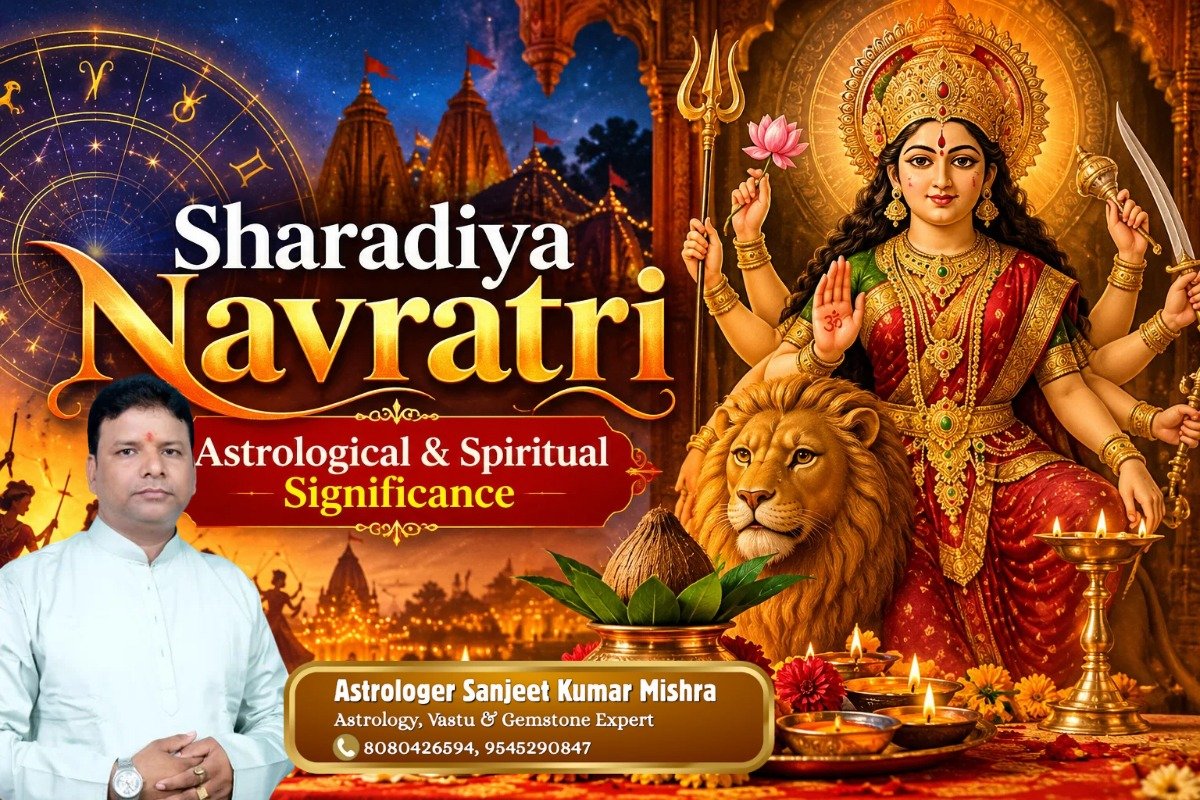
Sharadiya Navratri is one of the most important festivals dedicated to Goddess Durga and Shakti, the divine feminine power.
The festival is observed for nine days and is associated with devotion, spiritual discipline, fasting and the worship of the nine forms of Goddess Durga.
According to the Hindu calendar, Sharadiya Navratri begins on Pratipada (the first lunar day) of the Shukla Paksha in the month of Ashwin and continues for nine days.
Four Navratris Are Observed in a Year
According to Hindu traditions, four Navratris are observed during the year:
- Chaitra Navratri – observed in the month of Chaitra and also known as Vasant Navratri.
- Ashadha Gupt Navratri – observed during the Ashadha month and primarily associated with spiritual and Shakti-related practices.
- Sharadiya Navratri – observed during the Ashwin month and is the most widely celebrated Navratri.
- Magha Gupt Navratri – observed during the Magha month and associated with specific forms of Devi worship and spiritual practices.
Although all four Navratris have their own significance, Sharadiya Navratri holds a particularly important place in popular Hindu worship and religious traditions.
Spiritual Significance of Navratri
Navratri is traditionally regarded as a period for strengthening one’s mental, physical and spiritual discipline.
The practice of fasting and prayer is often understood as a way of exercising control over the senses, reducing distractions and turning one’s attention towards spiritual practices. Devotees may follow a sattvic diet, meditation, prayer and other forms of religious discipline during these nine days.
From a spiritual perspective, Navratri is also seen as an opportunity to awaken one’s inner strength and cultivate qualities such as courage, devotion, self-control and positivity.
Sharadiya Navratri also coincides with the transition from the monsoon season to autumn, bringing noticeable changes in the natural environment. Traditionally, this seasonal transition has also been associated with changes in diet, lifestyle and religious practices.
Worship of the Nine Forms of Goddess Durga
During the nine days of Navratri, devotees traditionally worship the Navadurga, the nine forms of Goddess Durga:
- Day 1 – Maa Shailputri
- Day 2 – Maa Brahmacharini
- Day 3 – Maa Chandraghanta
- Day 4 – Maa Kushmanda
- Day 5 – Maa Skandamata
- Day 6 – Maa Katyayani
- Day 7 – Maa Kalaratri
- Day 8 – Maa Mahagauri
- Day 9 – Maa Siddhidatri
Each form represents different aspects of Shakti and has its own religious and spiritual significance.
Connection Between Navratri and Lord Rama
Sharadiya Navratri is also closely associated with the story of Lord Rama’s victory over Ravana. According to the Ramayana tradition, Lord Rama worshipped Goddess Durga and sought her blessings before his battle with Ravana. This tradition is particularly associated with the worship of the Goddess before the victory of good over evil. The culmination of this period is celebrated as Vijayadashami (Dussehra), symbolising the victory of righteousness over evil. Therefore, Sharadiya Navratri is not only associated with the worship of Goddess Durga but is also connected with the broader spiritual theme of the triumph of good over evil.
Traditional Practices During Sharadiya Navratri
Devotees perform various rituals during Navratri according to their family and regional traditions. These may include:
- Installing a Kalash at home.
- Performing daily worship of Goddess Durga.
- Reciting the Durga Saptashati (Devi Mahatmya).
- Observing fasting or following a sattvic diet.
- Lighting a diya during the morning and evening prayers.
- Offering flowers, fruits and other traditional bhog to the Goddess.
- Performing Kanya Puja on Ashtami or Navami, according to tradition.
Some households also decorate the entrance with a mango-leaf toran and draw a Swastika at the main entrance as symbols of auspiciousness. These are traditional practices and may vary from region to region.
Religious Significance of Sharadiya Navratri
The worship of Goddess Durga during Sharadiya Navratri is described in Hindu religious literature, including the Devi Mahatmya (Durga Saptashati). The Devi Mahatmya describes the glory and divine power of the Goddess and her victory over forces representing evil and disorder. Devotees traditionally believe that sincere worship and recitation during Navratri can provide spiritual strength, inner peace and the blessings of the Goddess. The festival has been observed as an important period of Devi worship for centuries and remains one of the most significant celebrations of Shakti in Hindu traditions.
Astrological Significance of Sharadiya Navratri
From the perspective of Vedic astrology and traditional belief, Navratri is considered an auspicious period for Devi worship and spiritual practices. Some astrologers associate the worship of Goddess Durga with seeking relief from certain planetary influences, particularly those connected with the Moon (Chandra). Traditional astrological practices may recommend Devi worship for people experiencing certain planetary combinations or perceived doshas in their birth chart. For example, some astrological traditions consider combinations involving the Moon and Saturn to be challenging and may recommend spiritual practices, including Devi worship, as a remedial measure. However, these are traditional astrological beliefs and practices and are not scientifically established methods of treating planetary or personal problems. The appropriate spiritual remedy can also differ according to an individual’s birth chart and the specific astrological tradition being followed.
The Deeper Message of Navratri
At its deeper level, Sharadiya Navratri represents the awakening of Shakti—the divine power within and around us. The nine days provide an opportunity to move away from distractions, practise self-discipline, strengthen one’s faith and focus on positive transformation. The victory of Goddess Durga over evil and Lord Rama’s victory over Ravana both convey the same central message: righteousness, courage and truth ultimately triumph over negativity and injustice. Therefore, Sharadiya Navratri can be understood not only as a religious festival but also as a period of spiritual renewal, self-discipline and inner awakening.
Important Note
The religious rituals, astrological interpretations and practices associated with Navratri may differ according to region, family tradition, sampradaya and individual belief. References to planetary doshas and their remedies in this article are based on traditional Vedic astrological beliefs and should not be treated as scientifically proven claims.
Jyotishacharya Sanjit Kumar Mishra
Astrology, Vastu & Gemstone Expert
Contact: 8080426594 / 9545290847
Author

Related Stories

Most Read
- 1Argentina’s ‘Vanishing Sea’: Rare Low Tide
- 2Effect of the 12 August 2026 Solar Eclipse on the 12 Zodiac Signs, Know Who Will Benefit and Who Will Have to Be Careful
- 3HC finds peon’s dismissal over tea and biscuits amounted to ‘injustice’
- 4Brace for 29 June: a Capricorn Full Moon, Mercury retrograde and Jupiter’s leap into Leo
- 5Japan Coach’s Whiteboard Tactics Go Viral at FIFA World Cup