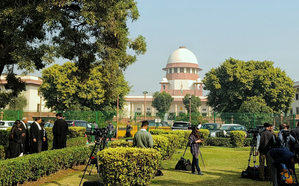
New Delhi: The Supreme Court on Tuesday sought response of the Centre and States on a plea alleging misuse of the Unique Identification Authority of India-issued Aadhaar cards as proof of citizenship, domicile, and residential address, and seeking directions to restrict its use strictly for identity verification. A bench of Chief Justice Surya Kant and Justice V Mohana issued notices to the Centre and all the states and UTs on a plea filed by advocate Ashwini Kumar Upadhyay and tagged it with the pending similar matters.
The plea has sought directions to the Centre, states, and the Election Commission to ensure that Aadhaar is used as a proof of identity and not as a proof of citizenship, domicile, address, and date of birth.
The plea, filed through advocate Ashwani Dubey, also sought directions that the use of Aadhaar as a proof of date of birth and residence in the application form for new voter registration be considered against Section 9 of the Aadhaar Act, 2016, Section 23(4) of the RPA, 1950, and Article 14 of the Constitution.
“Section 9 of the Aadhaar Act, 2016 expressly states that ‘Aadhaar is not the evidence of citizenship or domicile’. The Unique Identification Authority of India notification dated August 22, 2023 clearly states that ‘Aadhaar is proof of identity, not of citizenship, address, or date of birth’…
“Despite this, Aadhaar is not only being used as a proof of age, citizenship, and domicile for school admission, property purchase, and to obtain a birth certificate, ration card, driving licence, but also being used in the application form for new voter registration (Form-6) as a proof of date of birth and proof of residence. And thus, infiltrators and illegal immigrants are obtaining various documents using Aadhaar,” the plea said.
The petition contended that the existing verification mechanism under Form-6 is inadequate and might allow individuals without proper supporting documents to be included in the electoral database. The plea sought a comprehensive overhaul of the verification framework used in electoral processes and proposed the establishment of a high-powered monitoring committee comprising a retired Supreme Court judge along with cybersecurity and forensic experts to oversee reforms.
Author

Related Stories


Most Read
- 1Argentina’s ‘Vanishing Sea’: Rare Low Tide
- 2Effect of the 12 August 2026 Solar Eclipse on the 12 Zodiac Signs, Know Who Will Benefit and Who Will Have to Be Careful
- 3HC finds peon’s dismissal over tea and biscuits amounted to ‘injustice’
- 4Brace for 29 June: a Capricorn Full Moon, Mercury retrograde and Jupiter’s leap into Leo
- 5Japan Coach’s Whiteboard Tactics Go Viral at FIFA World Cup