From Sultanganj to Deoghar how Did the Tradition of the Shravani Mela Begin and Why Does It Still Attract Millions of People ?
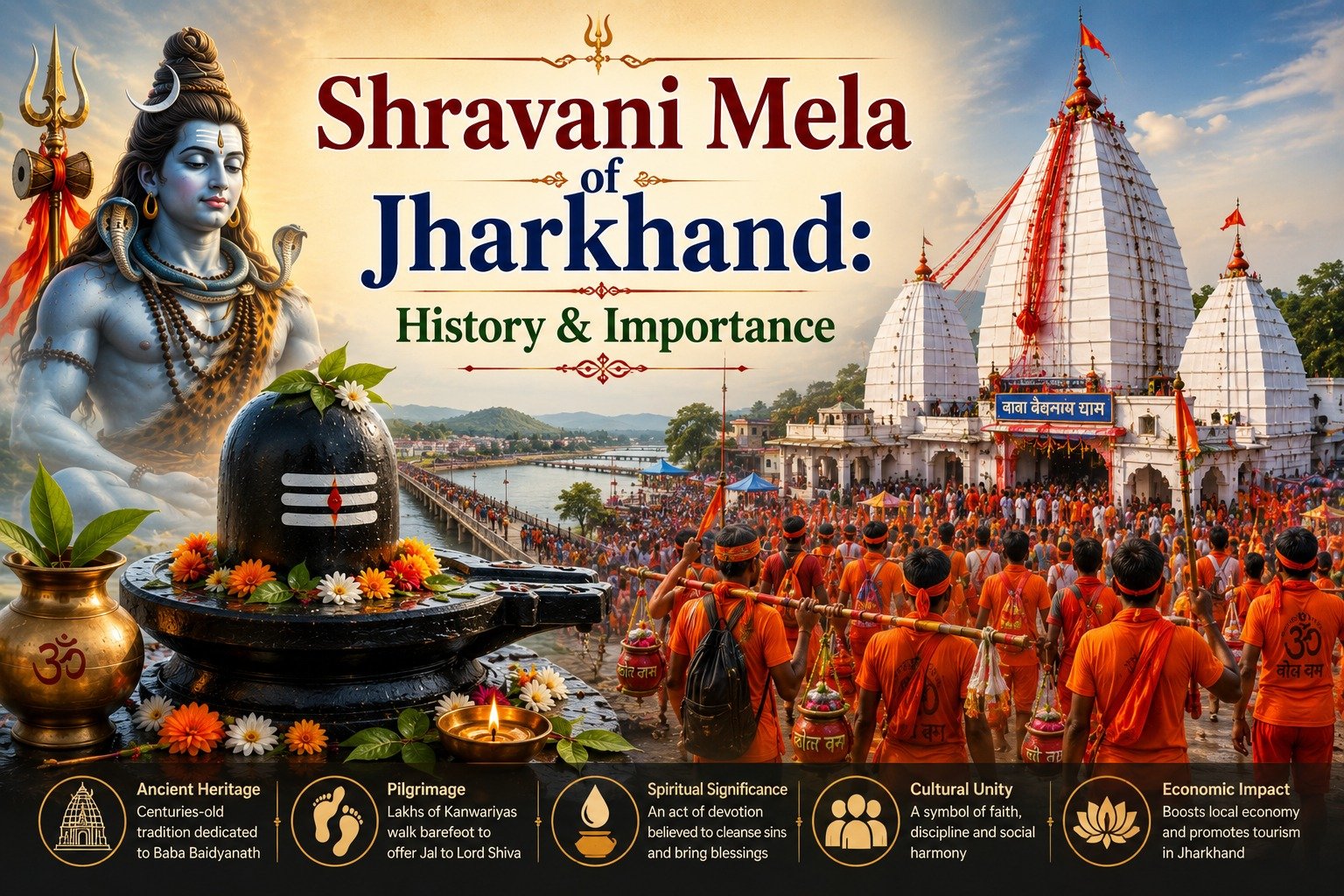
Every year, as the month of Shravan begins, Deoghar in Jharkhand is no longer just a religious place, but becomes a living center of faith, discipline, and folk culture. Millions of devotees of Lord Shiva from different states of the country carry Kanwars on their shoulders and walk to Baba Baidyanath Dham. This is the Shravani Mela, which is counted among the largest and longest-running religious fairs in the world. Its most special feature is that every devotee who arrives here completes a difficult journey of several days with the same faith. This is why this fair is not limited only to worship but has also become a symbol of Indian religious tradition, social unity, and cultural heritage.
The Tradition of the Shravani Mela Is Rooted in History
The tradition of the Shravani Mela is believed to be centuries old. It is associated with the Baba Baidyanath Temple, which is included among the twelve Jyotirlingas of Lord Shiva. According to mythological belief, Ravana, the king of Lanka, performed severe penance to please Lord Shiva. Lord Shiva granted him the Jyotirlinga but laid down the condition that it should not be placed on the ground anywhere during the journey. During the journey, the Jyotirlinga was established at present-day Deoghar, and from that time this place became a major center of faith for devotees of Lord Shiva. Based on this belief, the tradition of Jalabhishek during Shravan developed, which over time has taken the form of the grand Shravani Mela.
How Did the Tradition of the Shravani Mela Begin?
According to religious beliefs, the tradition of the Shravani Mela and the Kanwar Yatra traces its roots back to the Treta Yuga. It is believed that during this period, Ravana performed severe penance to please Lord Shiva and received the Kamna Ling from Him. On the other hand, historical evidence shows that after King Puranmal renovated the Baba Baidyanath Temple in the 17th century, this pilgrimage and the Shravani Mela developed into a more organized and widespread event.
Why Is the Gangajal from Sultanganj Considered So Special ?
The most unique tradition of the Shravani Mela begins from Sultanganj in Bihar. Here, the River Ganga flows northward, which is considered extremely sacred. Devotees collect Gangajal from here and complete a walking journey of about 105 kilometers to reach Deoghar. After that, the holy water is offered to Baba Baidyanath. This entire journey is considered a symbol of penance, discipline, and determination. Throughout the journey, the chants of “Bol Bam” and “Har Har Mahadev” further increase the enthusiasm of the devotees.
The Shravani Mela Is Not Only Religious but Also a Major Support for Jharkhand’s Economy
The impact of the Shravani Mela is not limited only to religious activities. During the fair, the income of thousands of people associated with hotels, dharamshalas, transportation, local markets, handicrafts, food services, and small businesses increases. The arrival of millions of devotees accelerates economic activities in Deoghar and the surrounding areas. Every year, the state government also makes special arrangements for security, healthcare, cleanliness, traffic management, and digital facilities so that the journey of the devotees becomes more convenient.
A Unique Example of Discipline Along with Faith
The Shravani Mela is an example that even large religious gatherings can be successfully organized through better management and social cooperation. Kanwariyas complete their walking journey while following the prescribed rules. Many devotees perform Jalabhishek as “Dak Bam”, running continuously without stopping, while ordinary Kanwariyas complete their journey by taking rest along the way. This tradition has continued for generations, and every year new devotees continue to become a part of it.
Why Is the Shravani Mela of Jharkhand So Special?
The Shravani Mela is not only a celebration of religious faith but also a celebration of that heritage of Indian culture in which faith, penance, service, discipline, and collective participation are seen together. Baba Baidyanath Dham in Deoghar continues to be a center of wishes and devotion for millions of people. This is why, as soon as Shravan begins, Jharkhand becomes one of the most important places on the spiritual map of the country. This centuries-old tradition is still as vibrant as ever and will continue to convey the message of faith along with cultural heritage to future generations.
Astrologer Sanjeet Kumar Mishra
Astrology, Vastu & Gemstone Expert
8080426594 / 9545290847
Author

Related Stories




Most Read
- 1Argentina’s ‘Vanishing Sea’: Rare Low Tide
- 2Effect of the 12 August 2026 Solar Eclipse on the 12 Zodiac Signs, Know Who Will Benefit and Who Will Have to Be Careful
- 3HC finds peon’s dismissal over tea and biscuits amounted to ‘injustice’
- 4Brace for 29 June: a Capricorn Full Moon, Mercury retrograde and Jupiter’s leap into Leo
- 5Japan Coach’s Whiteboard Tactics Go Viral at FIFA World Cup