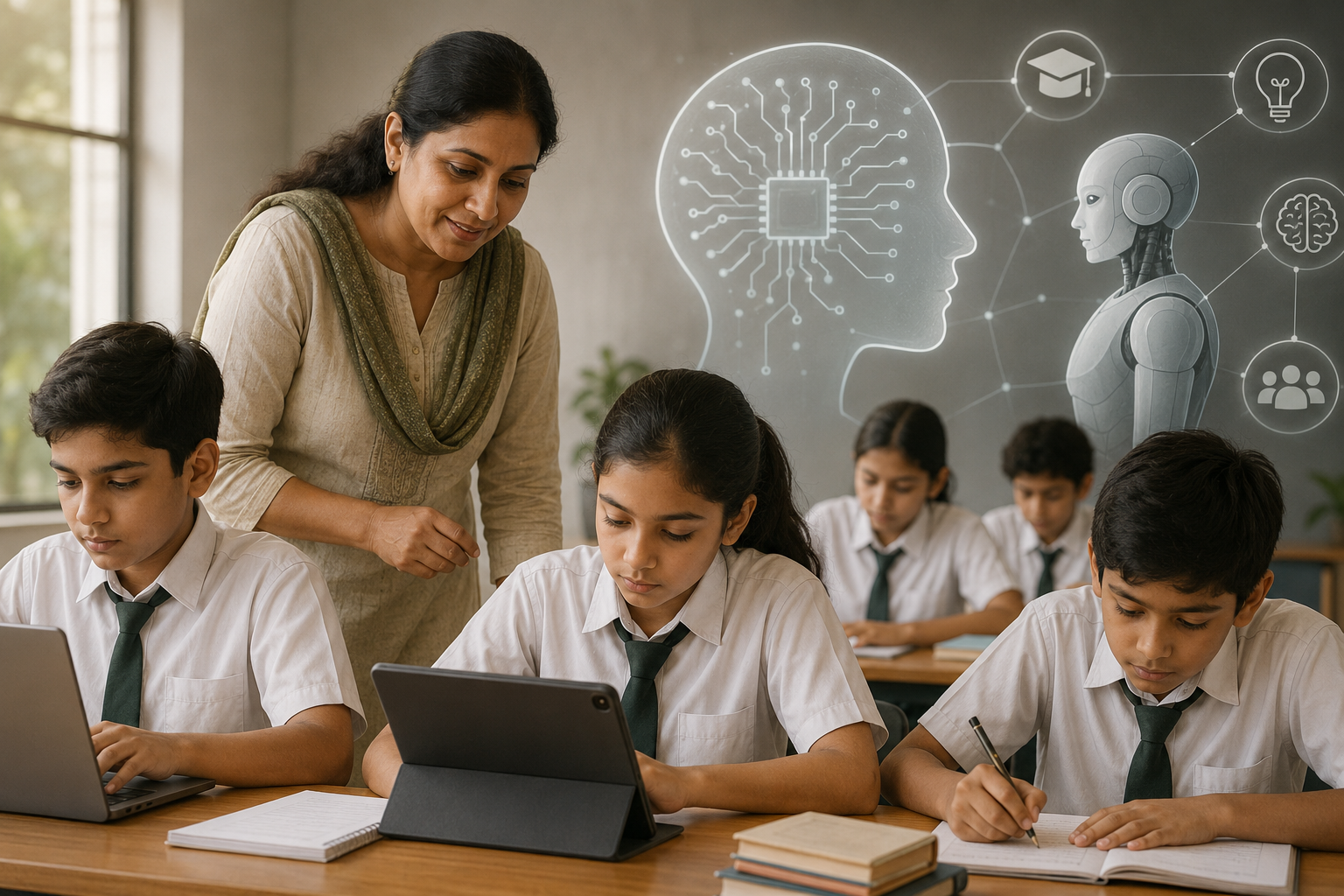
Artificial intelligence is rapidly transforming education, but beneath the promise of smarter classrooms lies a more difficult question: who should shape the future of education—the teacher and the public education system, or the technology companies providing the tools?
Across American schools, the influence of major technology companies is expanding. Microsoft, Google, Apple and OpenAI are providing teachers and pupils with training programmes, workshops, software and digital devices. Much of this is presented as an essential modernisation of education. Yet the growing corporate footprint deserves closer scrutiny, particularly when commercial platforms begin to influence not only how children learn, but potentially what they learn.
The American Federation of Teachers has partnered with Microsoft and OpenAI on an AI training initiative worth more than 220 crore. Its stated purpose is to equip teachers with the skills required to use AI effectively. That is a legitimate and necessary objective. But critics fear that such partnerships could gradually give corporations an undue influence over public education and, in the process, diminish the professional autonomy of teachers.
The concern is not confined to AI. Technology companies have long supplied schools with laptops, tablets, operating systems and educational platforms, while promoting coding, computer science and other areas aligned with the digital economy. Microsoft’s Minecraft, for instance, has been used as an educational tool for teaching computer science. The issue, therefore, is not whether technology belongs in the classroom—it plainly does—but whether the classroom should become increasingly dependent on the companies that sell the technology. That distinction matters.
A decade ago, the argument for teaching coding was largely driven by the demand for software engineers. Today, AI can write code, generate content and perform a growing range of technical tasks. The emphasis has consequently shifted towards AI literacy. That may be sensible, but it also raises a deeper educational question: are schools preparing children to use technology critically, or simply preparing them to use particular technologies?
There are growing concerns that AI chatbots could automate tasks traditionally performed by teachers, including providing feedback and assessing students’ work. Such tools can undoubtedly save time, but education is not merely an exercise in processing information. A good teacher recognises confusion, encourages curiosity, challenges assumptions and understands the individual child. Those qualities cannot simply be reduced to an algorithm.
The debate has direct relevance for India. During election campaigns, political parties and state governments frequently promise laptops, tablets and other digital devices to students. Providing access to technology is neither undesirable nor avoidable. But India must ensure that technology remains a means of education, rather than becoming an influence over its direction.
If technology companies provide devices, software or AI platforms to schools, governments must ask what interests accompany that support. Could commercial priorities eventually influence curricula, procurement decisions or teaching methods? Could students become dependent on a particular company’s ecosystem before they are mature enough to understand its limitations?
There is an equally important concern: human intellectual independence. AI can provide remarkably fast answers, but speed is not the same as accuracy. Every AI system is built on human-generated data, models and assumptions and can therefore reproduce errors or biases. If students begin accepting machine-generated answers without questioning them, independent thought, creativity, judgement and problem-solving could suffer.
India should not respond by keeping AI out of classrooms. That would be neither realistic nor wise. Instead, students should be taught how to use AI and, equally importantly, how to challenge it. They should learn to verify information, recognise uncertainty and make their own judgements.
The lesson is simple but consequential: AI should become a powerful tool in a child’s hands, not a substitute for the child’s mind. India needs an education policy in which technology and teachers, artificial intelligence and human judgement, digital skills and independent thinking reinforce rather than displace one another.
The real test of an AI-enabled education system will not be how quickly a student can obtain an answer. It will be whether the student still knows how—and has the confidence—to ask whether the answer is right.
Author

Related Stories



Most Read
- 1Argentina’s ‘Vanishing Sea’: Rare Low Tide
- 2Effect of the 12 August 2026 Solar Eclipse on the 12 Zodiac Signs, Know Who Will Benefit and Who Will Have to Be Careful
- 3HC finds peon’s dismissal over tea and biscuits amounted to ‘injustice’
- 4Brace for 29 June: a Capricorn Full Moon, Mercury retrograde and Jupiter’s leap into Leo
- 5Japan Coach’s Whiteboard Tactics Go Viral at FIFA World Cup