“In an age of constant movement, nothing is so urgent as sitting still.” ~Pico Iyer, from his TED Talk “The Art of Stillness”
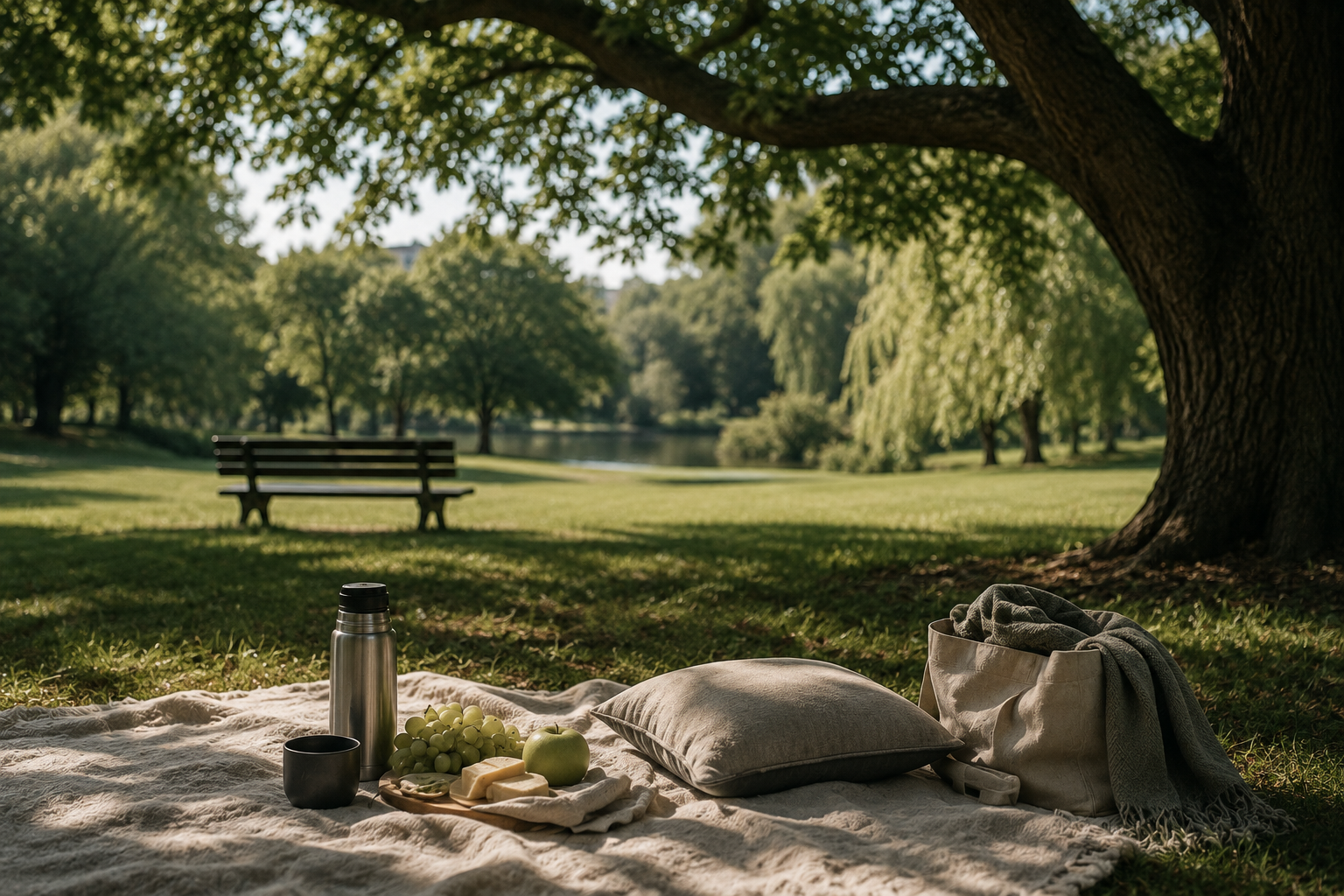
It was a Tuesday in late September, the kind of afternoon that feels borrowed from summer. I had a work deadline at 5:00. I went to the park anyway. I spread a blanket on the grass, unpacked a little cheese and some fruit, and poured tea from the thermos I’d filled mostly out of habit. I had a book in my bag that I never opened.
For two hours, I sat outside in the middle of an ordinary weekday, watched the light shift through the oaks, ate slowly, and thought about nothing that needed to be thought about. I also spent a significant portion of those two hours feeling like I shouldn’t be there. Not because anyone needed me. Not because a crisis was unfolding at home.
But because somewhere deep in the architecture of how I understand time and worth, an afternoon spent outside doing nothing productive felt uncomfortably close to failure.
Like a truancy. Like something I would eventually have to account for.
I stayed anyway. And what happened in that park—and what has happened each time I’ve gone back since—quietly changed something in me. At some point—gradually, collectively, so incrementally most of us didn’t notice—rest stopped being a natural part of life and became something you earned.
You rest after you finish. You relax when the work is done. The afternoon that belongs entirely to you comes after the afternoon of tasks, and only then, and only if you’ve completed enough to feel justified.
This story is so pervasive that most of us have stopped noticing it’s a story at all. It feels like common sense. It feels like responsibility. It feels, in the particular way that deeply absorbed beliefs always feel, simply like the way things are.
But the costs of living inside this story are significant and cumulative.
When rest must be earned, it is always deferred. The list is never empty. There is always one more thing that could reasonably be completed before you allow yourself to stop.
What comes instead is a kind of grinding exhaustion we’ve learned to normalize. A chronic depletion we manage with coffee and the quiet promise that things will slow down soon—after this project, after this season, after this particular stretch of demands.
The slowing down tends not to come on its own. It has to be chosen.
Neuroscience has a name for a network of brain regions that becomes especially active during periods of wakeful rest: the default mode network.
This neural system is associated with self-reflection, creative integration, and the processing of experience. It is, in a sense, a system through which we make sense of our own lives, and the empty space of doing nothing supports its particular, essential work.
We are not built for perpetual productivity. We are built for rhythm—effort and rest, engagement and withdrawal, doing and being. When we remove one half of that rhythm, we don’t simply become tired.
We become, over time, somewhat lost.
Disconnected from the thread of our own experience. Unable to hear the quieter signals of what we actually need and value and want.
Doing nothing—real, unscheduled, purposeless nothing—is how we find that thread again.
That September afternoon, I didn’t meditate. I didn’t journal. I didn’t set an intention or practice anything in particular. I just sat outside with food I didn’t rush through and nowhere I had to be for two hours. The first thirty minutes were uncomfortable.
(Views expressed are personal)
Author

Related Stories




Most Read
- 1Argentina’s ‘Vanishing Sea’: Rare Low Tide
- 2Effect of the 12 August 2026 Solar Eclipse on the 12 Zodiac Signs, Know Who Will Benefit and Who Will Have to Be Careful
- 3HC finds peon’s dismissal over tea and biscuits amounted to ‘injustice’
- 4Brace for 29 June: a Capricorn Full Moon, Mercury retrograde and Jupiter’s leap into Leo
- 5Japan Coach’s Whiteboard Tactics Go Viral at FIFA World Cup