Jamshedpur crash raises questions about speed control, roadside warnings and whether the Supreme Court’s road-safety principles are reaching high-speed urban corridors.
The truck was stationary. The car was moving. Four young lives were lost in seconds. Yet the questions raised by the Jamshedpur crash go beyond the circumstances of the collision. They concern what should have happened in the hours before it and whether the systems designed to prevent an avoidable roadside hazard from becoming a fatal one were working at all.
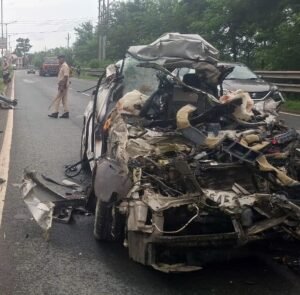
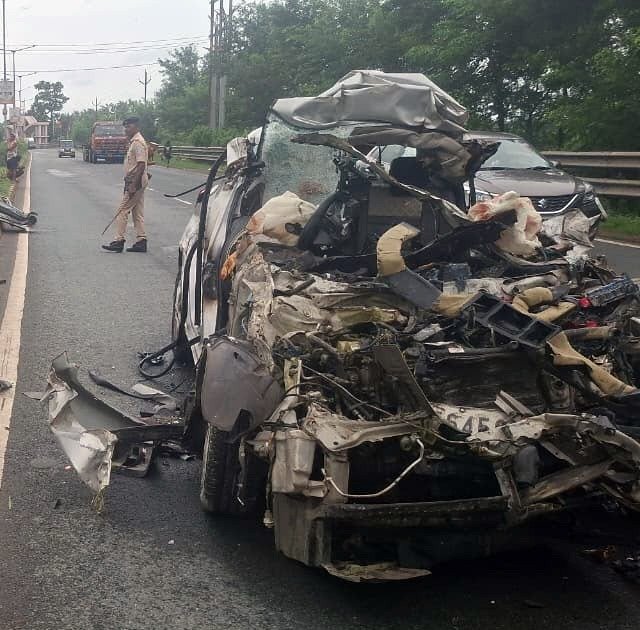
Four Class XII students, including Trisha Singh, daughter of Jharkhand Rural Development and Panchayati Raj Minister Deepika Pandey Singh, were killed in the early hours of 24 September when their car collided with a stationary commercial truck on Marine Drive near Domuhani. The impact was catastrophic. The students Trisha Singh, Sarthak Agrawal, Naman Gupta and Vanshika Khandelwal died in the crash. The police investigation will establish the precise circumstances, including the speed and position of the vehicles and the circumstances in which the truck had been left on the road.
Reports said the truck had broken down several hours earlier and was awaiting repairs. That detail matters, not because a breakdown can always be prevented, but because a broken-down vehicle need not automatically become an invisible obstacle for approaching traffic.
There is no basis at this stage to assign direct responsibility for the deaths to any particular official or agency. But there is a legitimate public-interest question about whether a high-speed urban corridor had adequate safeguards to detect, mark and protect a stationary heavy vehicle in darkness.
That question acquires greater significance in the light of the Supreme Court’s 13 April 2026 order in In Re: Phalodi Accident. The directions were framed for National Highways and the authorities responsible for them. They prohibit heavy or commercial vehicles from parking or stopping on a National Highway carriageway or paved shoulder except at designated bays, lay-bys or Wayside Amenities. They also require regular inspection and patrolling, dedicated surveillance teams and stronger enforcement mechanisms.
The Court went beyond parking. It directed NHAI to operationalise an Advanced Traffic Management System on four- and six-lane highways and expressways, including cameras, speed detectors, variable-message signboards and emergency call boxes. It also prescribed measures for accident blackspots, including lighting, speed-enforcement cameras, retro-reflective warning signs and appropriate road markings.
Marine Drive does not become a National Highway merely because it carries fast-moving traffic. The Supreme Court’s directions therefore cannot simply be transplanted to the road as though the same statutory framework applied. But the underlying principle is relevant: where traffic moves quickly, hazards must be detected and communicated quickly too.
That is where the Jamshedpur accident raises difficult questions. What is the prescribed speed limit on this stretch? Is it displayed prominently enough for a driver approaching at night to see it in time? Is speed enforcement continuous rather than occasional? Are cameras functional? Is there adequate illumination? How quickly is a reported breakdown attended to? And when a heavy vehicle is forced to remain on or beside a busy road, what warning system is required to alert approaching motorists?
A high-speed road cannot depend on a driver discovering an obstruction only when it is within the stopping distance of the vehicle. Warning signs, reflective devices, hazard lights, lighting and other approved safeguards exist precisely to create that margin of time.
The issue is therefore not simply whether the driver was travelling too fast or whether the truck was improperly positioned. Those are matters for investigation. The larger issue is whether the road-safety chain — detection, warning, patrolling, enforcement and emergency response — functioned as it should.
Jharkhand Transport Secretary Rajeev Ranjan has said the department has instructed district administrations to identify accident blackspots and intensify patrolling. District-level road-safety committees headed by deputy commissioners and involving police officials have also been apprised of the Supreme Court’s directions, he said. The department has further ordered action against illegal roadside establishments and parking facilities on national highways, state highways and other roads.
Those measures are important. But road safety is ultimately tested not by the existence of orders, committees or circulars, but by what a motorist encounters on the road at 3 am.
The Jamshedpur tragedy should therefore prompt a safety audit of Marine Drive and other high-speed urban corridors. The audit need not begin with blame. It should begin with evidence: the applicable speed limit, the location and visibility of signs, the functioning of cameras and lighting, the timing of the truck’s breakdown, the response to the breakdown, the nature of the warning placed around the vehicle and the pattern of night-time patrols.
There is also a case for extending the spirit of the Supreme Court’s road-safety framework beyond National Highways wherever cities have created roads that function as high-speed corridors. The legal jurisdiction may differ; the value of human life does not.
A truck can break down anywhere. A driver can make a mistake. Neither risk can be eliminated completely. What a functioning road-safety system can do is ensure that one hazard does not silently wait in the darkness for another human error to turn it into a catastrophe. The Supreme Court has treated road safety as a continuing obligation, backed by surveillance, enforcement and accountability.
For Jamshedpur, the question now is whether that principle exists only in orders and files, or whether it is visible on the road.
The truck was stationary. The system cannot afford to be.
What the Supreme Court Mazor ordered
- No parking on highways: Heavy/commercial vehicles cannot park on carriageways or paved shoulders except at designated bays, lay-bys or Wayside Amenities.
- Regular patrolling: Dedicated police/transport teams and NHAI patrol vehicles must monitor highways at intervals of up to 50 km.
- Real-time monitoring: ATMS with cameras, speed detectors, message boards and emergency call boxes must be operational on four/six-lane highways and expressways.
Author

Related Stories


Most Read
- 1Argentina’s ‘Vanishing Sea’: Rare Low Tide
- 2Effect of the 12 August 2026 Solar Eclipse on the 12 Zodiac Signs, Know Who Will Benefit and Who Will Have to Be Careful
- 3HC finds peon’s dismissal over tea and biscuits amounted to ‘injustice’
- 4Brace for 29 June: a Capricorn Full Moon, Mercury retrograde and Jupiter’s leap into Leo
- 5Japan Coach’s Whiteboard Tactics Go Viral at FIFA World Cup