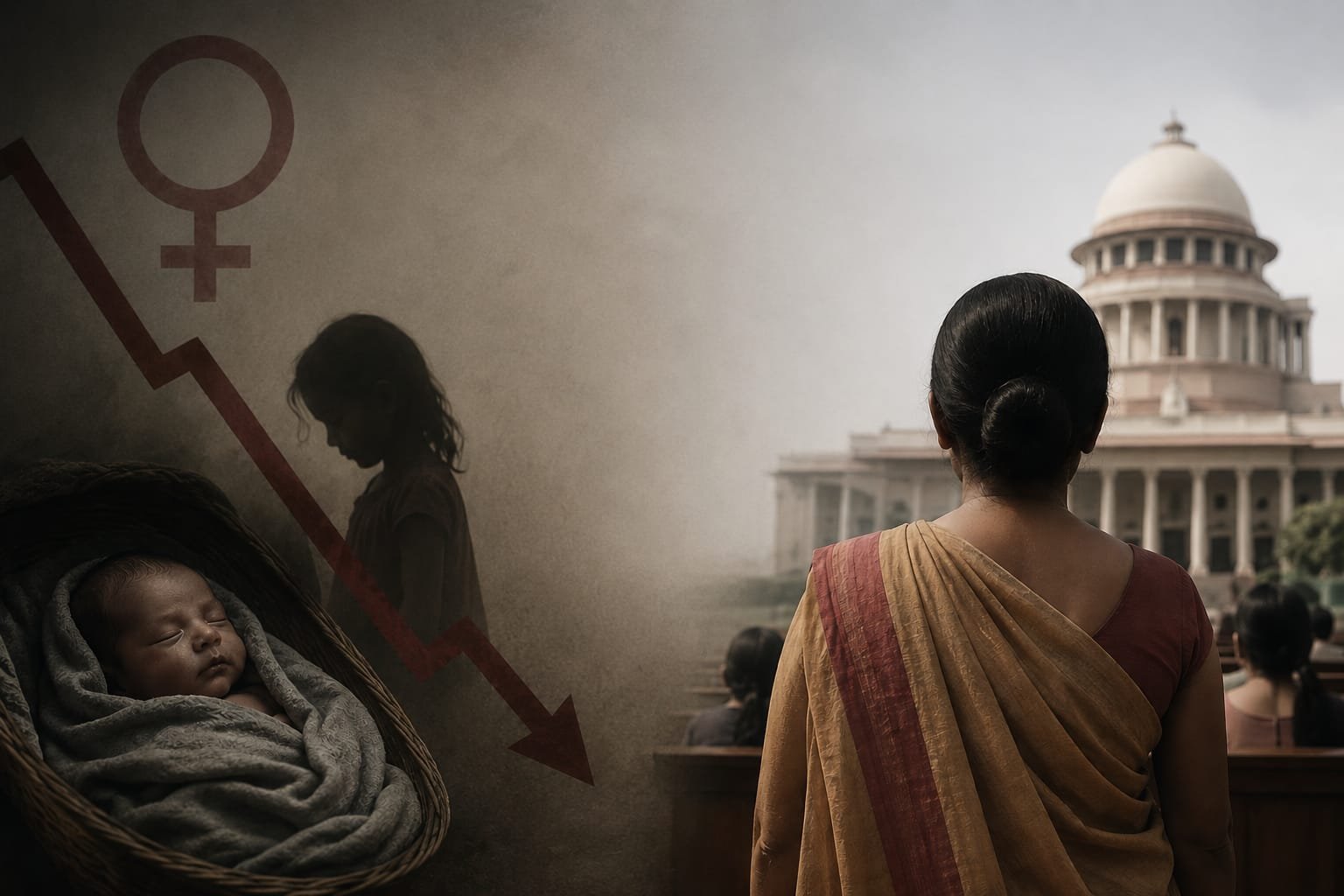
Despite being represented by prominent women political leaders at both the state and national levels, including Annapurna Devi, Union Minister for Women and Child Development, and Neera Yadav, MLA, Koderma continues to record the lowest Sex Ratio at Birth (SRB) in Jharkhand.
According to Health Management Information System (HMIS) data, Koderma reported an SRB of just 832 female births per 1,000 male births in 2025-26, the lowest among all districts in the state. The SRB of Jharkhand stands at 937 per 1,000 males in 2025-26.
Deep-Rooted Patriarchal Mindset and Proximity Driving Low Birth Ratios
Although the Koderma district showed a marginal improvement from 798 in 2024-25, it has consistently remained among the state’s poorest-performing districts, recording 826 in 2022-23 and 820 in 2023-24. Its latest figure is more than 100 points below the state average of 937.
Experts believe that Koderma’s proximity to neighbouring Bihar may be one of the factors influencing its declining sex ratio. Historically, parts of the region have been affected by deep-rooted patriarchal norms, including a preference for male children and the social burden associated with dowry. Such socio-cultural attitudes, particularly among economically weaker sections, have often contributed to discrimination against girl children.
Yadav said, “There is still a strong preference for a male child in society, and this mindset continues to affect the sex ratio. Awareness is needed to change these attitudes and promote gender equality.” Analysts emphasise that the decline in the sex ratio is a complex issue driven by multiple factors, including social practices, economic conditions, access to healthcare, and gender biases.
“The district’s low sex ratio is linked to a continued preference for sons in some communities. Improving awareness about the value of the girl child remains essential,” said Mahesh Kumar, District Programme Officer, Koderma.
PC-PNDT Act Crackdown: 30 Ultrasound Clinics Suspended as Six Districts Fall in ‘Red Category’
Though the Pre-Conception and Pre-Natal Diagnostic Techniques Act (PC & PNDT Act) was enforced in the state in 1996 to stop female foeticide, violations continue to be reported in some areas. The Act prohibits sex determination and sex-selective practices. Experts stressed that the lowest sex ratio could possibly be linked to the violations.
A total of 30 ultrasound clinics have been suspended, one centre has been sealed, and one case has been taken to court as part of the enforcement crackdown by the health department. The state has 1,161 registered ultrasound clinics, of which 718 have been inspected.
Moreover, the state SRB improved from 934 females per 1,000 male births in 2022-23 to 937 in 2025-26, but six districts, including Koderma, Chatra, Deoghar, Giridih, Hazaribagh, and Palamu, remain in the red category due to consistently low birth ratios.
Hazaribagh is another district with a persistently low ratio. The district recorded an SRB of 873 in 2025-26 after reporting 874 in 2022-23, 865 in 2023-24, and 895 in 2024-25.
In Deoghar, the sex ratio at birth declined from 901 in 2023-24 to 864 in 2025-26. The district recorded 875 in 2022-23 and 878 in 2024-25, which is an overall stagnant trend.
Chatra, which recorded one of the lowest SRBs at 842 in 2024-25, showed a slight improvement to 880 in 2025-26. However, the district remains below the state average.
Similarly, Giridih recorded an SRB of 898 in 2025-26, almost unchanged from 898 in 2022-23, with limited progress over the four-year period. Palamu also remained in the low-performing category, recording an SRB of 896 in 2025-26 after registering 887 in 2024-25.
On the other hand, several other districts in the state have recorded higher and more balanced sex ratios at birth. West Singhbhum recorded the highest SRB in the state at 1,026 females per 1,000 male births in 2025-26. It is followed by Lohardaga with 1,004, Khunti with 989, and Ranchi and Saraikela-Kharsawan with 977 each.
Positive Growth in West Singhbhum and Ranchi: How Jharkhand Plans to Fix Yellow Category Districts
The data also highlights encouraging trends in some districts. Khunti’s SRB improved from 979 in 2022-23 to 989 in 2025-26, while Ranchi’s figure rose from 943 to 977 during the same period. West Singhbhum maintained an SRB above 1,000 in recent years.
Apart from the six red-category districts, Bokaro, Dhanbad, East Singhbhum, Garhwa, Ramgarh, and Ranchi are in the yellow category due to lower SRB levels or complaints related to possible gender-biased practices.
Ajoy Kumar Singh, Additional Chief Secretary of the Health Department, said, “The exact reasons behind the low sex ratio in some districts are difficult to determine, and further study is needed to understand the factors contributing to the trend. These districts are under closer review as part of ongoing efforts to improve birth ratios and promote gender equity.”
Adding further, Singh said, “To address the issue, awareness drives, community programmes and district-level reviews are being conducted to promote gender equality and encourage a balanced sex ratio at birth.”
Moreover, the health department has reconstituted the State Appropriate Authority under the Pre-Conception and Pre-Natal Diagnostic Techniques (PC-PNDT) Act, 1994, to strengthen efforts to curb female foeticide and improve the state’s sex ratio.
Author

Related Stories



Most Read
- 1Argentina’s ‘Vanishing Sea’: Rare Low Tide
- 2Effect of the 12 August 2026 Solar Eclipse on the 12 Zodiac Signs, Know Who Will Benefit and Who Will Have to Be Careful
- 3HC finds peon’s dismissal over tea and biscuits amounted to ‘injustice’
- 4Brace for 29 June: a Capricorn Full Moon, Mercury retrograde and Jupiter’s leap into Leo
- 5Japan Coach’s Whiteboard Tactics Go Viral at FIFA World Cup