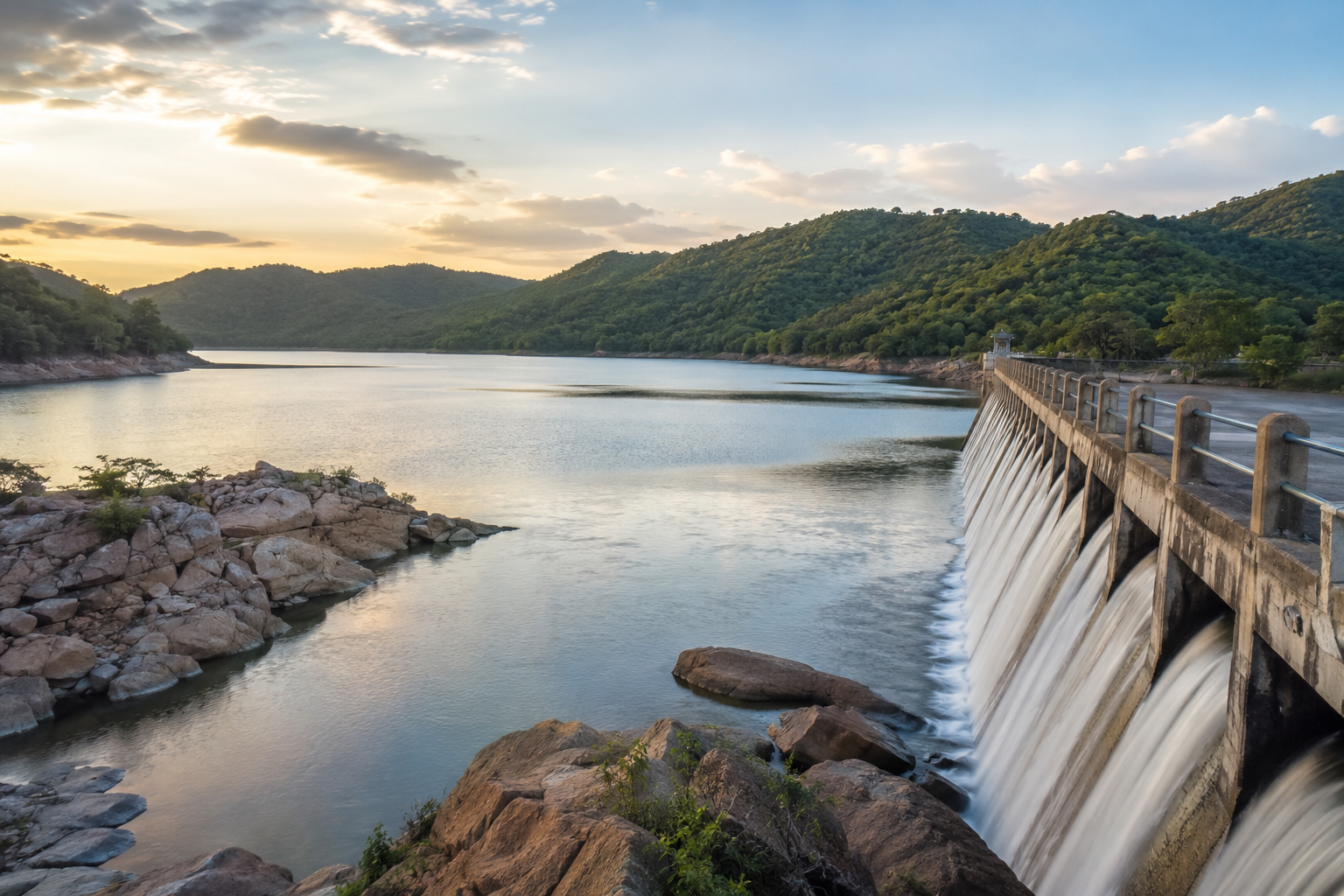
On the northern edge of Ranchi, where the city begins to give way to the contours of the Gonda Hills, Kanke Dam offers something increasingly rare in a growing Indian city: the illusion of space.
The reservoir is more than a familiar landmark. For generations of Ranchi residents, it has been part of the city’s everyday geography—a place associated with water, open skies, morning walks, family outings and the changing seasons.
Completed in 1954, after its planning and construction began during the British period, the dam has evolved from an infrastructure project into an important part of Ranchi’s civic identity.
Spread across roughly eight square kilometres, Kanke Dam was conceived primarily as a water-storage reservoir. Its importance, however, extends well beyond engineering.
It has long served as a significant source of drinking water for Ranchi and neighbouring areas, making the reservoir an essential piece of urban infrastructure rather than merely a scenic attraction.
That distinction matters.
As Ranchi expands, its relationship with water is becoming increasingly complicated. Urbanisation brings more construction, greater demand for drinking water and growing pressure on natural drainage systems.
A reservoir such as Kanke is therefore not simply something to be admired from its banks; it is an asset that requires long-term planning, ecological protection and responsible management.
Its location gives the dam another significance. The water body sits close to the Rock Garden, while its surrounding landscape has become one of the city’s better-known recreational spaces.
Families, walkers and visitors are drawn here not only by the reservoir but by the sense of relief it offers from the density and noise of urban life.
There is also an ecological dimension. Water bodies such as Kanke Dam can provide important habitats for birds and contribute to local environmental balance. Seasonal bird activity adds another layer to a landscape that is often viewed only through the lens of tourism.
But Ranchi should resist the temptation to treat Kanke Dam merely as a leisure destination.
The real question is whether the city can preserve the reservoir while accommodating the demands of a rapidly changing urban environment.
Encroachment, pollution, untreated waste, excessive construction around water bodies and inadequate catchment management can gradually undermine the very resource that gives such places their value.
Kanke Dam’s story, therefore, is also Ranchi’s story.
The reservoir was built in an era when the city was smaller and its demands were more modest. Today, its significance has grown precisely because the city around it has grown.
A modern Ranchi needs water infrastructure that is resilient, recreational spaces that remain accessible and ecological assets that are protected rather than consumed.
Kanke Dam quietly embodies all three.
Its greatest value may not be the view from the shore, or even the memories accumulated across seven decades. It lies in the simple fact that the city still has a place where water, landscape and urban life meet.
The challenge now is to ensure that future generations inherit not merely the memory of Kanke Dam, but the reservoir itself—clean, functioning and alive.
Author

Related Stories



Most Read
- 1Argentina’s ‘Vanishing Sea’: Rare Low Tide
- 2Effect of the 12 August 2026 Solar Eclipse on the 12 Zodiac Signs, Know Who Will Benefit and Who Will Have to Be Careful
- 3HC finds peon’s dismissal over tea and biscuits amounted to ‘injustice’
- 4Brace for 29 June: a Capricorn Full Moon, Mercury retrograde and Jupiter’s leap into Leo
- 5Japan Coach’s Whiteboard Tactics Go Viral at FIFA World Cup