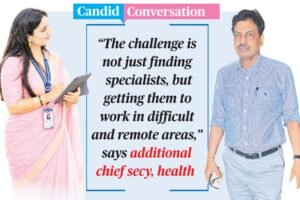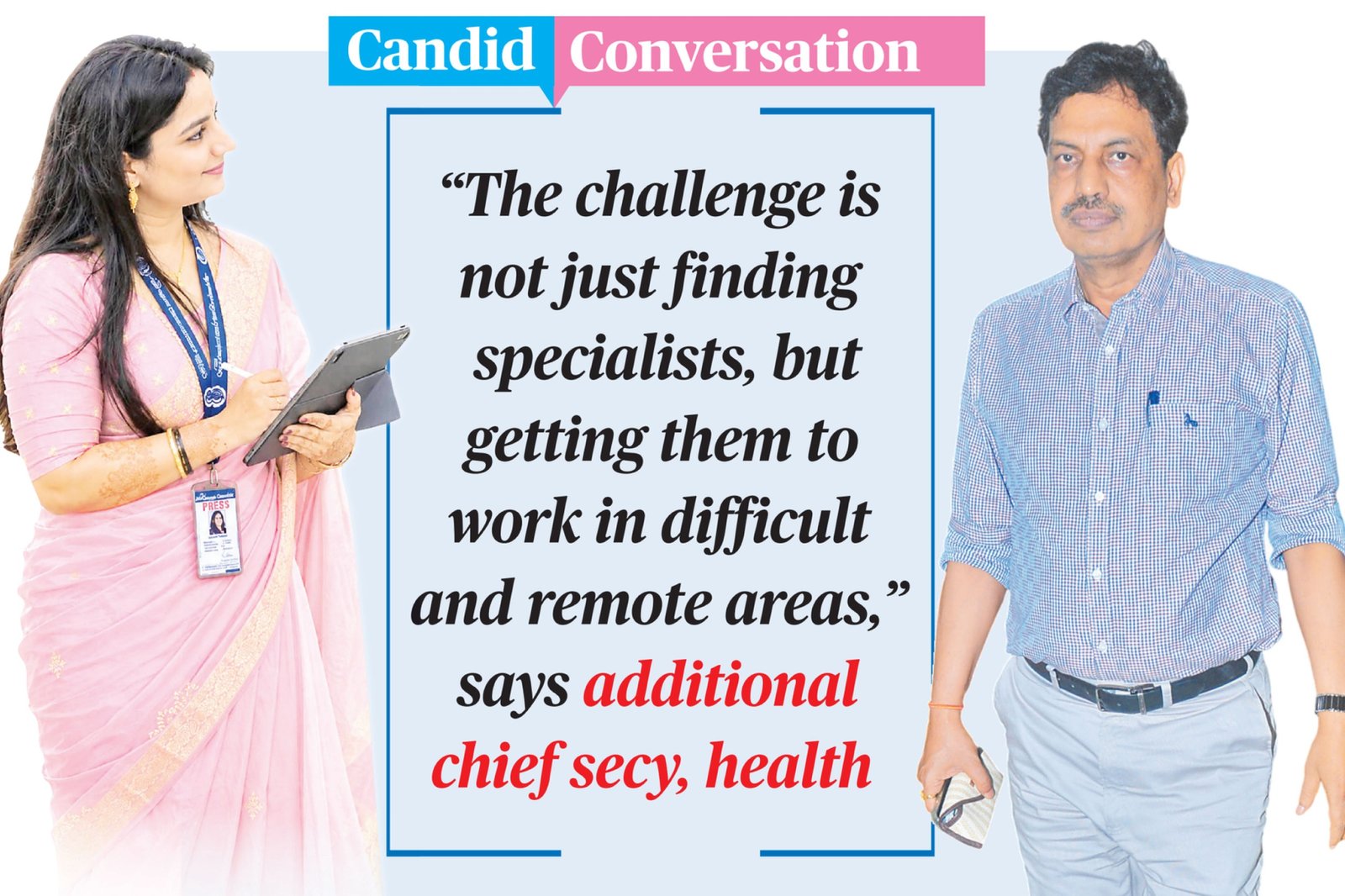
Jharkhand is seeking to strengthen its public healthcare system by addressing shortages of specialist doctors, improving district-level services, expanding medical education and exploring the use of artificial intelligence and data in patient care. Ajoy Kumar Singh, Additional Chief Secretary, Health Department, speaks to TGC Senior Correspondent Kritika Tiwari about the gaps in the system, the government’s recruitment plans and its longer-term vision for healthcare delivery across the state.
For a state where distance can still determine access to medical care, the challenge facing Jharkhand’s public health system is not simply one of building more facilities. It is also about ensuring that medicines reach patients, specialist doctors reach hospitals, technology is translated into usable services and people have sufficient confidence in public institutions to seek treatment close to home.
The government is attempting to address several of these issues at the same time. Additional funds are being made available to health facilities for essential medicines and other requirements, while the state is considering contractual recruitment to address an estimated shortage of about 1,000 specialist doctors.
There is also an attempt to look beyond conventional recruitment. The health department plans to reach out to doctors in cities such as Hyderabad, Bengaluru and Kochi, while using online recruitment and information campaigns to attract specialists to Jharkhand. Language and the ability to communicate effectively with patients are being identified as important considerations.
Technology forms another part of the proposed roadmap. The government is examining the use of artificial intelligence, data analytics and individual health profiles, alongside the possibility of robotic surgery. Its proposed AI Family Doctor initiative is also being considered on a pilot basis.
At the same time, the department says it wants to build a more systematic approach to non-communicable diseases, including hypertension, diabetes, cancer and heart disease, with greater emphasis on screening, data and follow-up.
What is being done to ensure the availability of medicines and vaccines at government health facilities, particularly at the rural and district levels?
The government has made provisions for additional funds to ensure that health facilities have adequate resources. District hospitals are being provided around 75 lakh, while provisions have also been made for sub-divisional hospitals and community health centres.
These funds can be utilised for medicines and other essential requirements. If there are gaps in availability at any facility, the objective is to address those shortages through the financial provisions available, so that patients do not have to face unnecessary difficulties.
If a particular medicine or vaccine is not available at a health facility, the shortage needs to be addressed at the system level. The government has provisions for providing funds to health facilities so that essential medicines can be procured locally when required.
The basic objective is to ensure that the absence of a particular medicine or essential item at one facility does not become an avoidable burden for the patient.
What do you consider the biggest challenge facing the health sector in Jharkhand at present?
One of the major challenges is the shortage of specialist doctors. However, the problem is not limited to the availability of specialists.
Another significant challenge is that many doctors, particularly specialists, are reluctant to work in difficult or remote areas. As a result, even when specialists are available, deploying them in remote districts and difficult locations becomes a challenge.
At present, Jharkhand has an estimated shortage of around 1,000 specialist doctors, and addressing this gap is one of the government’s priorities.
Since permanent recruitment is taking time, the government has decided to explore contractual recruitment of doctors to fill vacant positions.
The plan is to recruit specialists against available vacancies in government hospitals.
We are also looking at states and cities such as Hyderabad, Bengaluru and Kochi, where a larger pool of specialists may be available.
A dedicated team will be constituted to identify and approach doctors and encourage them to join Jharkhand’s government health system.
When is the recruitment process for specialist doctors expected to begin, and how will doctors from other states be attracted?
The government intends to issue the recruitment advertisement within this month. A team of around four to five people will be formed to identify doctors and reach out to them in different states.
The recruitment process will also use online mechanisms. In addition, information, education and communication activities will be undertaken to create awareness about the opportunities available in Jharkhand.
An important consideration is language. Doctors coming from outside the state should be able to communicate in Hindi, because understanding patients’ problems and communicating with them effectively is essential for proper treatment.
Ultimately, a doctor must be able to understand the patient and the patient must be able to communicate his or her problem. That is an important part of effective healthcare delivery.
What is the roadmap for advanced technologies such as AI, IT and robotic surgery in Jharkhand’s healthcare system?
The government is looking at the use of IT, data analytics and artificial intelligence in areas such as health monitoring, individual health profiles and the proposed AI Family Doctor initiative.
Robotic surgery is also being considered. Before introducing it, however, the government plans to identify the requirements, including the type of comprehensive robotic surgical equipment needed and the facilities where it can be effectively utilised.
A detailed assessment will be undertaken before implementation. It is important to first understand what is required, where it can be used effectively and how it can be integrated into the existing healthcare system.
Additionally, the long-term objective is to create a comprehensive health profile for individuals and families. The government is working towards having a database covering people and their health parameters.
This would go beyond simply having an Ayushman Bharat Health Account, or ABHA, number. An ABHA number provides a digital health identity, whereas the proposed approach is to develop a more comprehensive health profile containing relevant health information.
The intention is to use such information to understand an individual’s health needs more systematically and support better healthcare planning and delivery.
Many people, including affluent families and public representatives, still prefer to seek treatment outside Jharkhand. What is the government doing to build trust in state-run hospitals?
Improving people’s confidence in government hospitals requires strengthening both infrastructure and the quality of services.
The government is working on improving facilities at RIMS as well as district hospitals. At RIMS, various infrastructure and service-related improvements are being undertaken, and facilities such as deluxe rooms and suites are also being developed so that patients from different sections of society can receive treatment within the state.
At the district level too, gaps in infrastructure, equipment and specialised services are being identified.
The government is assessing what equipment and facilities are required at each hospital so that patients do not have to travel outside the state for treatment that can be provided locally.
The government is also considering an AI Family Doctor model on a pilot basis. The idea is that AI can assist families by analysing available health information and providing suggestions or guidance based on an individual’s health profile.
But technology alone cannot create confidence. Improving infrastructure, specialised services and the overall quality of treatment will be important in encouraging people to seek care within the state.
What is the government’s strategy for dealing with the growing burden of non-communicable diseases such as hypertension, diabetes, cancer and heart disease?
The first requirement is to have a reliable database of people suffering from, or at risk of, non-communicable diseases.
The government is therefore focusing on screening, data collection and data analytics. Dashboards and analytical systems will be used to identify people who have already been screened, understand their health status and determine the appropriate line of treatment.
The objective is to ensure that, particularly among people aged 40 and above, there is comprehensive coverage and regular monitoring.
If a person has not yet been screened, the system should identify that person and facilitate screening. This will allow the government to move from a fragmented approach to a more systematic model of NCD prevention, treatment and follow-up.
The idea is not simply to identify disease after it develops, but to create a system in which people at risk can be identified, monitored and brought into the appropriate treatment pathway.
How does the government plan to expand medical education and specialised healthcare capacity in the state?
Expanding medical education capacity is one of the major priorities. The government is working towards increasing the number of MBBS and postgraduate seats in the state.
The present capacity is expected to increase over the coming years, with a broader goal of expanding undergraduate medical education capacity.
At the hospital level, the plan is to strengthen district hospitals and medical colleges so that specialised treatment is available at different levels.
RIMS is being positioned to provide a broad range of specialised services, while other medical colleges will also be developed according to their requirements and areas of importance.
The broader objective is to strengthen the state’s healthcare capacity at multiple levels — from primary and district-level services to advanced and specialised treatment — so that patients can increasingly access appropriate care within Jharkhand.
Author

Related Stories




Most Read
- 1Argentina’s ‘Vanishing Sea’: Rare Low Tide
- 2Effect of the 12 August 2026 Solar Eclipse on the 12 Zodiac Signs, Know Who Will Benefit and Who Will Have to Be Careful
- 3HC finds peon’s dismissal over tea and biscuits amounted to ‘injustice’
- 4Brace for 29 June: a Capricorn Full Moon, Mercury retrograde and Jupiter’s leap into Leo
- 5Japan Coach’s Whiteboard Tactics Go Viral at FIFA World Cup