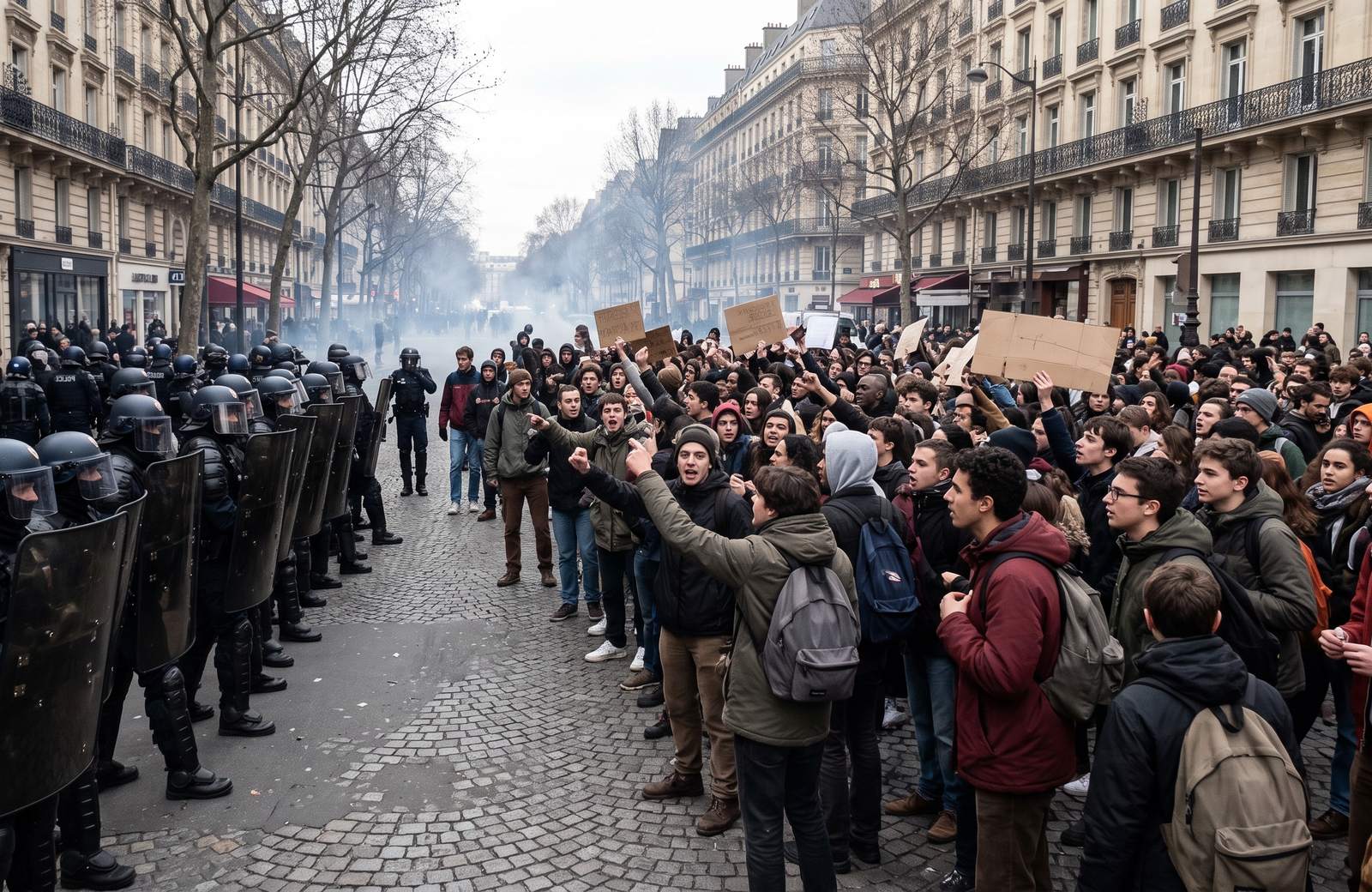
What began in France as a revolt over missing teachers, overcrowded classrooms and deteriorating school buildings has become something considerably larger: a test of the relationship between a younger generation and a state increasingly struggling to reconcile public expectations with fiscal constraint.
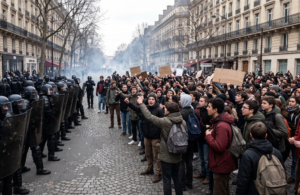
The protests, which began in the Paris region in September, have spread to hundreds of schools. On Tuesday, more than 266,000 people took part in demonstrations across France, according to interior ministry figures. Students were joined by teachers, parents and trade unions, turning what began as a school-based mobilisation into a broader expression of discontent over the condition of public services.
The grievances are strikingly mundane — and that is precisely their significance. Students have complained of teacher shortages, inadequate staffing, overcrowded classrooms, deteriorating buildings and school facilities unable to cope with rising temperatures. Reports of rats and other basic maintenance failures have added to the sense that an institution central to the French republican promise is failing to provide even the minimum conditions expected of it.
The response of the security forces has now become a second crisis. After a 15-year-old boy lost a hand during a confrontation in Lens, Interior Minister Laurent Nuñez suspended the use of stun grenades in the policing of high-school demonstrations until the circumstances are established. Eighteen internal investigations into alleged police misconduct have been opened. A separate case involving a 14-year-old seriously injured by a tear-gas grenade has further intensified scrutiny of police tactics.
More than 6,500 people have been arrested since the movement began, most of them minors, according to French authorities. The government has argued that some demonstrations have been infiltrated by violent groups and that attacks on police cannot be tolerated. That concern is legitimate. But so too is the question of whether a democratic state can distinguish between disorder and dissent without allowing the language of public order to eclipse the grievances that brought thousands of young people on to the streets.
This is where Donald Trump’s intervention has introduced a distinctly geopolitical dimension. In a Truth Social post, the US president dismissed the protests as being fundamentally about neither schools nor education, blaming what he described as uncontrolled mass migration and claiming that Islam was seeking to take over France.
There is, however, no evidence presented in the reporting on the movement that migration or Islam is the principal cause of the students’ mobilisation. Their stated demands centre overwhelmingly on education, staffing, infrastructure and resources.
Paris has pushed back. Foreign Minister Jean-Noël Barrot argued that France must tell its own story rather than allow foreign governments to define its internal political conflicts. That response goes beyond a diplomatic quarrel. It reflects a deeper struggle over who gets to interpret Europe’s social fractures — European governments themselves, or increasingly influential political voices in Washington and elsewhere.
The timing matters. France is already facing severe fiscal pressure. The proposed 2027 education budget increases funding by €1.2bn, while the wider government is simultaneously pursuing major savings. That contradiction lies at the heart of the crisis: citizens demand better public services at precisely the moment when governments have less room to spend.
Nor is France entirely alone. Student protests echoing the French mobilisation have now appeared in Belgium, where demonstrators have raised concerns over education costs and overcrowded classrooms. What is emerging may therefore be more than a French dispute: it is a warning about a generation questioning whether the institutions designed to prepare it for adulthood still work as promised.
The French government can repair buildings, recruit teachers and increase funding. It can also investigate police conduct. But neither a bigger budget nor a tougher security response will, by itself, resolve the deeper problem. The real question is one of trust.
When young people begin their protest by demanding a teacher, a functioning classroom or a safe school — and end up confronting riot police — the distance between the citizen and the state has already become the story.
France now has an opportunity to close that distance. Whether it does so through dialogue and reform, or allows the argument to be recast as another battle over migration, identity and cultural conflict, will shape not only its domestic politics but the wider European debate about what its next generation expects from democracy.
Author

Related Stories




Most Read
- 1Argentina’s ‘Vanishing Sea’: Rare Low Tide
- 2Effect of the 12 August 2026 Solar Eclipse on the 12 Zodiac Signs, Know Who Will Benefit and Who Will Have to Be Careful
- 3HC finds peon’s dismissal over tea and biscuits amounted to ‘injustice’
- 4Brace for 29 June: a Capricorn Full Moon, Mercury retrograde and Jupiter’s leap into Leo
- 5Japan Coach’s Whiteboard Tactics Go Viral at FIFA World Cup