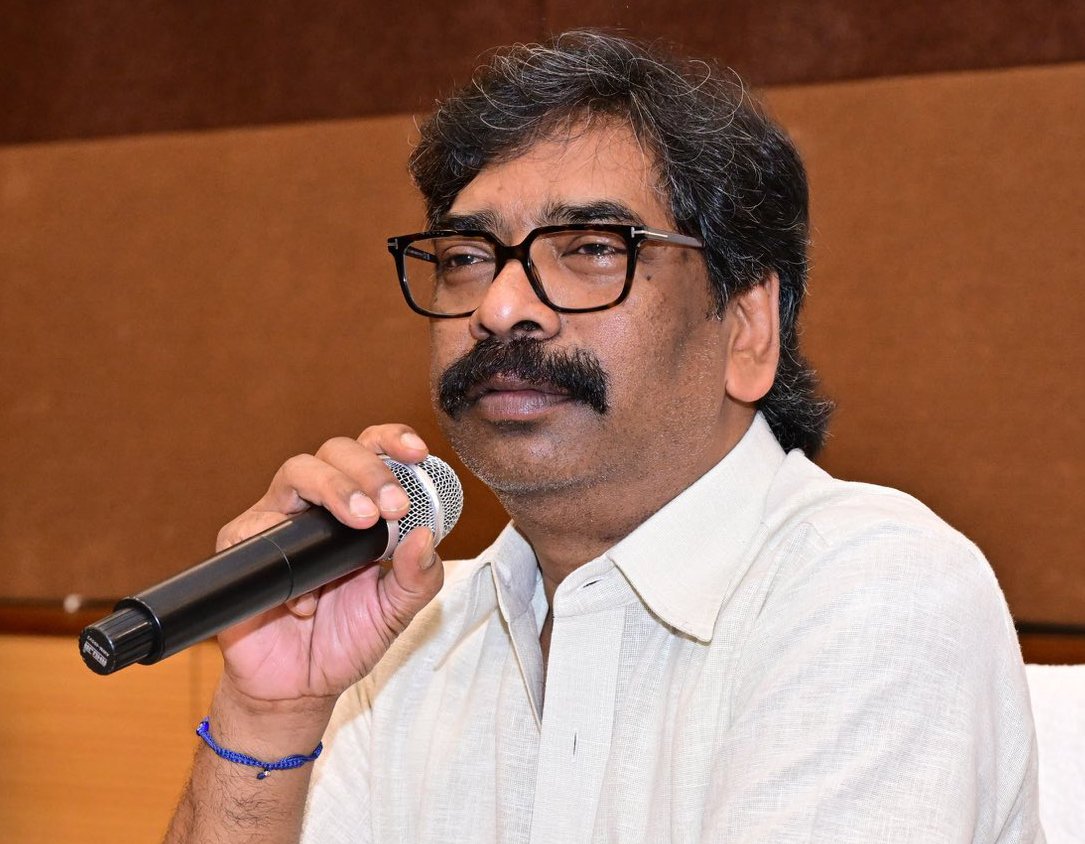
Chief Minister Hemant Soren has fired off letters to President Droupadi Murmu, Prime Minister Narendra Modi and Leader of the Opposition Rahul Gandhi in a last-ditch effort to stop the Centre from gutting the state’s power to tax mineral-bearing land, a fight he says could cost Jharkhand thousands of crores in annual revenue and derail welfare schemes for over 50 lakh women.
At the heart of the row is the Mines and Minerals (Development and Regulation) Amendment Bill, 2026, which has already cleared both Houses of Parliament despite Jharkhand’s objections. The Bill’s proposed Section 9D would bar states from levying any tax, cess or other charge on mineral rights or mineral-bearing land except under conditions dictated by the Centre, and could retrospectively wipe out unrecovered dues already owed to states.
Soren calls this an assault on federalism itself. In his letter to Modi, he draws a sharp constitutional line between Entry 49 (taxes on land, a state subject) and Entry 50 (mineral rights, where Parliament can restrict states) — arguing the Centre has no business extending its reach into Entry 49 territory. He leans heavily on the Supreme Court’s nine-judge Constitution Bench ruling in Mineral Area Development Authority vs. Steel Authority of India Ltd. (July 2024), which affirmed states’ right to tax mineral-bearing land and use mineral value or yield as the basis for that tax.
Earlier in a post on X, Soren termed the legislation a “black bill” and a grave injustice to Jharkhand. The CM said the state would not accept what he described as “stepmotherly treatment” from the Centre and would launch a “massive agitation” that the entire nation will watch.
“The Centre passed it in haste, tying Jharkhand’s hands and feet. Jharkhand will launch such a massive agitation to oppose it that the entire nation would see”, Soren said.
He warned that “Jharkhand will not tolerate step-motherly treatment and there will be fierce opposition to this in every district, every block, every panchayat, every town if the Centre fails to withdraw it.”
Soren said the impact of the legislation will be such that Jharkhand will have to stop all its welfare schemes providing social security to millions.
The money at stake is staggering. Mining already accounts for roughly 84.9 percent of Jharkhand’s own non-tax revenue. The state’s Mineral Bearing Land Cess, enacted in 2024 on the strength of that Supreme Court verdict, pulled in Rs 1,379 crore in 2024-25, surged to Rs 7,488 crore in 2025-26 and is projected to hit Rs 13,215 crore in 2026-27.
Soren warns that choking off this revenue stream threatens the flagship Mukhyamantri Maiya Samman Yojana, which puts cash directly into the hands of more than 50 lakh women, along with health, education and rural infrastructure spending.
Soren isn’t just crying poverty, he’s framing this as historical injustice. Jharkhand, he argues, has powered India’s industrial rise for decades while its tribal communities absorbed the fallout: displacement, land loss, pollution and the destruction of traditional livelihoods.
Public sector mining giants have profited handsomely from the state’s resources, he says, and it’s only “natural and just” that some of that value flows back to the people who paid the price. The retrospective clause has drawn particular fire. Soren contrasts it with the Supreme Court’s own graduated relief formula, 12 annual instalments from April 2026 with interest and penalties waived, and warns the Bill’s blanket invalidation of unrecovered dues will trigger fresh legal chaos.
Crucially, Soren says Jharkhand isn’t alone, Odisha and Karnataka are watching too, and has floated a GST Council-style consultation mechanism for mineral-producing states before any restrictions are imposed.
His parting shot to Modi is unambiguous: reconsider the Bill entirely or face Jharkhand in the Supreme Court.
Author

Related Stories



Most Read
- 1Argentina’s ‘Vanishing Sea’: Rare Low Tide
- 2Effect of the 12 August 2026 Solar Eclipse on the 12 Zodiac Signs, Know Who Will Benefit and Who Will Have to Be Careful
- 3HC finds peon’s dismissal over tea and biscuits amounted to ‘injustice’
- 4Brace for 29 June: a Capricorn Full Moon, Mercury retrograde and Jupiter’s leap into Leo
- 5Japan Coach’s Whiteboard Tactics Go Viral at FIFA World Cup