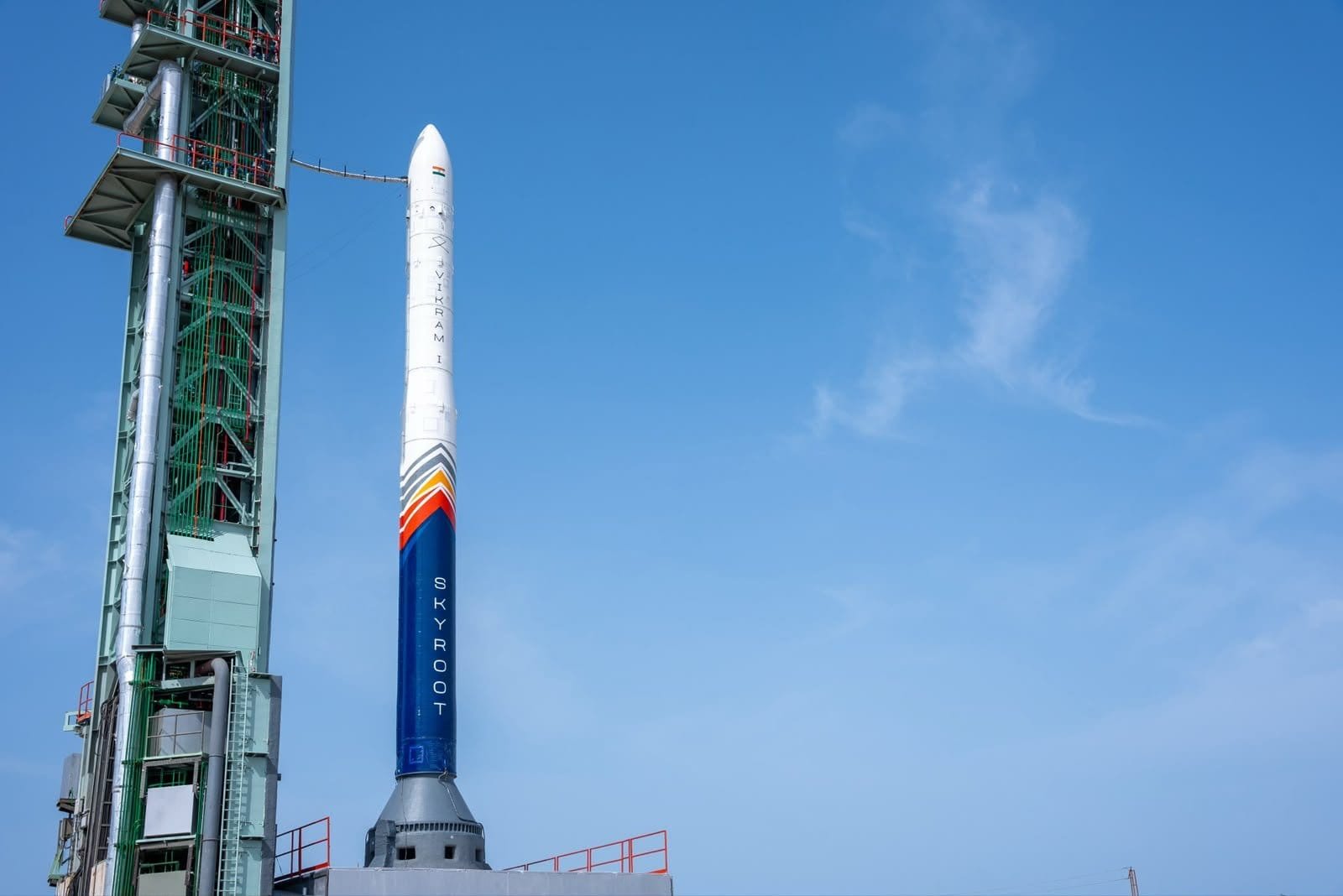
India’s first private orbital-class rocket, Vikram-1, carrying multiple technology demonstration payloads and a postcard from Prime Minister Narendra Modi, lifted off from this spaceport on Saturday.
Mission Aagaman: A historic milestone for India’s private space sector
Named “Mission Aagaman” (arrival), the test flight’s launch marks a historic milestone for the country’s commercial space sector and was executed by Hyderabad-based Skyroot Aerospace.
On a cloudy day, the seven-storey-tall, four-stage Vikram-1 rocket lifted off at 12:05 pm on Saturday from the First Launch Pad at the Satish Dhawan Space Centre here. Following a “planned hold” due to apparent navigation issues, the launch took place 35 minutes later than the originally scheduled time of 11:30 am.
After its initial journey of a little less than 16 minutes, Vikram-1 is expected to place the payloads, both domestic and foreign, into a Low Earth Orbit (LEO) at an altitude of 450 km with an inclination of 60 degrees.
Powered by 3D-printed engines: The advanced tech behind Vikram-1
Vikram-1 is built with an all-carbon composite structure and powered by in-house-developed propulsion systems, including 3D-printed engines and high-thrust solid-fuel rocket boosters.
The rocket is carrying payloads from Grahaa Space, Cosmoserve, DCubed, and Skyroot’s own SCOPE, along with an artwork titled “Cosmic Bloom.”
Author

Related Stories




Most Read
- 1Argentina’s ‘Vanishing Sea’: Rare Low Tide
- 2Effect of the 12 August 2026 Solar Eclipse on the 12 Zodiac Signs, Know Who Will Benefit and Who Will Have to Be Careful
- 3HC finds peon’s dismissal over tea and biscuits amounted to ‘injustice’
- 4Brace for 29 June: a Capricorn Full Moon, Mercury retrograde and Jupiter’s leap into Leo
- 5Japan Coach’s Whiteboard Tactics Go Viral at FIFA World Cup