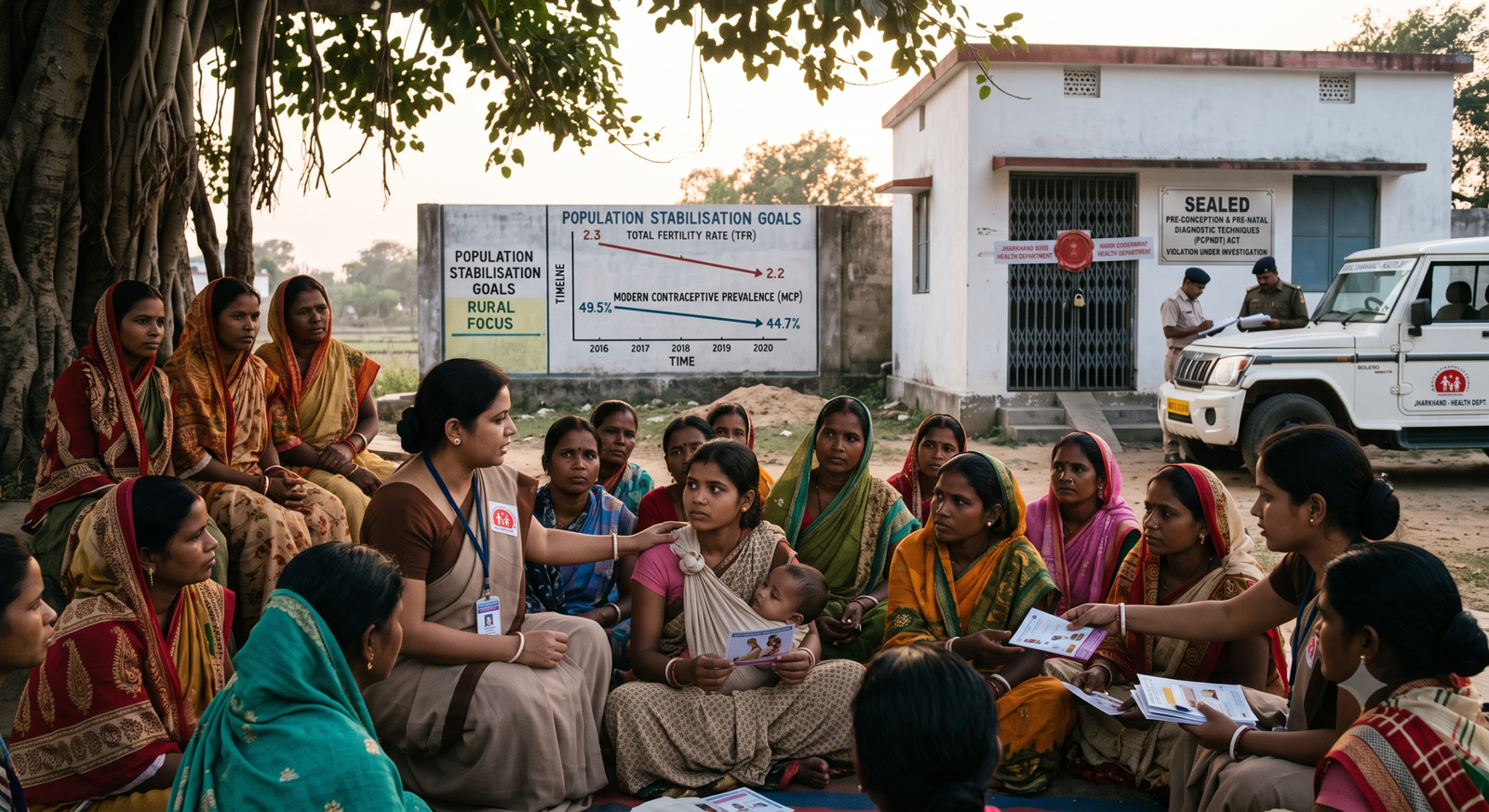
Jharkhand has registered a decline in its Total Fertility Rate (TFR), which is a positive indicator for population stabilisation. The state’s TFR has come down from 2.3 to 2.2, indicating that the average number of children born per woman has reduced compared to last year.
Urban-Rural Divide Plagues Fertility Decline as Modern Contraceptive Prevalence Drops
Gunjan Khalkho, coordinator, Family Planning, at National Health Mission, said, “The declining fertility rate is a positive trend and reflects progress in reproductive and maternal health. However, the decline could have been greater if the situation in rural areas had been better. Urban areas have already reached the replacement level of fertility, while rural regions continue to lag.”
Despite the improvement in TFR, the state has witnessed a decline in the use of modern contraceptive methods. The modern contraceptive prevalence rate is falling from 49.5% to 44.7%.
The MCP rate tracks the proportion of women aged 15 to 49 who utilize, or have a partner who utilizes, scientifically proven medical methods to avoid pregnancy. Additionally, the state has registered a decline in the unmet need for family planning from 12.6% to 11.5%.
Unmet needs refer to women of reproductive age who want to delay or stop having children but are not currently using any contraception.
According to experts, the trend suggests that traditional practices may be increasing instead of the adoption of modern contraceptive methods. Adding further, Khalkho said, “While the decline in fertility rate is encouraging, improving the uptake of modern contraceptive methods, particularly in rural areas, will be essential to sustain gains in population stabilisation.”
Strict PCPNDT Act Implementation: Health Department Seals Clinics to Check Sex Ratio
Meanwhile, the health department has intensified surveillance and enforcement measures to improve the sex ratio at birth (SRB) and curb gender-biased sex selection through implementation of the Pre-Conception and Pre-Natal Diagnostic Techniques (PCPNDT) Act, 1994.
The department has stepped up inspections of ultrasound clinics, increased decoy operations, and strengthened monitoring across districts.
According to health officials, more than 40 ultrasound clinics have been inspected across the state over the past one and a half months. During the same period, over half a dozen clinics have been sealed for alleged violations of the PCPNDT Act, with action continuing against erring establishments.
The department has also directed district authorities to conduct regular inspections and increase decoy operations to identify illegal sex determination practices. Decoy operations involve deploying undercover teams to catch offenders involved in prenatal sex determination and other violations of the Act.
Health officials said districts have been instructed to ensure compliance with regulations governing ultrasound centres, including verifying that a doctor does not practice at more than two registered ultrasound clinics, as prescribed under the rules. Data regarding doctors allegedly violating these provisions is being collected, following which appropriate action will be initiated.
The Informer Scheme under the PCPNDT Act has also been strengthened. Under the scheme, a reward of Rs 1 lakh is provided jointly to the informer, decoy pregnant woman, and assisting personnel upon successful detection.
Author

Related Stories




Most Read
- 1Argentina’s ‘Vanishing Sea’: Rare Low Tide
- 2Effect of the 12 August 2026 Solar Eclipse on the 12 Zodiac Signs, Know Who Will Benefit and Who Will Have to Be Careful
- 3HC finds peon’s dismissal over tea and biscuits amounted to ‘injustice’
- 4Brace for 29 June: a Capricorn Full Moon, Mercury retrograde and Jupiter’s leap into Leo
- 5Japan Coach’s Whiteboard Tactics Go Viral at FIFA World Cup