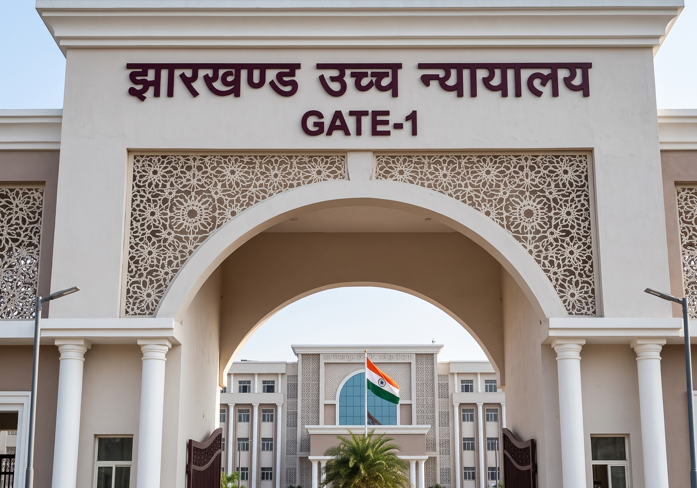
Bringing an end to a 23-year-old legal battle over prime land in Ranchi’s Morabadi area, the Jharkhand High Court has upheld the restoration of the disputed property to a Scheduled Tribe claimant under Section 71A of the Chotanagpur Tenancy (CNT) Act, reaffirming the law’s objective of protecting tribal land from illegal transfers.
Dismissing writ petitions filed by Ranchi’s noted neurosurgeon Dr H.P. Narayan and his late wife, Veena Narayan, Justice Anubha Rawat Choudhary refused to interfere with the concurrent findings of the revenue authorities, which had ordered restoration of the land in favour of Kuari Toppo.
The judgment was pronounced on July 22, nearly 23 years after the petitions were filed in 2003.
The dispute pertains to 1.22 acres of land at Morabadi in Ranchi. The petitioners had challenged the original restoration order passed by the Special Area Regulation (SAR) Court in 1997, the appellate order of 1998 and the revisional order of 2002, arguing that the restoration proceedings initiated in 1983 were not maintainable as the land had been converted into chhaparbandi (a non-agricultural, homestead plot used for dwellings or buildings) and therefore fell outside the ambit of Section 71A of the CNT Act.
They also contended that the restoration claim was filed after an unreasonable delay of nearly 40 years.
The petitioners claimed that the recorded raiyat had surrendered the land to the erstwhile zamindar, who settled it in favour of Sheikh Rahman Ali through a sada hukumnama in 1943. The Narayans said they subsequently purchased the land through registered sale deeds and had been paying chhaparbandi rent.
The high court, however, found that the authorities had consistently held there was no documentary proof of surrender by the original raiyat. It noted that the alleged sada hukumnama could not override an earlier registered sale deed executed in 1940 in favour of the predecessor of respondent Kuari Toppo.
The authorities had also concluded that the plea of chhaparbandi was not substantiated by credible evidence.
On the question of limitation, the court observed that the restoration applicant had alleged dispossession between 1976 and 1980 after her husband became mentally unwell and that the application filed in 1983 could not be treated as an inordinate or unreasonable delay.
It held that the petitioners had failed to establish either a valid chhaparbandi settlement or a superior title over the land.
Justice Choudhary upheld the concurrent findings of the SAR Court, appellate authority and revisional authority, observing that no perversity or jurisdictional error was made out warranting interference by the high court under Article 226 of the Constitution.
The writ petitions were accordingly dismissed, allowing the restoration of the land in favour of Kuari Toppo to stand.
Author

Related Stories




Most Read
- 1Argentina’s ‘Vanishing Sea’: Rare Low Tide
- 2Effect of the 12 August 2026 Solar Eclipse on the 12 Zodiac Signs, Know Who Will Benefit and Who Will Have to Be Careful
- 3HC finds peon’s dismissal over tea and biscuits amounted to ‘injustice’
- 4Brace for 29 June: a Capricorn Full Moon, Mercury retrograde and Jupiter’s leap into Leo
- 5Japan Coach’s Whiteboard Tactics Go Viral at FIFA World Cup