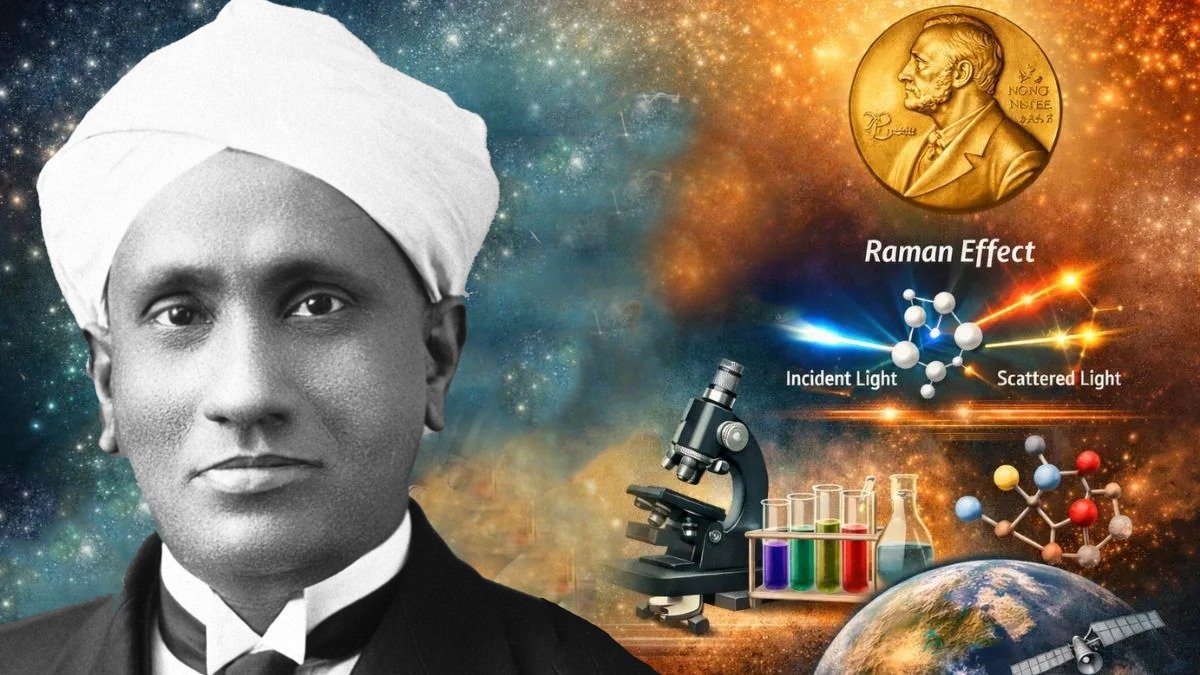
Sir Chandrasekhara Venkata Raman, universally known as C. V. Raman, was a visionary physicist who put modern Indian science on the global map. Born on 7 November 1888 in Tiruchirappalli, Tamil Nadu, Raman possessed a brilliant, inquisitive mind that reshaped the understanding of light and matter. His groundbreaking discovery of the Raman Effect in 1928 earned him the 1930 Nobel Prize in Physics, making him the first Asian and first non-white individual to win a Nobel Prize in any scientific discipline. Raman’s life stands as a monumental testament to what intellectual curiosity and dedication can achieve, even when working with highly limited resources.
Early Life and Academic Brilliance
Raman was born into an academic environment; his father was a lecturer in mathematics and physics, which sparked his early fascination with nature and numbers. A true prodigy, Raman passed his matriculation at the mere age of 11 and entered Presidency College, Madras. He completed his B.A. in 1904 and his M.A. in 1907, sweeping the top distinctions and gold medals in physics.
Despite his clear genius for research, a lack of viable scientific career paths in colonial India forced Raman to join the Indian Finance Department in Calcutta as an Assistant Accountant General in 1907. However, his passion could not be constrained by bureaucracy. For a decade, Raman led a grueling double life: working his administrative day job and spending his nights conducting cutting-edge physics experiments at the laboratories of the Indian Association for the Cultivation of Science (IACS).
Key Scientific Works and Discoveries
1. The Acoustics of Musical Instruments
Long before his work on light, Raman was deeply fascinated by sound and vibration. He performed rigorous mathematical and experimental evaluations of stringed instruments like the violin and cello. Crucially, he turned his attention to traditional Indian percussion instruments, notably the tabla and mridangam. He became the first to explain the acoustic mechanics behind their harmonious, pleasant overtones, which contrasted sharply with the noisy nature of Western drums.
2. The Blue of the Mediterranean Sea
In 1921, while sailing across the Mediterranean Sea on a voyage to Europe, Raman was struck by its deep, brilliant blue color. The prevailing scientific consensus, put forward by Lord Rayleigh, argued that the sea’s color was simply a reflection of the blue sky. Armed with a simple pocket nicol prism, Raman tested the water right on the ship deck and disproved Rayleigh’s theory. He proved that the blue hue was the result of molecular diffraction—the water molecules themselves were scattering the sunlight.
3. The Discovery of the Raman Effect
This voyage pivoted Raman’s research completely toward light scattering at IACS. On 28 February 1928, alongside his student and collaborator K. S. Krishnan, Raman achieved his crowning breakthrough.
Using basic, inexpensive equipment—including a heliostat, a purple filter, and a spectrograph—they observed that when a beam of monochromatic (single-wavelength) light passed through a transparent liquid, a small fraction of the light emerged with changed wavelengths and altered colors. This happened because the photons of light exchanged kinetic energy with the molecules of the substance, causing an energy shift.
Incoming Light Beam ───> [ Liquid/Molecules ]
───> Scattered Light Shifts
(Single Wavelength) (New Wavelengths/
Colors)
The Raman Effect
This phenomenon, known as Raman Scattering or the Raman Effect, provided definitive proof of the quantum nature of light. Today, it forms the foundation of Raman Spectroscopy, an invaluable chemical analysis tool used worldwide in pharmaceuticals, forensics, chemistry, and material science to identify substances non-destructively.
Institution Building and Later Years
Raman’s legacy extends far beyond his personal research; he was a master builder of India’s scientific infrastructure. In 1917, he left his government post to accept the Palit Chair of Physics at Calcutta University. In 1933, he moved to Bengaluru to become the first Indian Director of the prestigious Indian Institute of Science (IISc).
A man of independent spirit, he established the Indian Academy of Sciences in 1934 and later built his own sanctuary for pure science, the Raman Research Institute (RRI) in Bengaluru, in 1948. He spent his final decades at RRI, investigating the optics of minerals, diamonds, and the physiology of human vision until his death on 21 November 1970.
Conclusion
Sir C. V. Raman was a fiercely proud patriot who believed that India’s scientific progress should rely on its own intellect and indigenous effort rather than imported technology. In recognition of his immense service to the nation, the Government of India awarded him the country’s highest civilian honor, the Bharat Ratna, in 1954. Furthermore, the historic day of his discovery, February 28, is celebrated across the nation every year as National Science Day. His life remains an enduring inspiration, proving that monumental scientific breakthroughs require keen observation and unyielding curiosity far more than expensive apparatuses.
(The author teaches Physics at the N M P G Girls College, Pambam. The views expressed are personal.)
Author

Related Stories




Most Read
- 1Argentina’s ‘Vanishing Sea’: Rare Low Tide
- 2Effect of the 12 August 2026 Solar Eclipse on the 12 Zodiac Signs, Know Who Will Benefit and Who Will Have to Be Careful
- 3HC finds peon’s dismissal over tea and biscuits amounted to ‘injustice’
- 4Brace for 29 June: a Capricorn Full Moon, Mercury retrograde and Jupiter’s leap into Leo
- 5Japan Coach’s Whiteboard Tactics Go Viral at FIFA World Cup