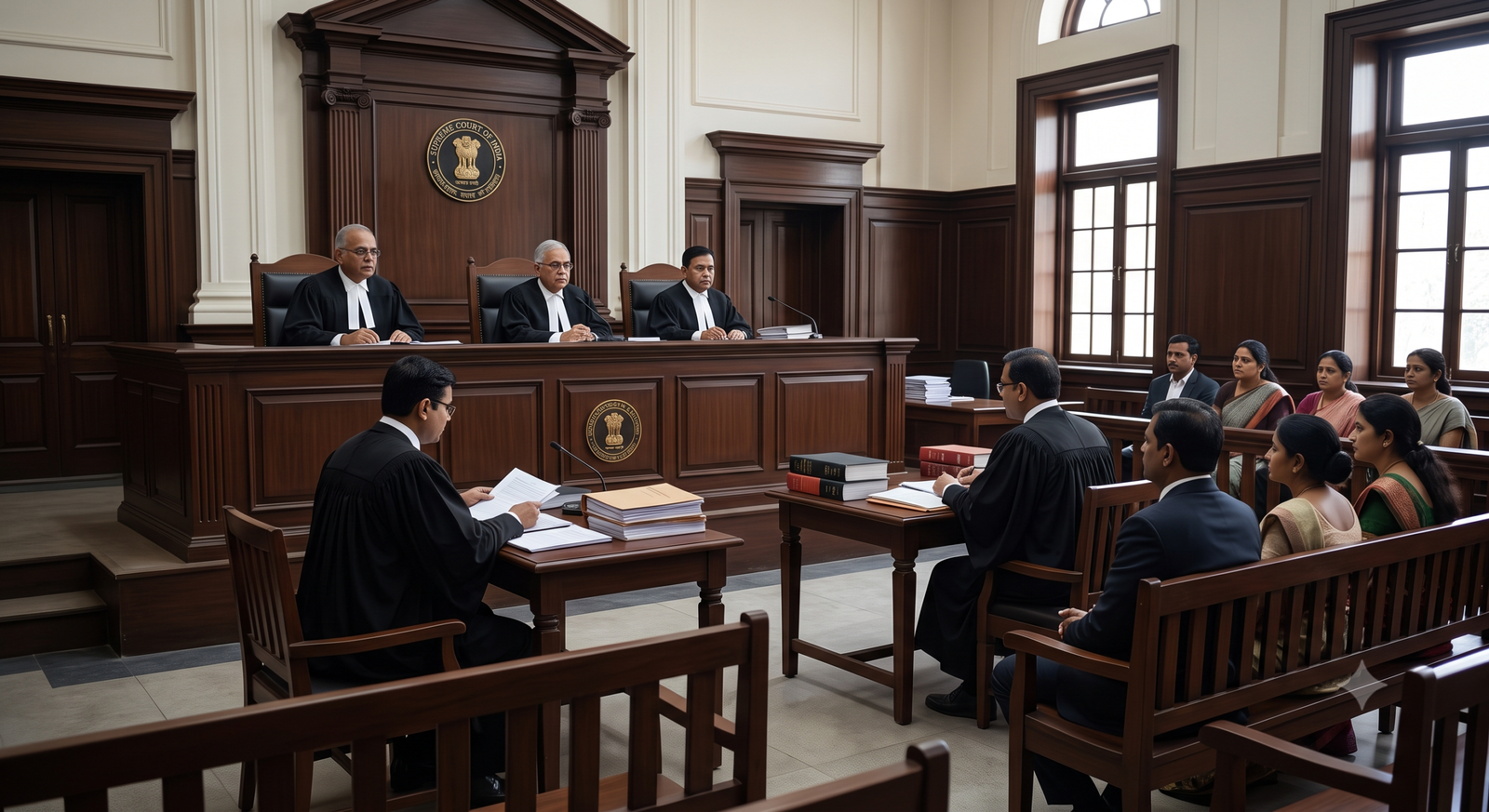
In a significant ruling on tribal customary law, the Supreme Court on Thursday held that there is no evidence of any recognised Oraon custom permitting an uncle-in-law to adopt his niece’s husband as a ghardamad (resident son-in-law), reiterating that any party relying on a customary practice must prove its existence through clear and consistent evidence.
A bench of Justices Sanjay Karol and Nongmeikapam Kotiswar Singh delivered the ruling while deciding a decades-old property dispute from Jharkhand involving members of an Oraon family.
The dispute arose from the family of Sukhu Oraon, who had three sons—Dhungru, Ledura and Bhoula. The plaintiff, Bejla Oraon, was Dhungru’s son and claimed that after the deaths of his uncles without male heirs, he became entitled to the ancestral property as the nearest male agnate.
The claim was opposed by Bhoula’s daughter, Budhain, and her husband, Punai Oraon. They argued that since Ledura had no children, he had accepted Punai as his ghardamad under Oraon custom, entitling him to inherit Ledura’s property. The lower courts accepted this contention and dismissed the plaintiff’s suit.
The Supreme Court, however, found a crucial gap in the evidence. While the material on record established that a ghardamad may, in certain circumstances, acquire rights in the property of his father-in-law, there was nothing to show that an uncle-in-law could similarly adopt his niece’s husband as a ghardamad.
“The person who alleges a custom must prove it,” the bench observed, adding that the mere absence of a prohibition against such a practice cannot be treated as proof of its existence.
The court also faulted the Jharkhand High Court for framing the substantial question of law regarding the validity of such an adoption but failing to answer it on merits merely because the trial court and first appellate court had returned concurrent findings of fact.
Reiterating the principles governing customary law, the bench said a valid custom must be ancient, certain, reasonable, continuously followed and proved by reliable evidence. Customs cannot be assumed or inferred from isolated instances.
Relying on the authoritative writings of anthropologist Sarat Chandra Roy on Oraon customary law, the court held that in the absence of a validly recognised ghardamad or another direct male heir, the property would devolve upon the nearest male agnate.
Holding that the respondents had failed to establish the alleged custom, the Supreme Court set aside the judgments of the trial court, first appellate court and the Jharkhand High Court, decreeing the plaintiff’s suit and restoring the property claim in his favour.
Author

Related Stories




Most Read
- 1Argentina’s ‘Vanishing Sea’: Rare Low Tide
- 2Effect of the 12 August 2026 Solar Eclipse on the 12 Zodiac Signs, Know Who Will Benefit and Who Will Have to Be Careful
- 3HC finds peon’s dismissal over tea and biscuits amounted to ‘injustice’
- 4Brace for 29 June: a Capricorn Full Moon, Mercury retrograde and Jupiter’s leap into Leo
- 5Japan Coach’s Whiteboard Tactics Go Viral at FIFA World Cup