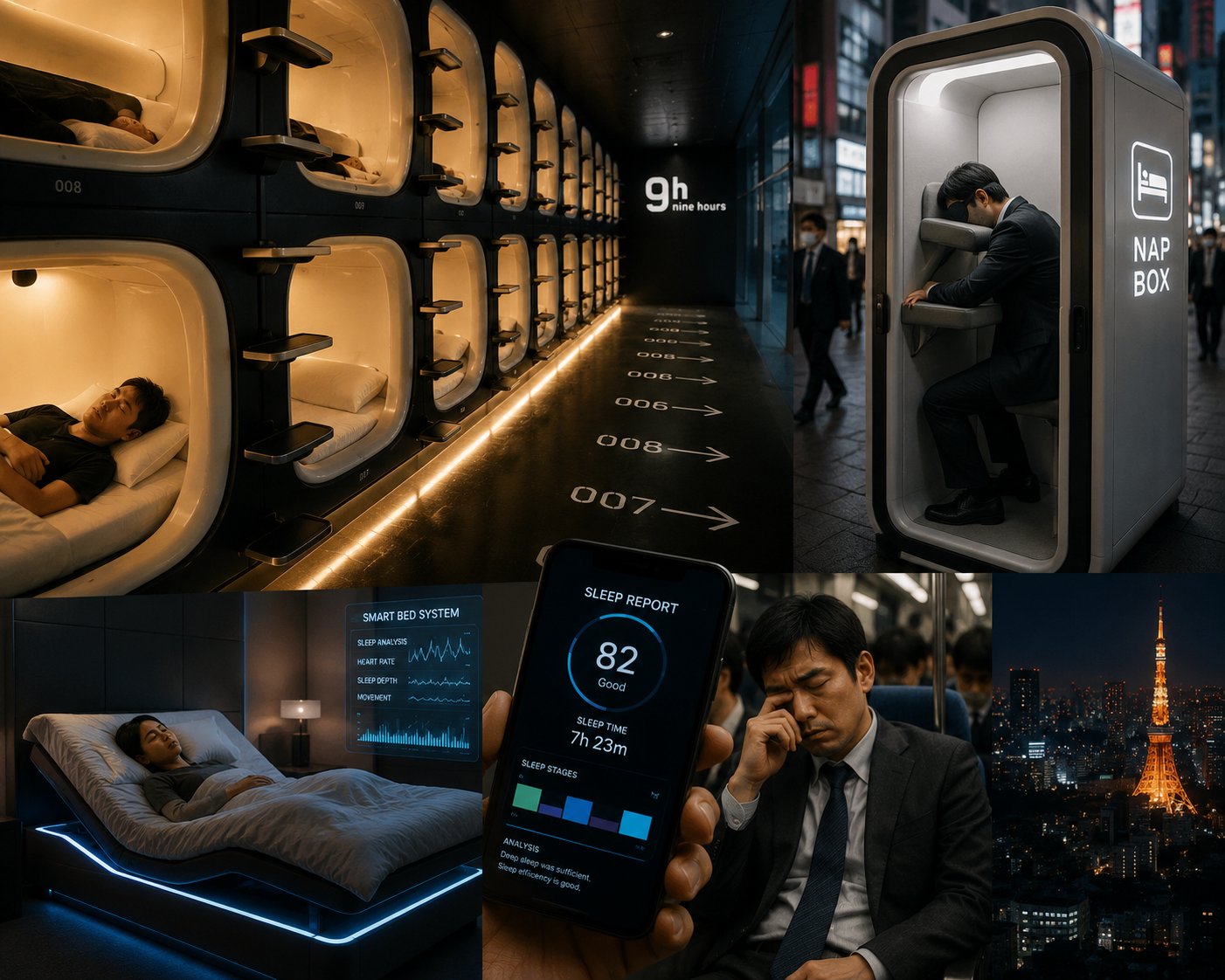
Not getting enough sleep has become one of the defining ailments of modern urban life. Few countries illustrate this more vividly than Japan, where exhaustion has become so normalised that an entire industry has emerged to manage it.
The Rise of Futuristic Sleep Pods
In Tokyo, the capsule hotel Nine Hours Akasaka has transformed an inexpensive overnight stay into an experiment in sleep science. Capsule hotels, resembling highly organised dormitories of compact sleeping pods, provide researchers with a remarkably controlled environment.
Each pod is almost identical, allowing sleeping patterns to be studied with unusual consistency. Sensors embedded throughout the pods monitor guests’ sleep without requiring them to wear intrusive devices.
While preserving privacy, anonymised data are shared with medical and research institutions to improve understanding of sleep disorders.
Some guests whose results suggest potential health concerns are referred to clinics for further examination. Others receive detailed reports identifying patterns and factors affecting the quality of their sleep.
The boundary between hospitality, healthcare, and technology is becoming increasingly blurred.
Japan’s fascination with sleep technology extends far beyond monitoring. Standing nap boxes now allow office workers to take ten-minute power naps while remaining upright.
Smart beds adjust their angle in response to a user’s movements, while specialised systems aim to deliver a twenty-minute nap that refreshes without producing the grogginess often associated with waking from deeper sleep.
For many workers, such innovations are less a luxury than a necessity. Long commutes, extended working hours, and the bright, restless rhythm of city life have created a society that is chronically short of sleep.
The Corporate Paradox: Adapting Humans to Fatigue Instead of Fixing Work Culture
According to data from the OECD, Japanese people sleep significantly less than many of their counterparts in other advanced economies, including the United States.
The result is a flourishing sleep-technology industry worth billions. Yet there is an uncomfortable irony at its centre.
Rather than reorganising work around the biological needs of human beings, modern societies increasingly seek technologies that help people adapt to exhaustion.
Perhaps the real question is not how to sleep more efficiently, but why so many prosperous societies have become places where adequate sleep itself feels like an unattainable luxury.
Author

Related Stories




Most Read
- 1Argentina’s ‘Vanishing Sea’: Rare Low Tide
- 2Effect of the 12 August 2026 Solar Eclipse on the 12 Zodiac Signs, Know Who Will Benefit and Who Will Have to Be Careful
- 3HC finds peon’s dismissal over tea and biscuits amounted to ‘injustice’
- 4Brace for 29 June: a Capricorn Full Moon, Mercury retrograde and Jupiter’s leap into Leo
- 5Japan Coach’s Whiteboard Tactics Go Viral at FIFA World Cup