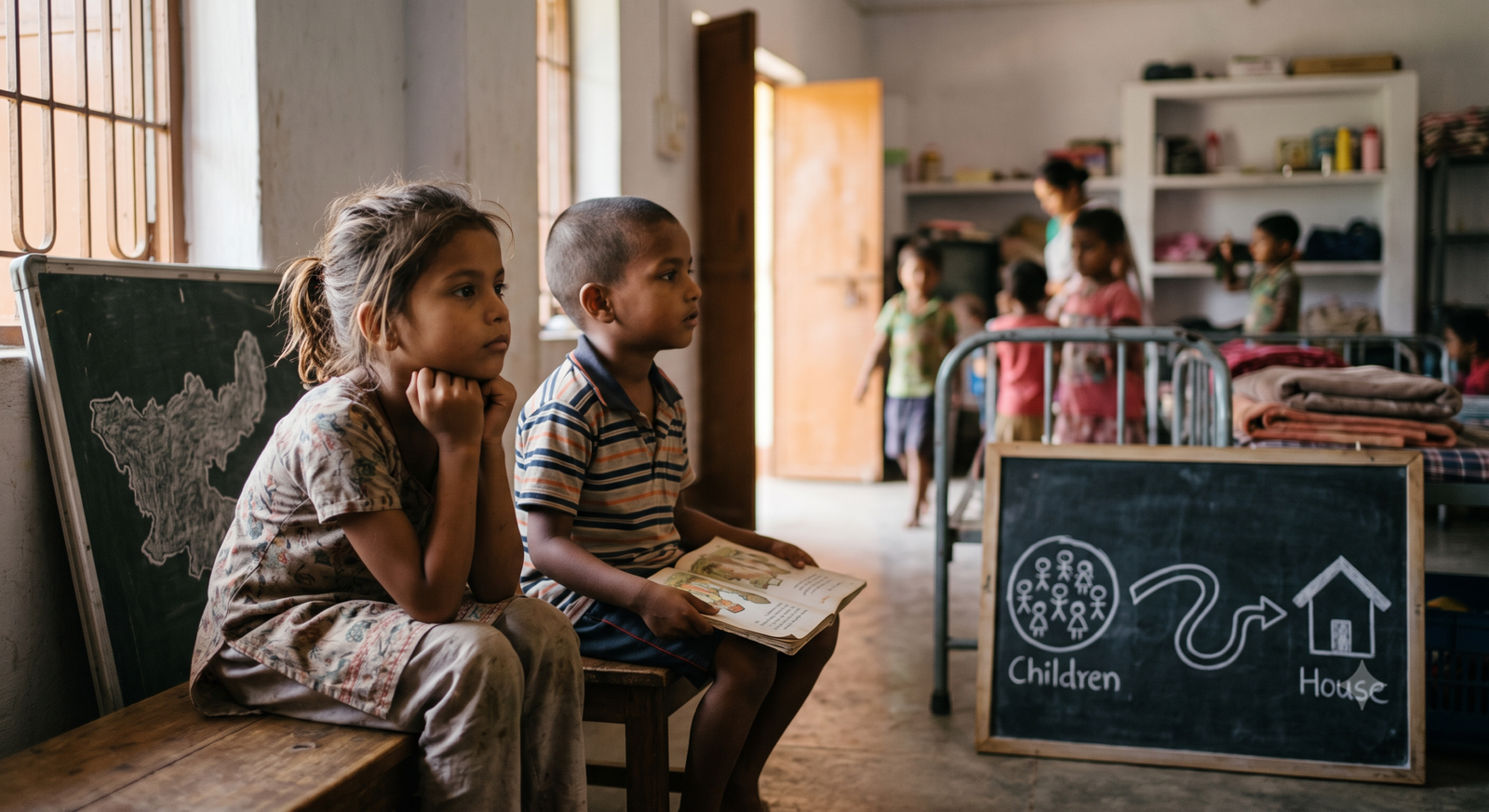
In Jharkhand, the waiting list is not of families hoping to welcome a child—it is of children waiting for a family.
Over 200 Children Are Eligible for Foster Care, Yet a Shortage of Families Limits the Initiative
While hundreds of orphaned and vulnerable children continue to grow up in Child Care Institutions (CCIs), only 36 are currently living with foster families, exposing the limited reach of a programme designed to give children the security of a home instead of an institution.
According to child rights activists, more than 200 children currently living in CCIs could be placed with foster families if more eligible households came forward. However, poor public awareness and limited understanding of foster care continue to keep the programme on the margins of the state’s child protection system.
“More than 200 children living in Child Care Institutions could be placed with foster families if more eligible households came forward,” said Sanjay Kumar, founder of Bal Kalyan Sangh, a child welfare organisation.
Unlike adoption, foster care is a family-based rehabilitation mechanism under which children who cannot remain with their biological families are placed with approved families while continuing to remain under the supervision of the child protection system.
Foster Care vs Adoption in India: Eligibility, Rules, and Monthly Financial Assistance Explained
Foster parents assume responsibility for the child’s education, health, nutrition, and emotional well-being, while periodic monitoring is carried out by the Child Welfare Committee.
The Jharkhand Foster Care Guidelines, 2018, framed under the Integrated Child Protection Scheme (ICPS), provide for the placement of orphaned, abandoned, and other vulnerable children below the age of 18. Couples above 35 years of age are eligible to become foster parents and receive financial assistance of Rs 2,000 per child every month.
According to Kumar, family-based care provides children with emotional security, stability, and a sense of belonging that institutional care often cannot. Yet, many children continue to spend their formative years in institutions because few families are willing to opt for foster care.
Child rights activists also flagged broader concerns affecting the state’s child protection system, alleging that financial assistance under foster care and sponsorship schemes, besides payments under ChildLine services and Mission Vatsalya, has remained pending for nearly 10 to 11 months.
Bijay Sinha, Director of the Jharkhand State Child Protection Society (JSCPS), said efforts were underway to improve awareness and strengthen implementation of the programme.
“We are working to increase awareness of foster care, encourage more eligible families to come forward, and ensure all placements are made in accordance with the Juvenile Justice Act and the Jharkhand Foster Care Guidelines. We are also reviewing implementation challenges to improve the effectiveness of the system across the state,” he said.
For child welfare experts, expanding foster care is not merely about reducing the number of children in institutions, but about ensuring that every child deprived of parental care has the opportunity to grow up in the warmth, security, and dignity of a family environment.
Author

Related Stories




Most Read
- 1Argentina’s ‘Vanishing Sea’: Rare Low Tide
- 2Effect of the 12 August 2026 Solar Eclipse on the 12 Zodiac Signs, Know Who Will Benefit and Who Will Have to Be Careful
- 3HC finds peon’s dismissal over tea and biscuits amounted to ‘injustice’
- 4Brace for 29 June: a Capricorn Full Moon, Mercury retrograde and Jupiter’s leap into Leo
- 5Japan Coach’s Whiteboard Tactics Go Viral at FIFA World Cup