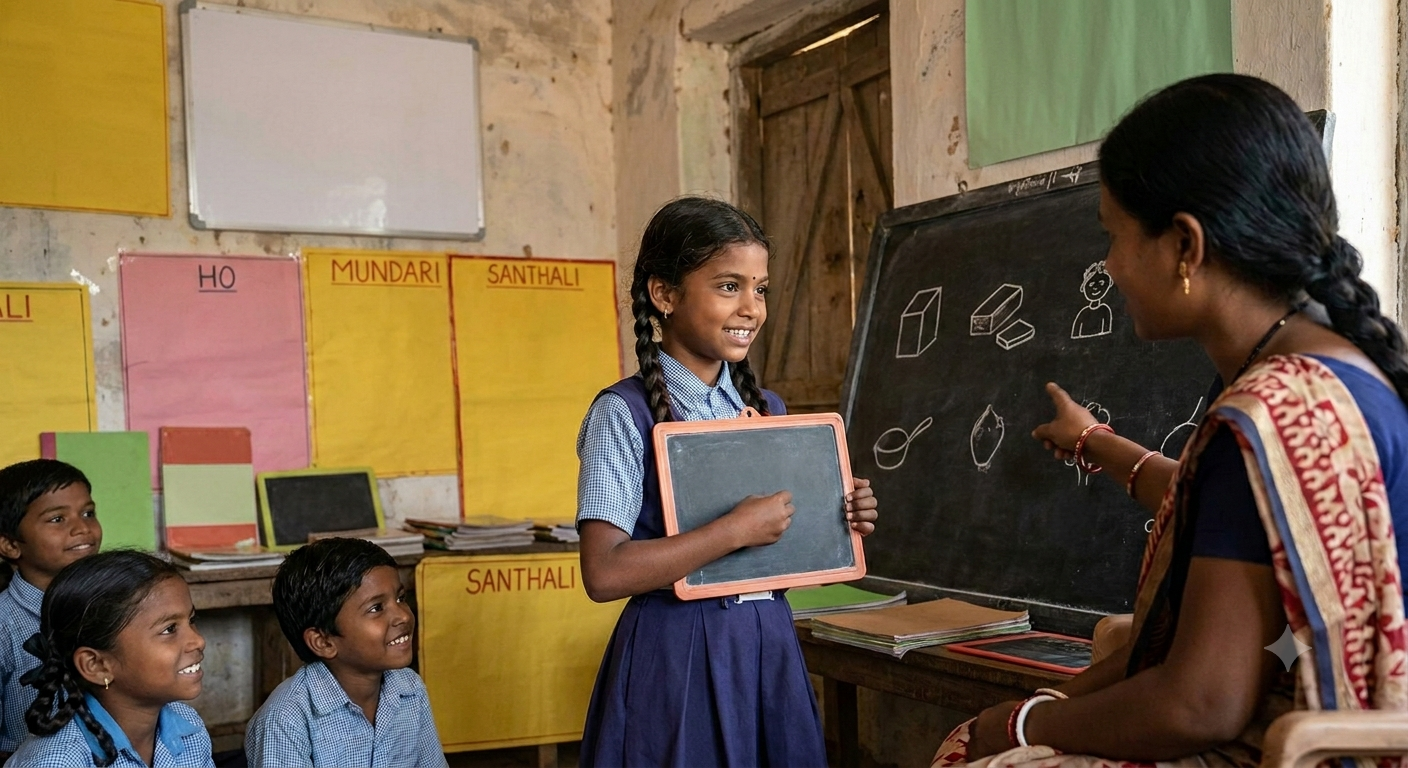
Nisha Samad, a Class III student of Bonga Sindri Primary School in West Singhbhum, was initially hesitant to attend classes and struggled to understand lessons. However, after being taught in her native language. Later, she has become more confident and actively participates in classroom activities. Courtesy, the Jharkhand Education Department’s multi-lingual education language (MLE) programme, which strives to successfully transform Nisha like many other children. Jharkhand Education Project Council (JEPC) is currently running the MLE project in 1041 schools across eight districts in the state to bridge language barriers in classrooms for students from class I to III. The project involves 1,548 registered teachers to help out 15,829 students. The initiative covers tribal and regional languages including Santhali, Ho, Mundari, Kurukh, Kharia and Nagpuri. According to officials, it has been designed to ensure that children receive their first experiences of formal education in a language they understand.
Speaking to TGC, Abhinav Kumar, state programme officer at JEPC, said, “One of the biggest challenges faced by children in tribal and remote regions is the language gap between their home environment and the language used in classrooms. Many students enter school speaking only their indigenous language and often struggle to understand Hindi or other commonly used instructional languages. They face difficulties in comprehension, classroom participation and overall learning. To address this issue, the MLE programme integrates children’s home languages into classroom instruction. The curriculum focuses on comprehension, vocabulary development, cultural knowledge and self-expression through written, oral and activity-based learning methods. Students from Classes I to III participate in language focused activities designed to strengthen reading, writing and numeracy skills. Launched in 2024, it also includes an annual MLE Championship to encourage learning and showcase students’ language abilities. School, cluster and block-level competitions are conducted across intervention districts, with teachers receiving special guidance on conducting multilingual activities and assessments. Language and Learning Foundation (LLF) and Leap Forward Foundation also support the implementation of the programme.
Nisha said, “I understand my subjects much better in my own language and now enjoy studying.” Nisha’s teacher, Mecho Sindhu, asserted that Nisha comes from an economically disadvantaged family and her father depends on farming for an uncertain livelihood. “Despite financial hardships, she always wanted to learn. The language barrier was her biggest challenge. Since she started learning in her mother tongue, her interest in studies has increased significantly. Last year, she secured second position in the MLE Championship, which saw participation from students across the country.” Similarly, Lal Tudu, a Class III student at Middle School Bathani, struggled to cope with classroom learning after losing his mother at a young age. Teachers said he found it difficult to understand lessons because they were not delivered in a language familiar to him. However, after receiving instruction in his mother tongue, he was able to understand lessons more effectively and has learned many new concepts and skills.