
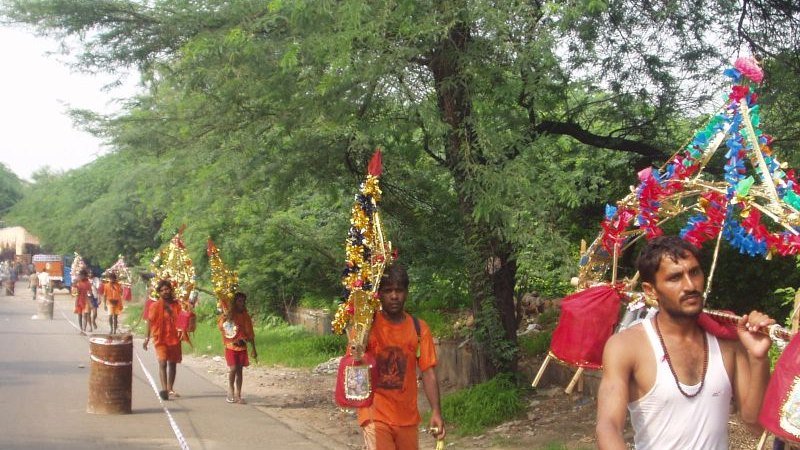
Every year during the sacred month of Shravan, lakhs of saffron-clad devotees undertake one of India’s most remarkable acts of faith: a barefoot walk of roughly 105 kilometres from Sultanganj in Bihar to Baba Baidyanath Dham in Deoghar, Jharkhand. Carrying holy Ganga water in decorated kanwars balanced on their shoulders, these pilgrims, known as kanwariyas, cover the distance on foot to offer jalabhishek at the Jyotirlinga. This guide explains the route, what the journey is like, and why the water matters so deeply.
Where the Yatra Begins: Sultanganj
The journey starts at Sultanganj, a town on the banks of the Ganga in Bihar’s Bhagalpur district. What makes Sultanganj special is that the Ganga here flows northward (uttarvahini), which devotees consider especially auspicious. Pilgrims descend to the ghats, bathe in the river, and fill their vessels with Ganga-jal. Once the water is collected and the kanwar is sealed, the pilgrim is bound by tradition not to set the kanwar down on bare ground for the entire journey.
The Route to Deoghar
From Sultanganj, the path runs broadly southeast toward Deoghar, covering approximately 105 km. During Shravani Mela the route is organised as a dedicated kanwariya path, a lane of packed earth and sand maintained to be gentler on bare feet, running alongside the main road. The way is lined with rest points, water stations, and stalls set up by volunteers and the administration.
Well-known halt points and landmarks along the traditional route include:
- Kamraganj and Dharara, early stops after leaving Sultanganj
- Masumganj and Tarapur, mid-route towns with markets and rest areas
- Suiya, a notable resting place traditionally associated with the first night’s halt for many walkers
- Abrakhia, Katoria and the Jharkhand border stretch
- Inaravaran and Goriyari as Deoghar draws nearer
- Darshaniya, the point from which the temple spire first comes into view for many pilgrims
How Long the Walk Takes
Most pilgrims complete the walk over three to five days, depending on pace, health, and the crowd. Ordinary kanwariyas walk in stages, resting through the hottest part of the day and covering ground in the cooler morning and evening hours. A smaller number, the dak bam pilgrims, undertake the entire journey in a single continuous run without stopping, a far more demanding vow that must be completed within a set window.
What the Walk Is Like
The atmosphere along the route is devotional and communal. Chants of “Bol Bam” ring out constantly, strangers walk together as companions, and free food, water, and medical help are offered by camps along the way. The monsoon weather can swing between fierce heat and sudden rain, and the packed path can become muddy. Walking barefoot for days is physically hard, and pilgrims typically prepare their feet, pace themselves, and lean on the support network of fellow travellers.
The Significance of Carrying Ganga Water
The water itself is the heart of the pilgrimage. Ganga-jal is regarded as sacred and purifying, and carrying it on foot across such a distance is an offering of devotion, discipline, and endurance. When the pilgrim finally pours that water over the Baidyanath Jyotirlinga, the physical hardship of the journey becomes an act of surrender and thanksgiving. The unbroken effort, from filling the vessel at Sultanganj to the final abhishek at Deoghar, is what gives the Kanwar Yatra its meaning.
What the Administration Has Arranged for 2026
The kanwariya path was readied ahead of the 30 July start, with the Deoghar Deputy Commissioner and Superintendent of Police jointly inspecting the route. Confirmed arrangements for this season:
- Soft sand laid along the barefoot path from Dumma — the Bihar–Jharkhand border point — up to Baba Mandir, to spare pilgrims’ feet.
- Round-the-clock drinking water, with continuous cleaning of toilets and bathing points, and drainage laid to stop the path turning to mud in the monsoon.
- Separate toilet and bathing facilities for men and women, plus changing space, along the route.
- Barricading, directional signboards, control rooms and help desks at intervals for crowd management, with dharamshalas and pandals for rest.
- Health camps along the whole route. On the Bihar leg there are over 40 camps across Bhagalpur, Munger and Banka, staffed by medical officers and stocking free medicines for dehydration, heat exhaustion, blisters and minor injuries.
- Roadwork on the Basukinath–Deoghar four-lane was accelerated before the Mela to improve pilgrim facilities and road safety.
Route arrangements, the exact alignment of the kanwariya path, and facility locations are set by the district administration each year and can change during the Mela. Confirm current details against official Deoghar district administration announcements (deoghar.nic.in) before you travel.