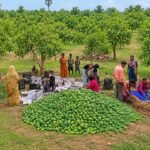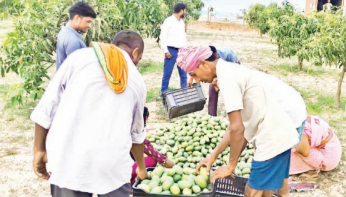
Breaking geographical barriers, farmers from the remote villages of Simdega have successfully entered the global market as their prized Amrapali mangoes reached London. The first export consignment, grown in village orchards and supported by the collective efforts of local farmers, was shipped to the United Kingdom on Friday, opening new opportunities for the region’s agricultural community. The export of Amrapali mangoes from Simdega to London marks a significant rural development milestone, demonstrating how targeted government schemes can transform local agriculture into a globally competitive enterprise. The export initiative has been made possible through the convergence of the Birsa Harit Gram Yojana, Mahatma Gandhi National Rural Employment Guarantee Act (MGNREGA) and Jharkhand State Livelihood Promotion Society ( JSLPS). According to officials, farmers cultivated Amrapali mangoes that met export standards and attracted international buyers.
The first commercial consignment consists of 13,22 kilograms of mangoes, purchased directly from farmers at Rs 42 per kilogram.
Speaking to the Guardian Chronicle, Kanchan Singh, deputy commissioner, Simdega, said, “The state government is committed to empowering rural women through sustainable livelihood initiatives and market driven opportunities. Through coordinated efforts of district administration, JSLPS and partner departments, women farmers are being connected to premium markets, enabling them to secure better returns for their produce. The successful export will encourage more farmers to adopt rural entrepreneurship.” One of the aspects of the export initiative is the role played by women-led farmer producer organisations. The export was facilitated by Mahila Jagriti Farmer Producer Company Limited and Beura Farmer Producer Company Limited both functioning under JSLPS.
The mangoes underwent quality check, grading and procurement processes in line with export requirements for international markets. The quality check was carried out under monitoring of the Agricultural and Processed Food Products Export Development Authority (APEDA). The APEDA ensured that the produce met necessary standards for overseas consumers. The commercial export consignment was formally flagged off from Kolkata Airport. Mango cultivation was undertaken on around 3000 acres involving around 300 farmers.
Neera Devi, a farmer of Pabura Village in Bano Block, said, “With the support of district administration and JSLPS, we are receiving better market access and fair prices for our produce. We never imagined that mangoes grown in our village would one day reach international markets. Earlier even selling our produce in district markets was challenging, but now the mangoes have been purchased directly from our orchard.” The success of Simdega’s farmers also showcases the role of institutional support in rural transformation. Technical guidance, capacity building, quality certification and market facilitation by government agencies and livelihood missions helped bridge the gap between local producers and international buyers. The export to London serves as a model for inclusive growth, proving that farmers from remote regions can successfully integrate with global value chains when provided with adequate support and market access.